Water on the Moon and Chandrayaan the first, collaboratively catalyzing a global lunar rush
Moon Monday #293 and Indian Space Progress #43.
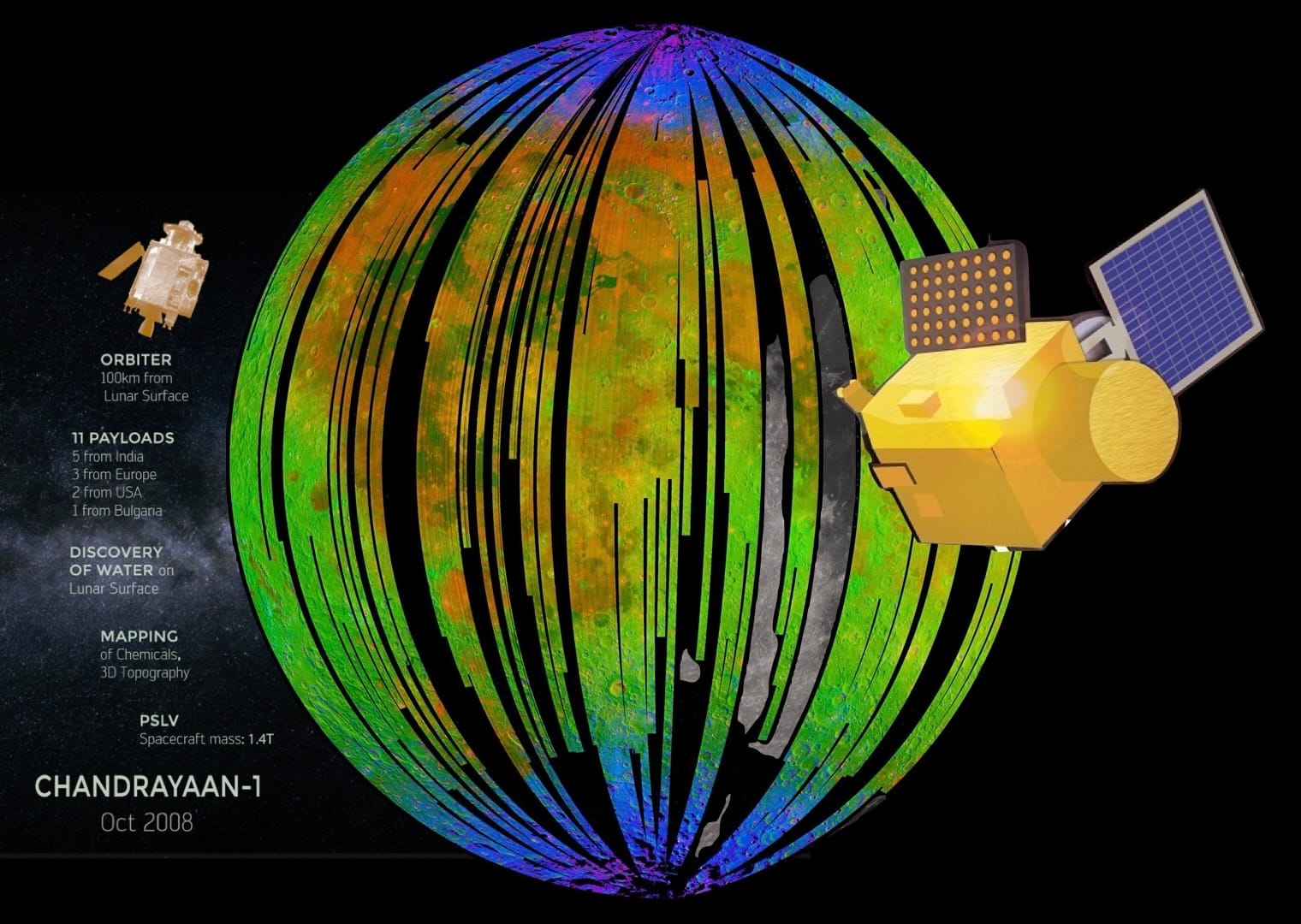
17 years ago this week, a paper published in Science announced the discovery of water on the Moon by India’s Chandrayaan 1 orbiter. Changing the notion of a bone-dry Moon as cemented during the Apollo era, the finding had fundamental implications for understanding the origin and evolution of our Earth and its cosmic companion. That water was present on Luna in multiple forms also meant it could be used as a resource for future deep space exploration, offering breathable air for astronauts, water to drink and use, and fuel when its hydrogen and oxygen is liquefied to power longer, more ambitious missions. This potential, combined with the Moon’s proximity making it a technological catalyst, has led to nations around the world sending or planning to send a flurry of robotic and even crewed missions to the Moon. Chandrayaan 1 catalyzed a global Moon rush after the decline of last century’s Cold War lunar race at the dawn of the Space Age.
The discovery of lunar water came through a notable act of collaboration. Chandrayaan 1 carried 11 scientific instruments, six of which involved foreign partnerships across five nations. Lunar water’s presence was confirmed by the Moon Mineralogy Mapper (M3) instrument onboard Chandrayaan 1, provided by the US’ premier space agency National Aeronautics and Space Administration (NASA). Some other Chandrayaan 1 instruments also saw signs of water but M3’s detection was the unequivocal one. It could differentiate between ice, liquid water, and water vapor based on how the lunar surface reflected and absorbed infrared light, which meant avoiding false positives in measurements. M3 was also an excellent mineral mapper; its data has helped scientists worldwide churn out hundreds of lunar findings and counting. Noah Petro, a former Project Scientist for NASA’s Lunar Reconnaissance Orbiter (LRO) mission and currently a Science Lead in the agency’s Artemis program to return humans to the Moon, praised M3 in 2019:
10 years ago today Chandrayaan-1 ended. I was so lucky to be a small part of that mission. The M3 instrument allowed us to take a huge step forward in learning about the composition of our 8th continent!
Unlike countries with developed space programs, India had not been one to explore worlds in our Solar System other than Earth for most of its space-faring life since the 1960s. With Chandrayaan 1’s launch in 2008 on a PSLV-XL rocket, India forayed into planetary exploration. Confirming water’s presence on the Moon was a primary mission objective for the Indian Space Research Organization (ISRO), the country’s governmental space agency who designed, developed, launched, and operated Chandrayaan 1. That India achieved such an important discovery & goal on its debut planetary mission inspired people around the world, including myself. I was in school at the time, fascinated by all things space and science. Chandrayaan 1’s water gem catapulted my imagination of the international prowess of space exploration. It’s worth remembering that collaboration is what catalyzed Chandrayaan 1’s success.
Late Srinivasa Hegde, who worked at ISRO’s Satellite Center for 36 years, was the Mission Director of Chandrayaan 1. Hegde was deeply involved in many aspects of the mission: the design of the various mission phases, data management, orbit determination, strategies for course corrections, orbiter operations, and so on. I asked him during a 2020 interview about the driving philosophy behind ISRO soliciting scientific instruments from other space agencies around the world for Chandrayaan 1. He noted the following:
We had our own science payloads on Chandrayaan 1 but we also wanted to provide the spacecraft as a platform for others we could collaborate with. And so ISRO put out an announcement of opportunity to scientists all over the world to pitch payloads for Chandrayaan 1. We got instruments from ESA as well as NASA, including universities associated with them. I think the timing of Chandrayaan 1 was good as NASA’s next Moon mapper LRO was still a year away.
Past missions had hinted at water’s presence on the Moon. Because of its potential for exploration and future economics, space agencies globally were keen to confirm water’s presence. NASA responded to ISRO’s call for payloads and got to fly two of its water-hunting instruments onboard Chandrayaan 1: the M3 and the Miniature Synthetic Aperture Radar (Mini-SAR). The latter found indications of water ice in more than 40 craters host to frigid permanently shadowed regions on the Moon’s poles. But just like with efforts in the previous decade such as from NASA’s Clementine lunar-mapping orbiter, the data wasn’t conclusive by itself to rule out false positives, such as certain rough rock textures mimicking water-ice-like signals. M3’s measurements provided independent proof of water’s existence, and validation for some measurements by other instruments.
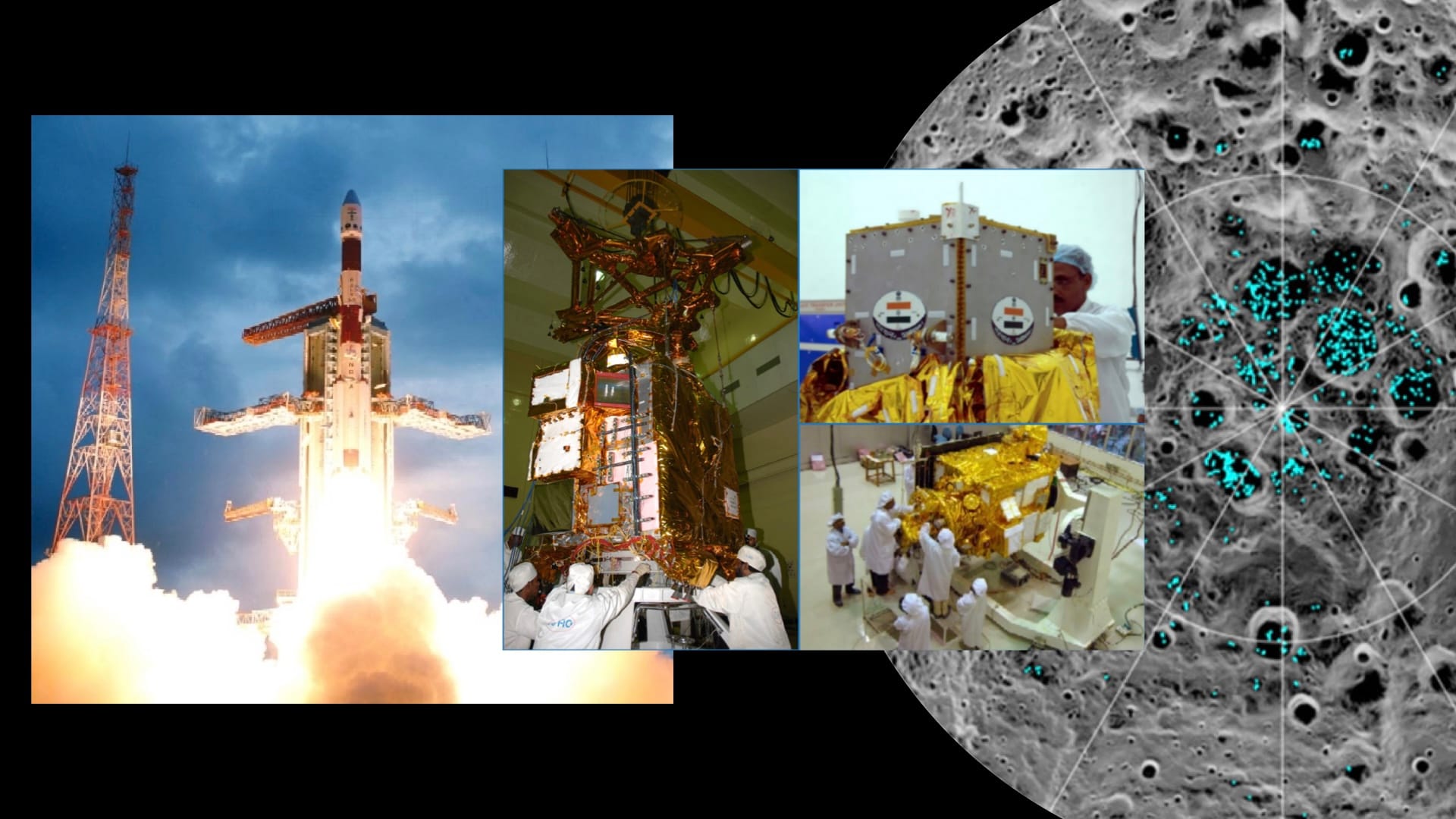
Among the many more scientific results that came out of Chandrayaan 1, another collaboration stands out. India, Sweden, and the European Space Agency (ESA) collaborated on the Sub-keV Atom Reflecting Analyzer (SARA) instrument. By analyzing how protons—hydrogen nuclei—in the Sun’s radiation wind impact the Moon and get reflected, SARA helped scientists better estimate the amount and distribution of water or hydroxyl molecules locked in the soil across the Moon. The discovery helped future confirmation of water’s presence across the lunar globe, embedded in its soil and rocks. It also proved timely for ESA’s ongoing BepiColombo mission to study Mercury, which carries instruments similar to Chandrayaan 1 for detecting water.
Operating and balancing the goals of 11 instruments on Chandrayaan 1 as a debut planetary mission wasn’t easy. One of Hegde’s tasks was to accommodate the needs of foreign instruments onboard alongside optimal craft operations. In his own words:
It posed challenges because they [the foreign payloads] had diverse requirements. For instance, scientists behind Mini-SAR wanted to calibrate the instrument when the spacecraft would be en-route to the Moon. They were unhappy with the fact that we couldn’t accommodate that due to certain changes in our launch schedule. However, at a later stage we provided them with a geometry in lunar orbit for calibration which they said was even better than what they originally asked for.
Following up on Chandrayaan 1’s findings, missions from China, USA, India itself, South Korea, Europe, Japan, and more are trying to unravel the exact nature, state, and abundance of lunar water as the next logical step. Sustained crewed lunar exploration plans by China and the US also depend on it.
The Indian Government’s Department of Space (DOS), under which ISRO operates, stated the cost of the Chandrayaan 1 mission to be ₹386 crores in 2008, which is approximately $89 million in 2026. As far as lunar and planetary missions go, that’s on the lower side of expenditure. As evident by the debut mission’s fundamental discoveries, welcoming foreign instruments proved effective in increasing mission science without increasing costs. Participating nations got to fly their scientific instruments without having to build an entire mission of their own. At the same time, experience gained by ISRO in developing and/or operating some planetary instruments in collaboration with NASA and ESA helped the agency make fully indigenous, state-of-the-art instruments for the Chandrayaan 2 orbiter.
For Chandrayaan 1, India also established the Indian Deep Space Network to communicate with the spacecraft as well as future planetary missions. The mission established operational experience for India with spacecraft at the Moon, feeding into future planetary missions. Hegde noted here that the India-US partnership on Chandrayaan 1 also extended to NASA providing ISRO with access to its iconic Deep Space Network. It was used for communicating with Chandrayaan 1 for additional bandwidth, and when the craft was outside the range of India’s newly built planetary communications network. This deal with NASA for having additional communications layers for ISRO’s planetary craft has persisted through India’s first Mars orbiter Mangalyaan, the Chandrayaan 2 orbiter, and the Chandrayaan 3 landing mission.
The world is now mounting numerous Moon missions. As we directly explore the treacherous lunar south pole and its water, we would be wise to remember the compounding effects of collaboration and sharing to make expensive, high-frequency exploration not only safer and more successful but also efficient. Chandrayaan 1’s catalyzing of a global Moon rush can remind us of the collaborative mindset the world needs more of, if only we remember its vantage point.
Many thanks to The Takshashila Institution, PierSight and Gurbir Singh for sponsoring Moon Monday and Indian Space Progress. If you too appreciate my efforts to bring you these curated community resources on global lunar exploration and India’s space activities for free, and without ads, kindly support my independent writing as it’s purely reader-funded. I don’t use AI to write a single word and cite everything.