Rocket equation 101: Revealing our Moon’s value as a launchpad
Moon Monday #288: Realizations from fundamental physics at the heart of the rocket equation. Paired with memes for fun and poetry for ethics.
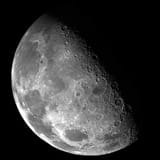
The global rush to the Moon this century is catalyzed in major part by the presence of water ice, soil rich in oxygen and metals, and other such resources. The long-term bet is that extracting resources in-situ on Luna, using oxygen and hydrogen as rocket fuel, and manufacturing things there itself will ultimately create an independent enough planetary economy that’s no longer completely dependent on Earth for at least the most basic supplies needed by humans and bots alike. Rockets and spacecraft launched from the Moon would have easier access to destinations across the Solar System than terrestrial ones do. To that end, building for the harshest environments on the Moon makes it easier to build for many places in the Solar System as well.
Whether the long-term bet will actually work in practice is not a guarantee at this nascent point in humanity’s space endeavors, no matter what the marketing and punditry of the space sector would have you believe. Nor is it guaranteed that any scale of sustained living across the Solar System will be equitable and responsible across many ethical considerations. [James Corey’s Sci-Fi book series starting with Leviathan Wakes and its progeny show The Expanse are a good mental excercise to this end.] However, unlike the fallacy of true orbital data centers existing in space anytime soon, without brute force and twisting of definitions, at least physics does not rule out the idea of our Moon being a potent launchpad. If anything, the fundamental nature of gravity staunchly supports the premise. This article explains how.
Getting to space
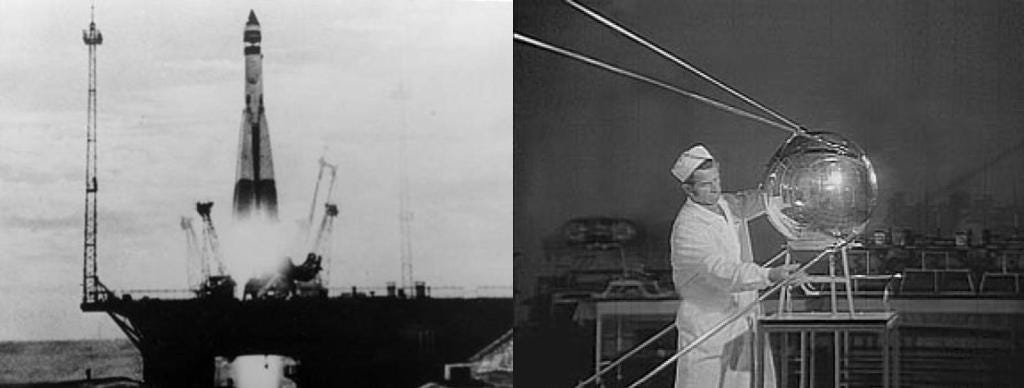
When dabbling with the laws of motion in the 17th century, Isaac Newton realized that it’s indeed possible to send an object out of Earth, into space. As long as an object is unobstructively shot away from Earth with a high enough velocity, it will reach space and orbit our planet. With the launch of the Sputnik satellite in 1957 onboard a powerful enough rocket, the Soviet Union achieved exactly that. For the first time in the roughly four billion years of life on Earth, something was intentionally sent to space.
Give a satellite a greater speed boost, either by launching it on a more powerful rocket or using onboard thrusters, and it can raise its orbit or even escape Earth’s gravitational hold altogether. That’s how you can send missions to our Moon, Venus, Mars, asteroids, Saturn and so on. But one of these two things is not like the other.
Enter the Tsiolkovsky rocket equation.
This rocket equation is what allows scientists and engineers to quantify and compare the energy required to reach various destinations in space. Its implications are far reaching but not intuitive so I attempt to explain them here without the use of any mathematics.
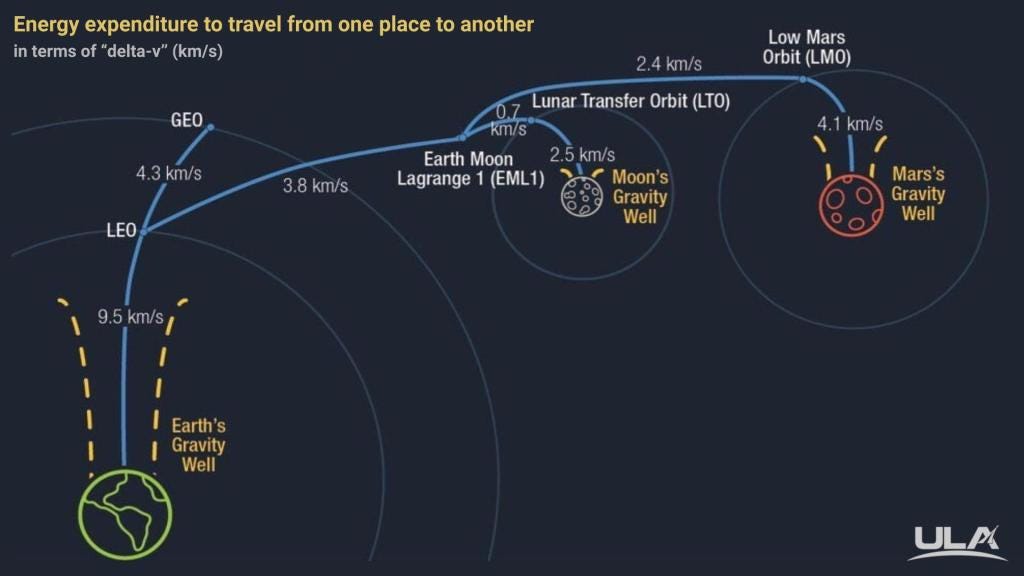
The rocket equation tells us that the amount of energy a rocket must expend to go from the Earth’s surface to an orbit 250 kilometers above, called Low Earth Orbit (LEO), is almost thrice as much as going from that orbit to the Moon. Likewise, getting to LEO from Earth costs twice as much energy than to reach Mars from LEO. Even if we include the energy expenditure to land on the Moon instead of just reaching its vicinity from LEO, the first part of getting to Earth orbit from land itself is about 50% more expensive still. In other words, attaining Earth orbit is the first and the most significant barrier to space exploration. The giant leap for humanity was thus not stepping on the Moon but getting to Earth orbit in the first place.
Note: Technically, energy expenditure is different from delta-v, which is the actual measure of work required by rockets to reach different destinations. But since energy expenditure is proportional to delta-v, they have been approximated to have the same effect here to make the article tangible for the masses.
Planetbound
The rocket equation doesn’t just dictate how much energy you must spend to reach various destinations in space but also if you can reach space at all.
Even though a satellite comprises but a small fraction of the total mass of the rocket that lifts it, relatively smalls changes in its mass greatly affects the mission. When you increase a satellite’s mass, to make it more useful perhaps, it also means you’d require more rocket fuel to loft the heavier satellite to the desired orbit. But that added fuel in itself makes the overall system weigh more too. This means some more fuel is required to fly the system in a way that your satellite attains the same final orbit. As a rule of thumb, fuel requirements increase exponentially with every step increase in mass added to a satellite or spacecraft.
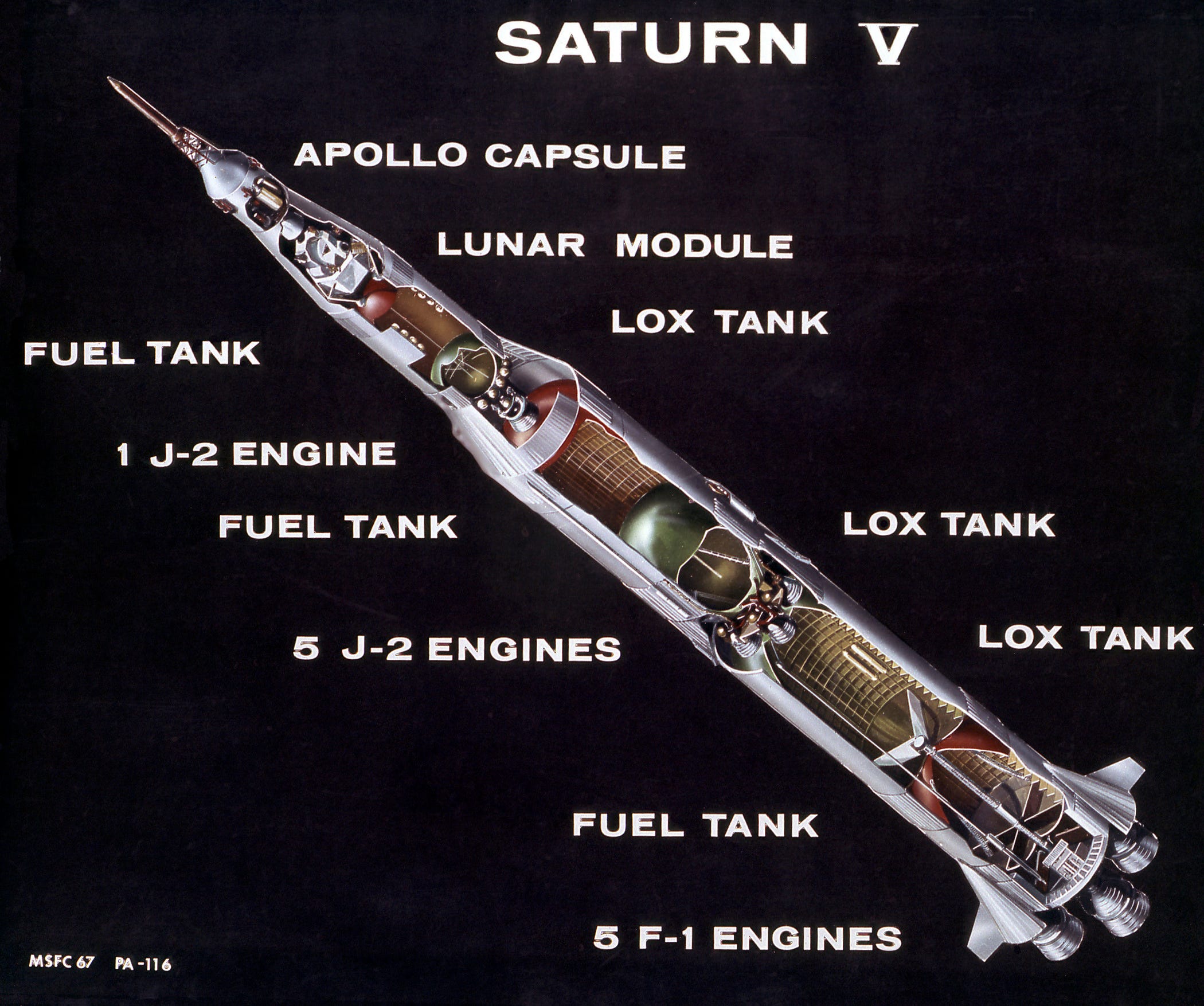
This is how we end up with rockets being mostly fuel and less metal. The mighty Saturn V rocket that sent astronauts to the Moon comprised about 85% fuel by mass and only 13% in structures—including the rocket body, its plumbing, and other parts. Only the remainder 2% of the total mass made up the Moonbound spacecraft with astronauts inside.
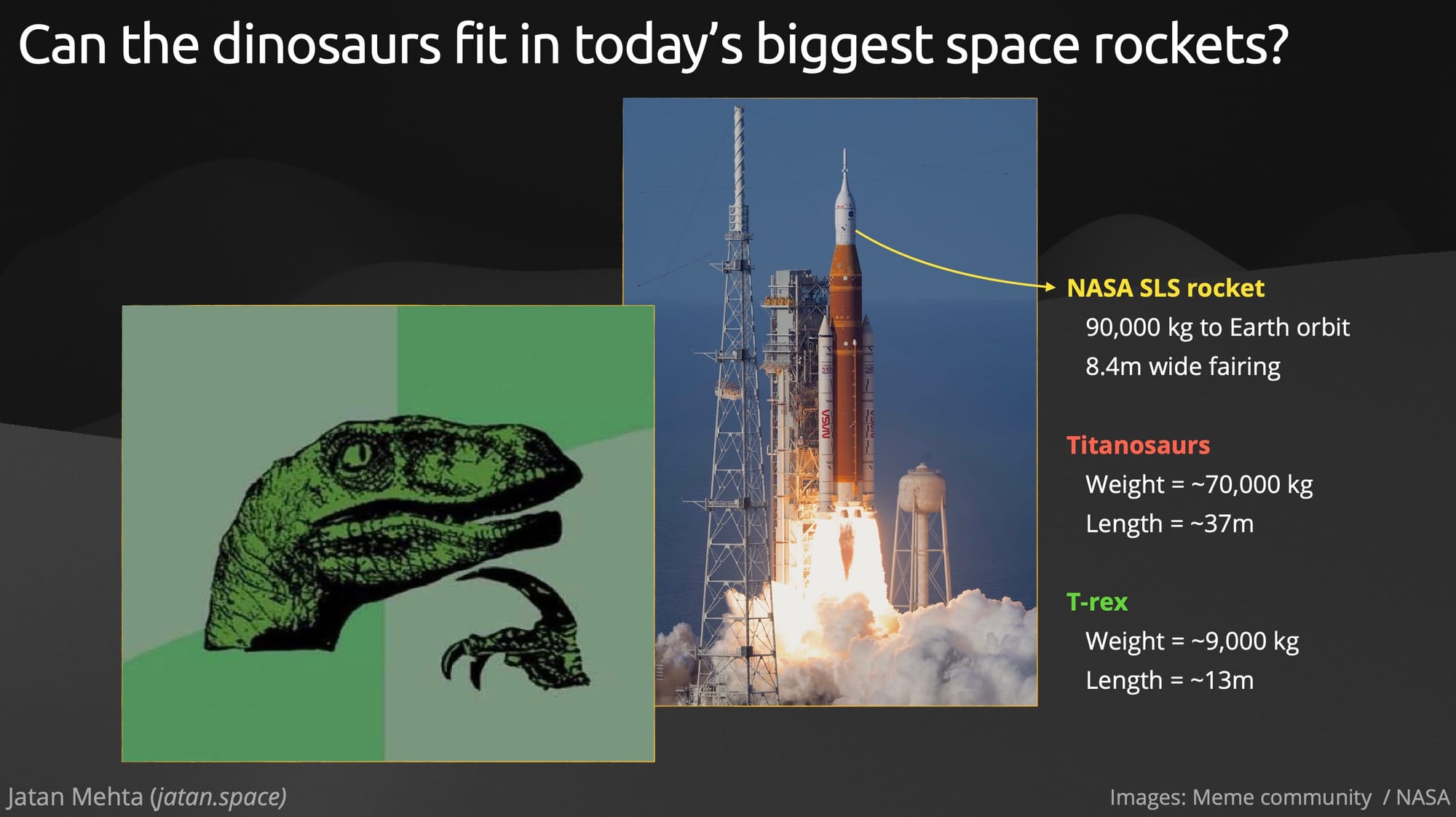
The dinosaurs could not stop an asteroid from destroying their reign over Earth. They did not have a space program [citation needed]. Even if they did have one, lofting the larger, more massive dinosaurs to space would be a challenge when such a tiny percentage of rocket mass is available for the payload. One of today’s most powerful rockets, NASA’s SLS, cannot carry the larger dinosaurs alongside the ship’s life support systems to space. So maybe the most imposing dinosaurs were doomed after all. There’s a limit to how large and massive rockets can get, thereby limiting the mass they can deploy to space. Of course, you can keep docking and stacking smaller spacecraft launched to space but that can be exponentially more expensive and complicated compared to single large flights.
The mass limit works in the other direction too. Imagine if our Earth was 10% more massive or dense. A rocket would require more fuel than that percentage to match the enormous amount of energy needed to enter orbit. Such a rocket might be 90–95% fuel-heavy and 10–5% metal. Increase Earth’s mass further and the fuel-to-mass ratio starts skyrocketing to a point where it’s simply not possible to engineer such a nearly-all-fuel rocket. Crunching the numbers in this manner, it turns out that if our Earth was 50% more massive, you simply wouldn’t be able to get to space even with the most energetic chemical fuel combination of liquid hydrogen and liquid oxygen.
Such a massive rocky planet is not imaginary; many of its kind exist. Of the thousands of planets around other stars we’ve discovered to date in our galaxy, more than a thousand belong to a category scientists have labelled as ‘Super Earths’. These are planets which are up to 10 times more massive than Earth and up to twice as large. Beyond that limit, planets don’t remain rocky and start turning into Uranus- or Neptune-like gas giants.
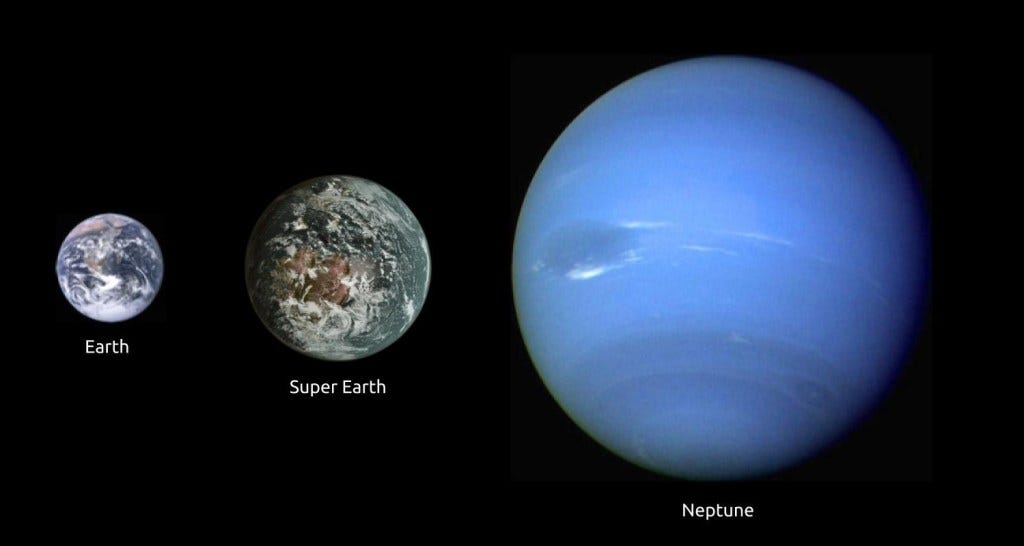
Many Super Earths lie in the respective habitable zones around their stars, meaning conditions there could support life as we know it. Given that we’ve only searched a small fraction of our galaxy for planets, it’s fair to say there could be millions of Super Earths, many of which could host life. If intelligent life were to exist on these Super Earths, they would have a hard time building rockets that get things off-planet. Since even the most energetic chemical rockets won’t get them to space, they might get incentivized to build something with more thrust that works, such as nuclear propulsion rockets. Sometimes nature doesn’t give you a choice.
The Moon is not the harsh mistress. Gravity is.
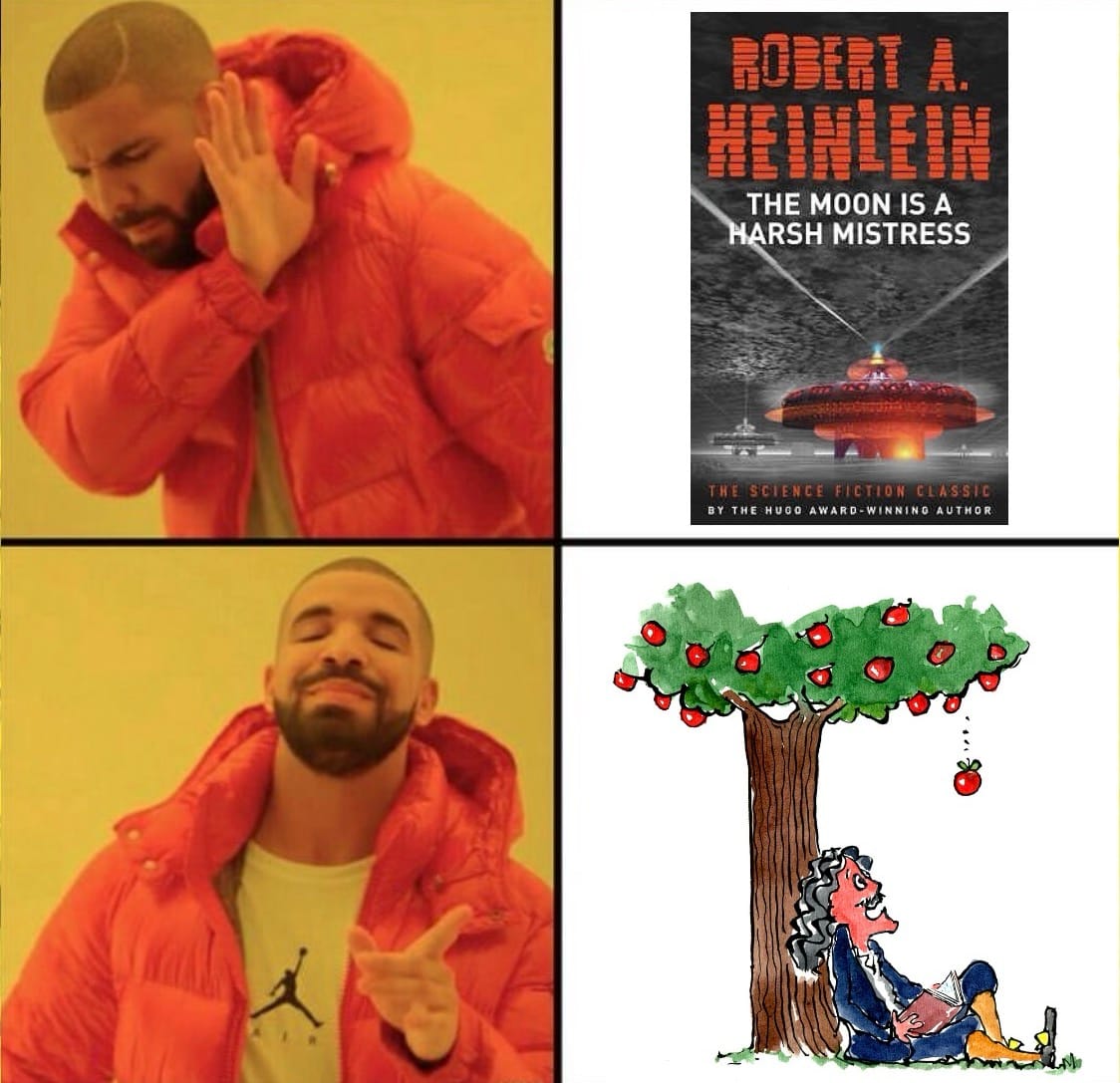
You might be wondering where is our Moon in all this as noted in the beginning? Well, just like the rocket equation makes it exponentially harder to orbit and escape a planet as mass increases, it also makes it exponentially easier to leave objects as mass lowers. Luckily, the nearest celestial body to us is one such place.
Dalla Luna, to the red planet and beyond
Our Moon’s gravity is weaker than Earth by about six times, allowing rockets to take off from its surface with ease. This was most notable during the Apollo missions, when even a spacecraft hosting two astronauts could gracefully make its way to lunar orbit. Importantly, the Moon lies at the outer edge of Earth’s gruesome gravity well, meaning it’s far easier to escape our planet’s pull completely if we can launch spacecraft from Luna. One can reach Mars from the Moon and still have some fuel to spare compared to the energy expenditure required to merely get from Earth’s surface to low Earth orbit.
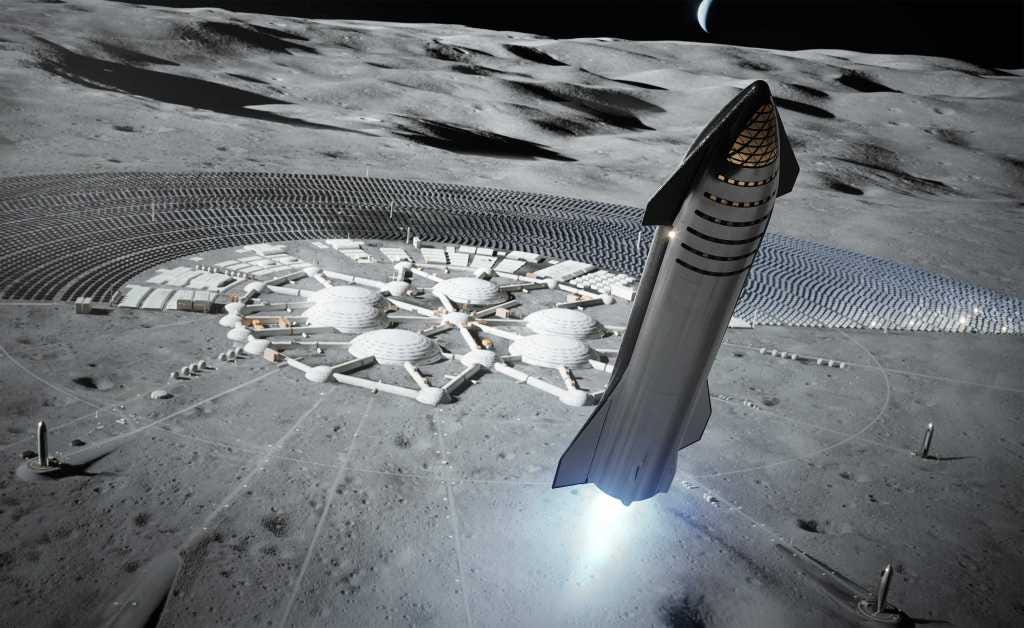
Likewise, the rocket equation lends an advantage to future spacecraft launched from Luna in efficiently reaching other worlds in our Solar System. The equation tells us that even when objects in the outer reaches of the Solar System are closer to Mars than the Moon distance-wise, the more massive red planet’s deeper gravity well means greater energy is required to get out of its pull than to reach those destinations from thereon. For a rocket to reach the asteroid belt from the Moon’s surface, it takes at least 40% less energy than from Mars’ surface—even though the red planet is about 75 million kilometers closer to the belt.
This is the difference gravity makes, and which the rocket equation allows us to see. True lunar launchpads, untethered to Earth, can accelerate missions to places like Ceres and Vesta, which can in turn with refueling stations lend us the same kind of energy expenditure advantages as Luna embodies for vividly exploring outer worlds of immense scientific promise such as Europa, Enceladus, Miranda, Neptune and its moons, and so on.
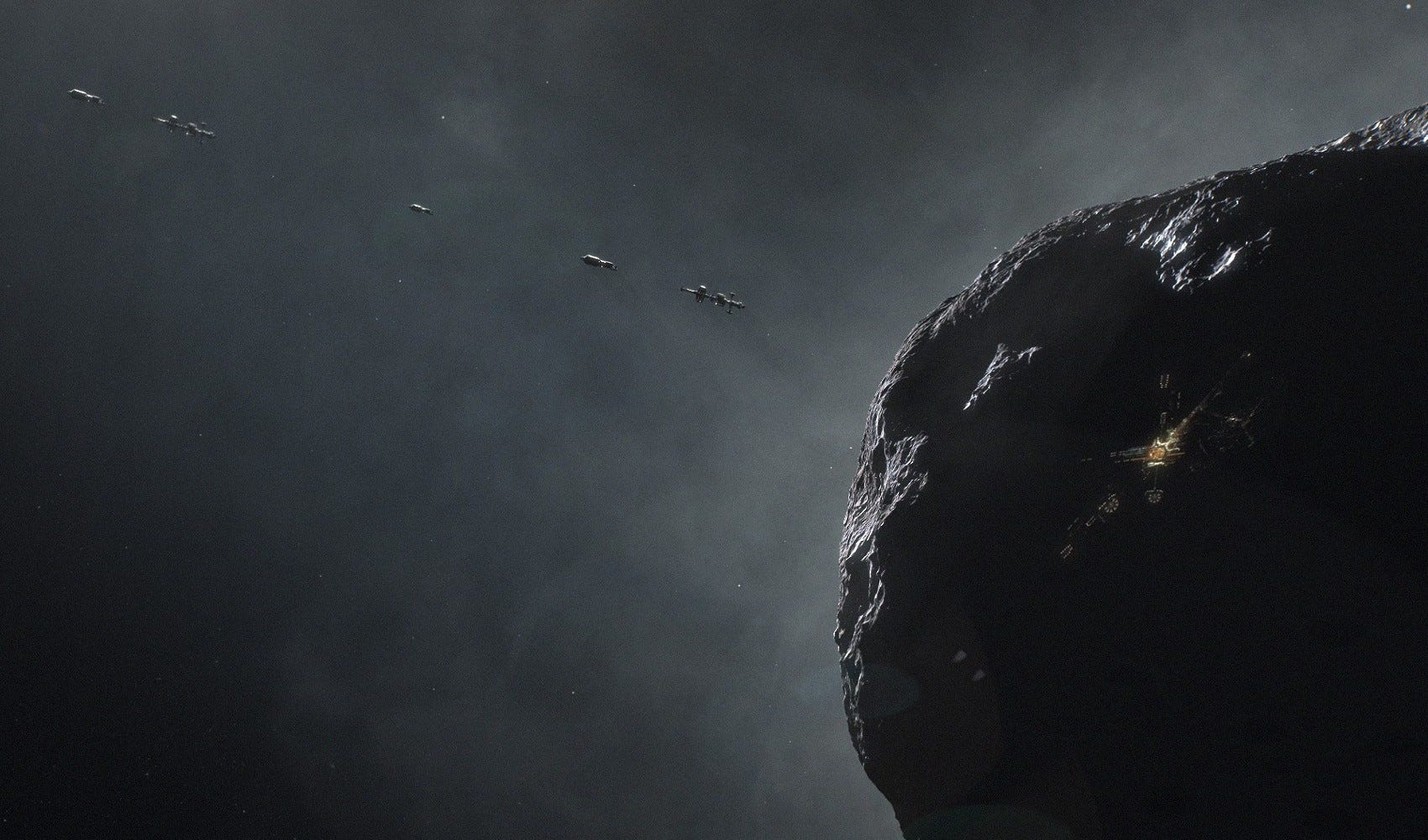
Our Moon’s accessibility as a cosmic neighbor, its low gravity barrier, and its unique resources are few of the reasons why Luna is valuable even beyond itself. Of course, all of this assumes we’re even able to build out and sustain an independent enough presence on our Moon for living and manufacturing. Even if we don’t keep fighting ourselves and stay focused, it might take a long time for us to have true lunar launchpads. But at least there’s nothing in the physics to disallow it.
What physics doesn’t dictate however is ethics. That responsibility is on us to carry alongside our spacecraft as we explore more and more of the Solar System and Cosmos. To that end, I wrote a poem.
Poem: On the edge
Craft launched from Luna, no tether
can go farther, faster
while being lighter
Exploring more worlds
with joy and curiosity
hosting ideas, deploying empathy
and even skepticism for humanity
From the edge of a gravitational well
they can push the discourse
and shape its course
All of these futures can bloom
with the fervor and fragrance of you.
Poem notes: I love writing poetry where words allude to technical space themes. It’s challenging and fun to distill the complex thoughts and concepts into words that flow while making sense in layers. Just like my poem The dawn of your light, this one was written to appreciate the qualities of someone I’ve had the pleasure of working with. The gratitude extends to others in my circles sharing those qualities. :)
If you liked this space poetry of mine, read Seven uni-verses, my globally published poetry pamphlet.
Article originally published in 2021, updated and more context included in 2026. Original piece republished by The Wire Science.
Thanks to Adithya K Pani for reviewing the article.
Many thanks to Catalyx Space, Ajay Kothari, Gordon Roesler and Justin Alva for sponsoring Moon Monday. If you too appreciate my efforts to bring you this curated community resource on global lunar exploration for free, and without ads, kindly support my independent writing, which is purely reader-funded. I don’t use AI to write a single word and cite everything.