Thailand and the Moon Village Association convene Korean, Japanese, Chinese, and Western space organizations for sustainable lunar operations
Moon Monday #298: Sawadee from Bangkok!
Thailand is the only country in the world which has active civil and scientific space programs, and is also party to the US-led Artemis Accords as well as China-led ILRS frameworks for cooperative lunar exploration. Which is why the Moon Village Association’s 10th global lunar symposium piqued my interest since Thailand’s leading space organization, called Geo-Informatics and Space Technology Development Agency (GISTDA), co-hosted the event in Bangkok last week on October 26 & 27. The fact that both US and Chinese government officials were present made the space event one of the few in the world of its kind. And that lunar operators from South Korea and Japan were presenting too convinced me to attend the event and cover notable highlights here on my Moon Monday blog+newsletter.
While the program topics spanned a wide range, the standouts were talks and panels discussing the existing and impending challenges of lunar traffic management, especially in orbit. Two leading ones among those deliberated on ‘coordination in lunar operations’ and ‘lessons from terrestrial space debris governance for sustainable lunar activities.’ The conversation on the overall theme thus encompassed multiple sessions.
Lunar orbital coordination today
To understand the context in which lunar operators and their organizations surfaced challenges and possible pathways, we first need to understand the specifics of the situation at Luna. Our Moon may be one of the largest satellites in the Solar System but its exploration in this decade and next is being largely concentrated in select regions. One of them is low lunar orbit, where mapping spacecraft from three countries have been concurrently flying from pole to pole between 50 to 150 kilometers above the Moon’s surface for over four years. These comprise the US’ Lunar Reconnaissance Orbiter (LRO), India’s Chandrayaan 2 orbiter, and South Korea’s KPLO spacecraft. The Moon’s gravity being uneven means they have to operate in select orbital planes which maintains their mapping orbits and avoids crashing into the Moon. But that also means their orbits often overlap, increasing the likelihood of these orbiters running into each other at high velocities.

The situation compelled their three space agencies—NASA, ISRO, and KARI—to start coordinating and sharing precise trajectory information of the lunar satellites with each other. Each satellite operator has thereby conducted many diversion maneuvers to avoid uncomfortably close passes with one or the other craft. Moon-Jin Jeon, the KPLO operations lead who spoke virtually at the MVA & GISTDA event has previously presented on the topic at the Secure World Foundation’s Summit for Space Sustainability event in 2024. Jeon had described how the three agencies use NASA’s MADCAP software to predict and alert operators of potential close approaches between their orbiters, after which a decision is taken by either craft to divert.
In October 2021, ISRO commanded the Chandrayaan 2 orbiter to slightly change its orbit to avoid a three-kilometer-close approach to NASA’s LRO. Similarly, LRO postponed a maneuver in 2023 to avoid more such close conjunctions. An August 2023 blog post by ISRO, which was specifically on the importance of managing growing lunar traffic, mentioned the Chandrayaan 2 orbiter maneuvering to avoid close approaches to KPLO. In turn, KPLO too has performed multiple such maneuvers. Even in 2025, despite better predictions, improved trajectory sharing, and increased coordination between parties, the Chandrayaan 2 orbiter still had to perform two collision avoidance maneuvers with LRO on January 1 and July 24 respectively.

Such maneuvers necessary for safety of operations will only grow in number in the coming years as more reconnaissance orbiters become operational amid increasing Moon missions worldwide. Upcoming orbiters expected to also occupy low lunar orbit as soon as next year are China’s Chang’e 7 and US-based Firefly’s Ocula craft. Several more are expected to launch through the rest of this decade.
Flight C3 International
Moreover, at the MVA & GISTDA event, China shared many details of their upcoming “Cislunar Cubesat Constellation (C3)” of 34 satellites, being built with international participation—Thailand included. Zhongmin Wang, Director of CNSA’s International Cooperation Center at the Deep Space Exploration Laboratory (DSEL), presented the C3 mission’s three developmental phases before launch in 2030, and its scientific & technological objectives of demonstrating collective measurements of the deep space environment and lunar surface. Wang noted that 15 international institutions are participating in C3 at the moment, and that there’s room for more until next year. I wanted to write a whole article on this complex and inspiring mission but instead I thought of getting you something better in the moment: the full set of Wang’s slides. I approached DSEL, CNSA and asked permission to share the slides and information publicly on Moon Monday. They agreed. Attached here is the presented PDF.
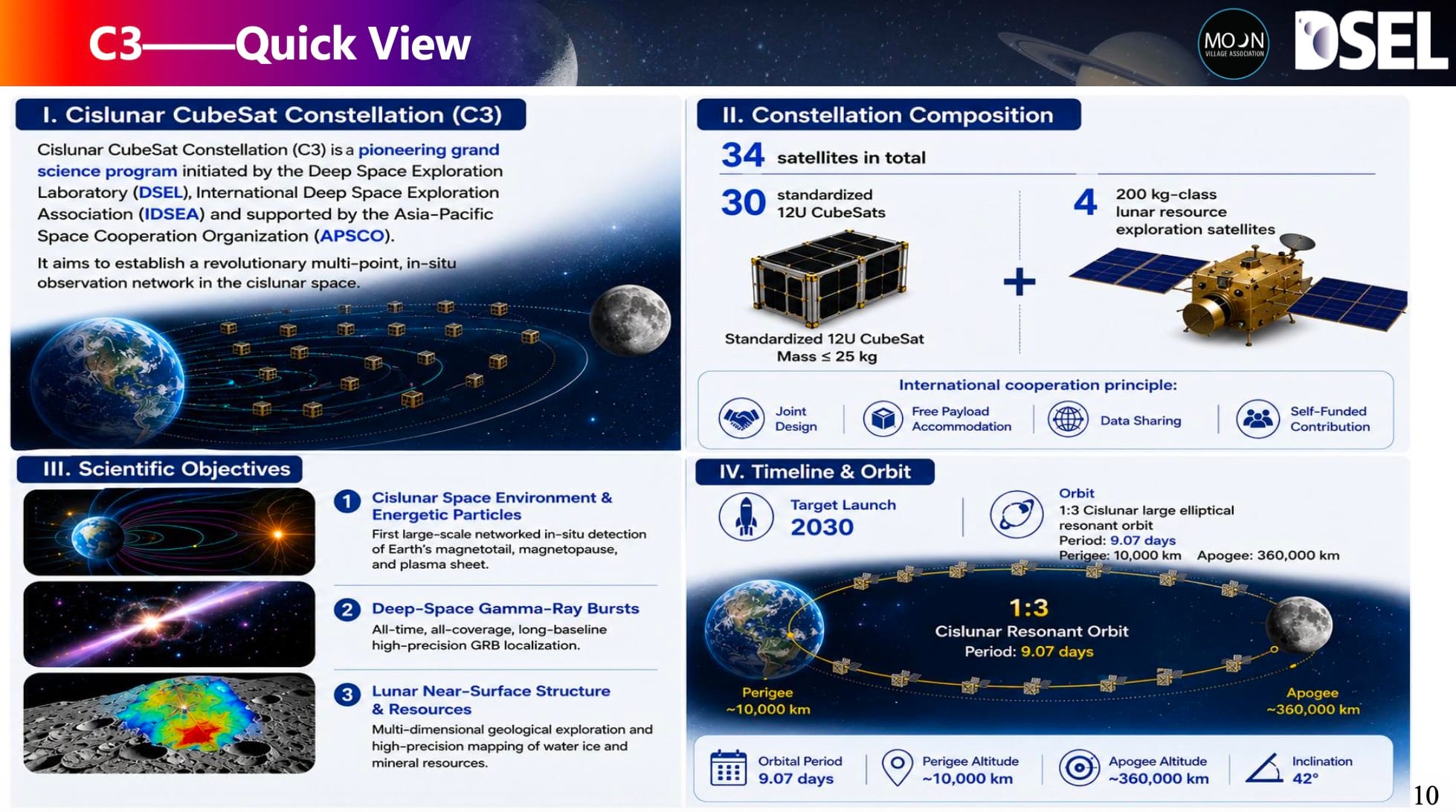
Zhongmin characterized C3 as the “largest space environmental detection constellation ever”, which other than lunar studies will detect and localize gamma ray bursts from energetic cosmic objects with high precision. The nerds among us would love not just the mission’s functions but its name C3 due to the term’s characteristic role in the rocket equation. C3 the mission will not be in low lunar orbit. Instead, its 34 satellites will be deployed in a 1:3 elliptical resonance orbit of about 9 days between the Earth and Moon. The perigee will be ~10,000 kilometers and the apogee ~360,000 kilometers. Each C3 satellite will fly past the Moon periodically but together they will have numerous passes to collectively map the lunar environment and surface resources like water ice.
Alarming events
While C3’s trajectory avoids crowding low lunar orbit, other reconnaissance missions will still use that space, including a litany of landers who will pass through it temporarily but dynamically. To cite a real event, in 2024 KPLO avoided a close approach to Japan’s SLIM spacecraft before the latter’s Moon landing. [That ISRO’s Chandrayaan 2 orbiter separately aided SLIM’s precision landing adds another interesting layer to this cooperation dynamic.] What alarmed everyone involved was that KPLO’s maneuvering decision for SLIM had to be evaluated and taken within a single day. During the MVA symposium, Jeon highlighted this event and thus the increasing risks of cascading accidental collisions within the tight orbital mapping spaces our Moon’s gravity allows. Based on KPLO’s operational experience, Jeon stressed on two key takeaways, requesting the following from all future Moon missions:
- Share updated orbiter prediction and trajectory plans with fellow operators in advance.
- “Establish communications channels before launch.”
While the existing coordination between KARI, NASA, and ISRO has averted both loss of spacecraft and major cuts in valuable observation time, establishing said coordination earlier in the decade wasn’t easy to begin with. Citing roadblocks, Jeon noted that KARI’s initial emails to ISRO about potential orbital conjunction warnings got erroneously blocked by ISRO’s system protections. KARI had to go through NASA, who forwarded said emails. In a more fast-paced situation like KPLO’s one-day-maneuver for SLIM, such unexpected coordination blockers can become lethal. SLIM is not the only example of a lander-orbiter coordination, as evident within ISRO’s summary of its space situational awareness report about events in 2025:
The required coordination for spaceflight safety was carried out for all operational [lunar] satellites. For CH2O [the Chandrayaan 2 orbiter], such coordination with Firefly Aerospace, Intuitive Machines, and ispace [landers] during their lunar orbiting phase was facilitated by NASA.
It’s important to note here though that unlike South Korea and the US, no ISRO official or engineer was present at the MVA & GISTDA event in Thailand, physically or virtually. It’s an oddity considering that ISRO and GISTDA are already active space partners. So we have less visibility on ISRO’s side of lunar coordination beyond intermittent official posts on the space agency’s website.
Building a new lunar order
Regardless, the current coordination process being more manual than automated is thus slow, and will not scale as lunar activity grows, as was also noted in another panel than Jeon’s by Antonio Stark, Senior Business Associate at ispace Japan and also MVA’s Global Network Coordinator. Relatedly, ispace Japan and US-based Argo Corp announced earlier this year that the duo aim to deploy at least five lunar navigation and communications satellites by 2030, with the first one aimed for launch in 2027. The fact that there is no globally accepted and adopted lunar time standard will also become concerning as satellites crowd the tight low lunar orbit.
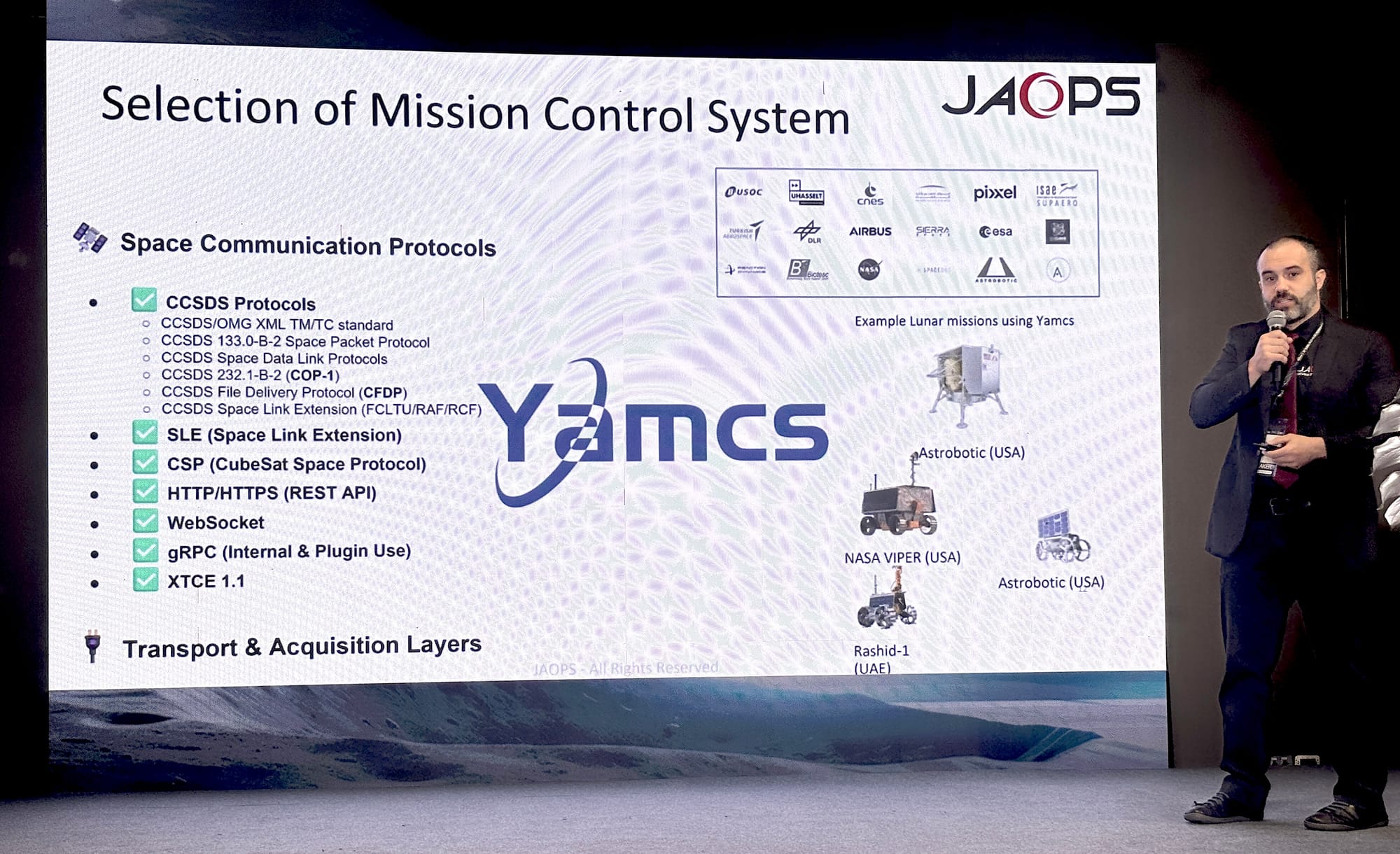
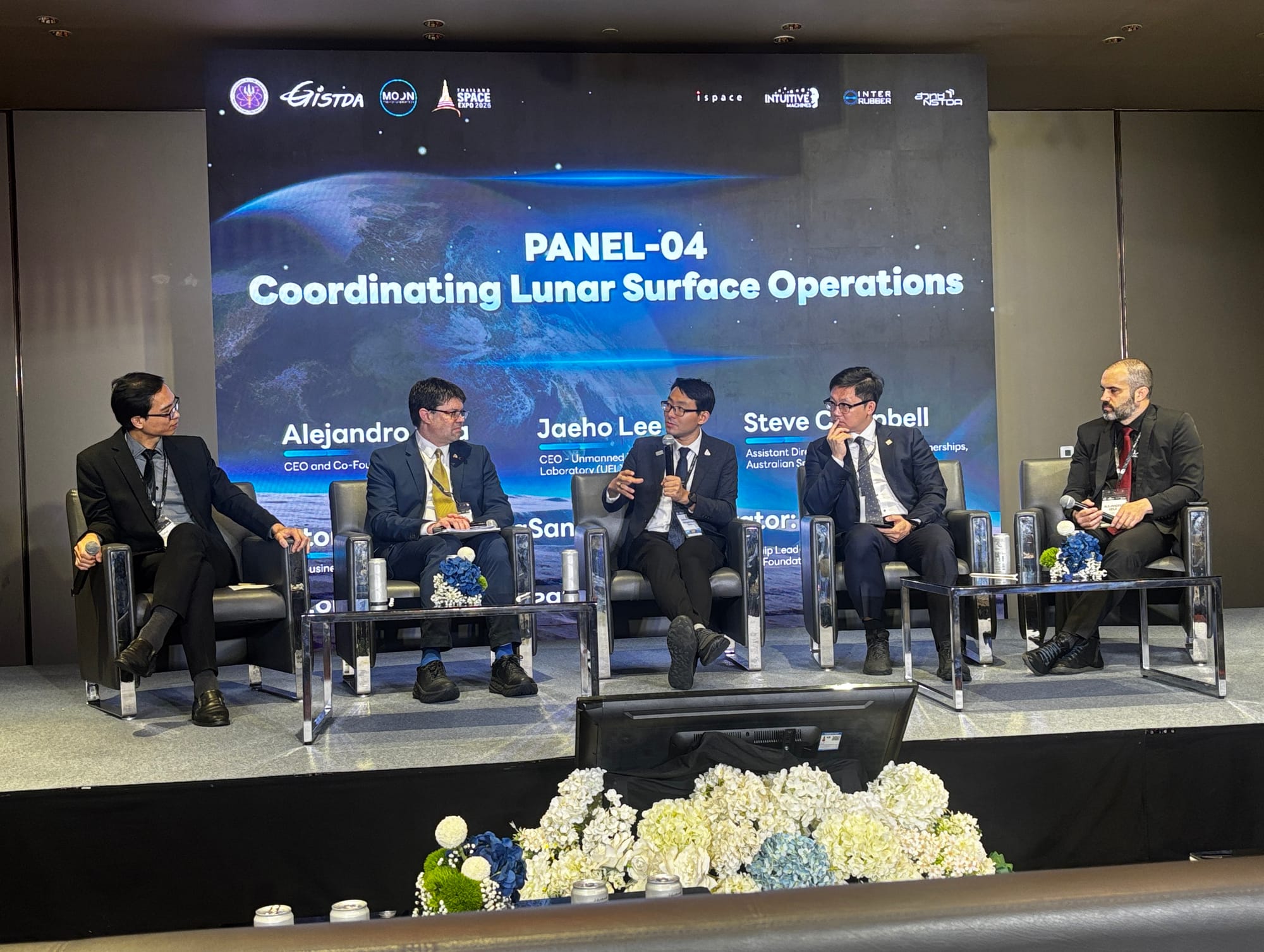
Alejandro Sela, CEO and co-founder of JAOPS, which commercially operated Dymon’s YAOKI lunar rover last year onboard Intuitive Machines’ IM-2 spacecraft, noted in the panel with Stark that data sharing connections between commercial companies are weak. Sela then highlighted how many lunar and space missions have begun using the open source mission operations software Yamcs, the shared foundation of which allows for easier data sharing between operators should they choose to. “Valuable operational data being shared would make our ecosystem more powerful.” To Sela’s point, JAOPS has in fact made public all the raw telemetry, telecommands, and images from YAOKI’s mission, which includes data distribution through a partnership with the Lunar Ledger of the Open Lunar Foundation (a Moon Monday sponsor). Data sharing in this manner could be a rising tide for all given the treacherous nature of the lunar south pole.
Global level coordination usually demands legally binding agreements between states. However, Yu Takeuchi, Director of the Space Law Research Center at Keio University in Japan, cautioned against enforcing this approach. Takeuchi highlighted in the same panel as Jeon’s that common understanding among various actors for operations doesn’t necessarily require legally binding measures. Imposing the latter can in fact reduce adoption in Takeuchi’s view, as has been seen in space history. During his panel, Stark likened information sharing challenges for commercial companies as a version of the “prisoner’s dilemma” wherein if only a few companies share information but others don’t, it creates unfair advantages for the passive players. In fact, this is the exact kind of problem the Lunar Ledger of the Open Lunar Foundation (a Moon Monday sponsor) aims to solve in a bottom-up manner by being a mutually trusted third party facilitator.
SSTL UK, which is about to launch the Lunar Pathfinder orbiter next year onboard Firefly’s Blue Ghost 2 Moon mission, had presence at the MVA & GISTDA event through Alex Da Silva Curiel, who leads the company’s international business. Curiel remarked how when deciding norms for Earth orbit, we humans did not think far enough ahead, giving us the current congestion situation and cascading collision risks. Mega-constellations weren’t originally considered at all when shaping terrestrial space norms. With the Moon however, Curiel expressed, we have a chance to do fundamentally better by planning far enough into the future.
In essence, everyone agrees that coordination at the Moon is needed. In practice, people are unsure of exactly how to coordinate, precisely what [not] to share, and when so. Towards the end of the symposium, I was reminded of what was stated in a recorded speech during the inaugural sessions by Aarti Holla-Maini, Director of United Nations Office for Outer Space Affairs (UNOOSA):
How we address these [sustainability] challenges today will shape the future of lunar exploration for generations to come. We have an opportunity and a responsibility to ensure that progress in science & technology is matched by progress in international cooperation.
Setting inspiring precedence along those lines, Jeon shared during his panel that the KPLO team has planned a controlled lunar impact of the satellite towards the end of its mission, which will avoid sensitive hardware areas and natural regions of international interest. Jeon added that KARI will share KPLO’s collision details in advance with the international community.
Many thanks to Catalyx Space and Gurbir Singh for sponsoring Moon Monday. If you too appreciate my efforts to bring you this curated community resource on global lunar exploration for free, and without ads, kindly support my independent writing as it’s purely reader-funded. I don’t use AI to write a single word and cite everything.