What does Blue Origin’s New Glenn rocket explosion mean for NASA’s Artemis program? A domino of timeline lapses and strategic failures.
Moon Monday #277: How quickly Blue flies New Glenn again, the timing and outcome of the first Mark 1 lander flight, and what NASA shares about the crewed Mark 2 are the key things to watch out for.

Following NASA’s Artemis rejig, catalyzed Moonbase plans, and the crewed Artemis II lunar flyby earlier this year, the agency has been trying to go full speed in its grand plans for returning US astronauts to the Moon alongside placing of long duration infrastructure. It’s to that latter end that on May 26, the agency took another necessary step by announcing firm, fixed price contracts being awarded to teams led by Astrolab (a Moon Monday sponsor) and Lunar Outpost respectively for building crew-capable Moon rovers. Each contract is worth about $220 million. These ~1000-kilogram “Lunar Terrain Vehicles” (LTVs) will be more advanced than the rover driven by Apollo astronauts, capable of long range exploration and site scouting with onboard instruments. They will also tout autonomous driving or remote operations, useful for when astronauts are not around. To deliver these rovers on the Moon, NASA awarded Blue Origin contracts worth up to $280.4 million. Two Blue Moon Mark 1 landers will perform the job as part of the agency’s CLPS program. The landers hosting the rovers would be launched on Blue’s New Glenn rockets.
Explosion, not anomaly
In what couldn’t be more harsh a timing, just two days later Blue Origin’s New Glenn rocket suffered a massive explosion during a test fire on its pad ahead of an orbital launch. Felt dozens of kilometers away, the explosion destroyed the rocket, a lightning protection tower, the pad structure, and the rocket transport. The few elements that survived were also significantly damaged. The only silver lining is that no person was close enough to get killed. Although dangerous debris from the explosion did enter public waters.
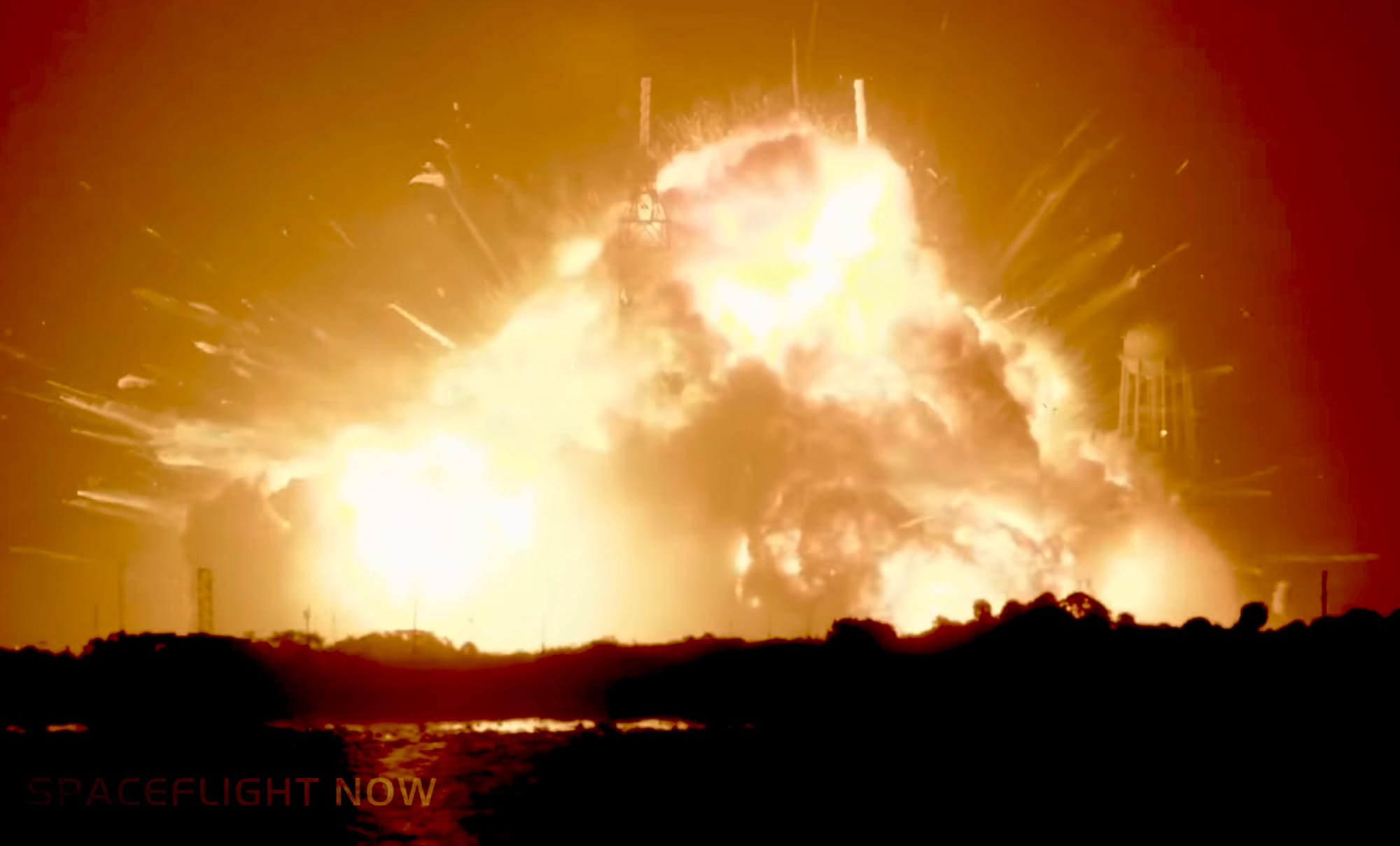
In spite of the intensity of New Glenn’s blow up and resulting damage, the company and NASA chose to describe the event as an “anomaly”, as if lending the usage of inapt euphemisms from the company owner’s other businesses in books and the media. Since Blue lost its only launchpad to space, and a second one is still in an early development phase, it will be at least 2027 until Blue regains a baseline level of launch infrastructure. The back-to-pad time for New Glenn will additionally depend on Blue identifying the root causes and fixing them soon enough. The explosion, coupled with the failure of the third New Glenn rocket in April have fiercely pushed back every ambition and mission schedule of Blue by at least a year or more, including multiple contracted robotic and crewed Moon missions for NASA.
Between Blue’s explosive delays and SpaceX’s Starship setbacks, the US has lost even more years across both its bets to land astronauts on the Moon, which the country wants to accomplish before China despite having started on its program a decade earlier. While the NASA Administrator Jared Isaacman expressed that NASA will support Blue in overcoming the obstacles ahead, and that’s a good thing, receding milestones are inevitable amid physics & engineering realities that no amount of PR or wealth can overcome. While Starship landing astronauts on the Moon in the near future has long been impossible, the small silver lining that the US had of Blue achieving so—only in its most optimistic universe—has now turned on its head upside down. To understand the loss and impact to Blue and NASA, consider the specifics of each mission Blue is supposed to launch and how they are affected as well as related to each other.
Blue Moon Mark 1, the first

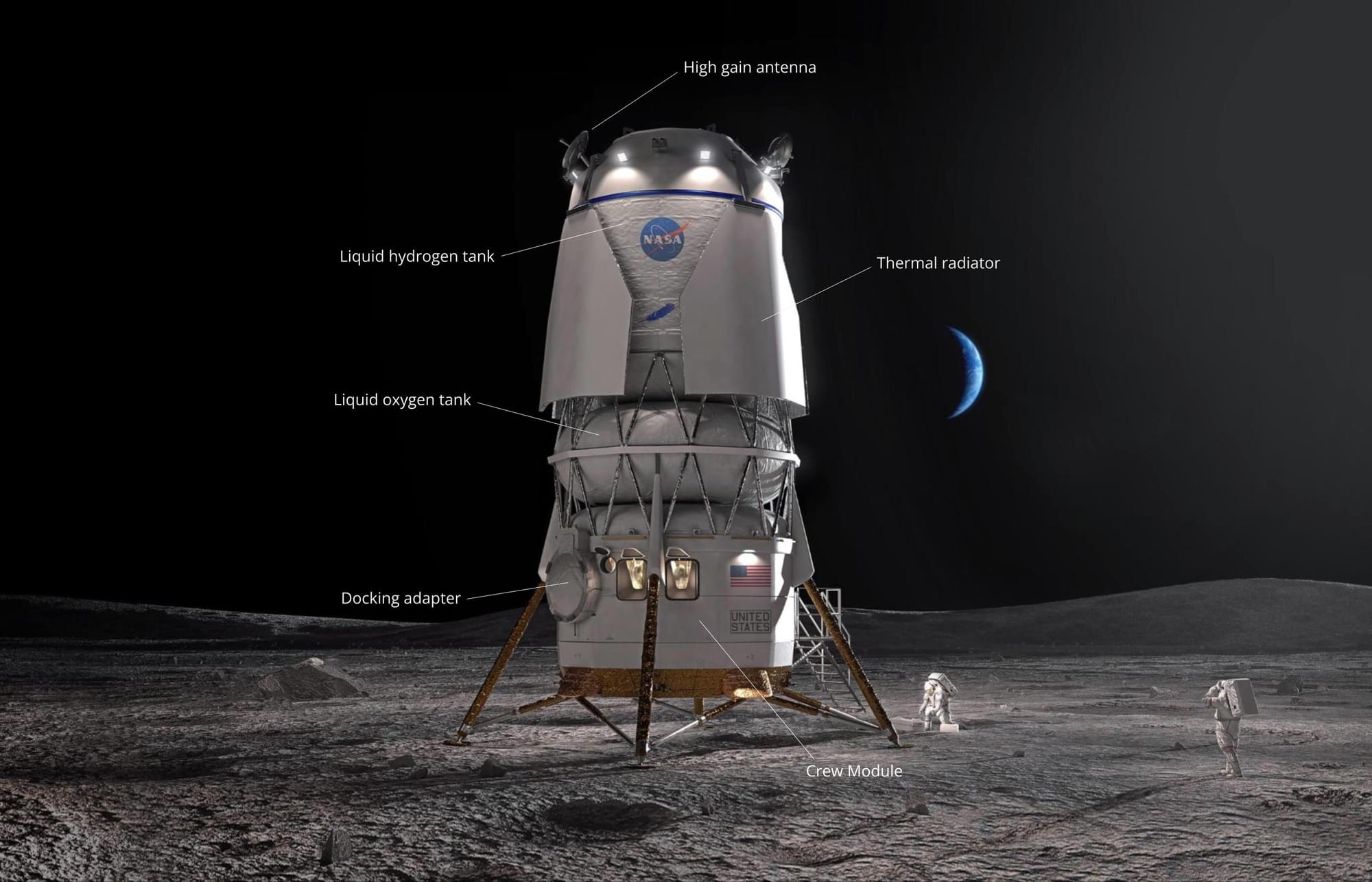
Before New Glenn’s explosion, the company’s first Blue Moon ‘Mark 1’ lander named Endurance was being aimed for launch by the end of this year, following a one-year delay. Targeting a lunar south polar landing, Endurance is a pathfinding mission aiming to test and validate key design decisions and precision landing systems ahead of more robotic flights. These latter flights need to carry increasingly important payloads for NASA to study water ice deposits and other such resources relevant to sustaining lunar exploration. In turn, these flights will refine systems and knowledge of the local lunar environment, feeding into Blue’s massive ‘Mark 2’ lander contracted to land NASA astronauts on the Moon.
One payload the first Mark 1 will carry is NASA’s third version of the multi-camera SCALPSS payload. The second SCALPPS, which flew on Firefly’s first Moon lander called Blue Ghost in 2025, snapped close-up images of the Moon’s surface as the lander’s thruster plumes vigorously kicked up lunar dust, soil, and rocks—collectively called regolith. Together, these measurements will help lunar scientists and engineers better understand how rocket plumes blast out lunar regolith and affect the local lunar environment, and thus how to best protect future astronauts, critical hardware, and long-term habitats on the Moon.
NASA is re-flying SCALPPS on a Mark 1 because unlike smaller landers like Blue Ghost, Mark 1 will generate high enough trust to allow NASA to gauge engine plume effects at the scale of large crewed (Artemis) landers like the Mark 2. That is what allowed NASA to award the payload’s flight to Blue Origin under a $6.1 million CLPS contract without holding a competition. Although NASA did not publicly announce the contract itself at the time.
The only other NASA payload onboard the first Mark 1 seems to be a small retroreflector for lunar satellite ranging and navigation studies. Note that the Mark 1 lander has a large payload capacity of ~3000 kilograms. That’s more than the entire fueled mass of smaller landers like Firefly’s Blue Ghost and India’s Chandrayaan 3! And yet NASA isn’t flying any other scientific instruments on Endurance. Considering that the US has been failing to explore lunar water as the principal goal of Artemis, and that the Mark I’s landing site is the lunar south pole, it would be remiss for NASA to skip flying any lunar water related payloads on Endurance as a bare minimum. Whether that be through Artemis, CLPS, or other funding sources does not ultimately matter. Carrying two small payloads represents a low value bet on Blue by NASA despite the higher risk postures that CLPS orders are supposed to accept.
Endurance recently passed space environmental testing at NASA’s Johnson Space Center. The tests were conducted at the center’s Thermovac Chamber A, which simulates temperatures and vacuum conditions the lander is expected to face during its flight to the Moon and at the lunar south pole. It was edging closer to flight. New Glenn’s explosive delays though will now keep the large lander grounded. Given the pressing need to nail the lunar landing on its first attempt, and the harsh lighting conditions on its polar landing site being favorable only during certain times, it’s now quite likely that Blue’s first Mark 1 lander will not launch until the second half of 2027.
A still tentative VIPER rover delivery
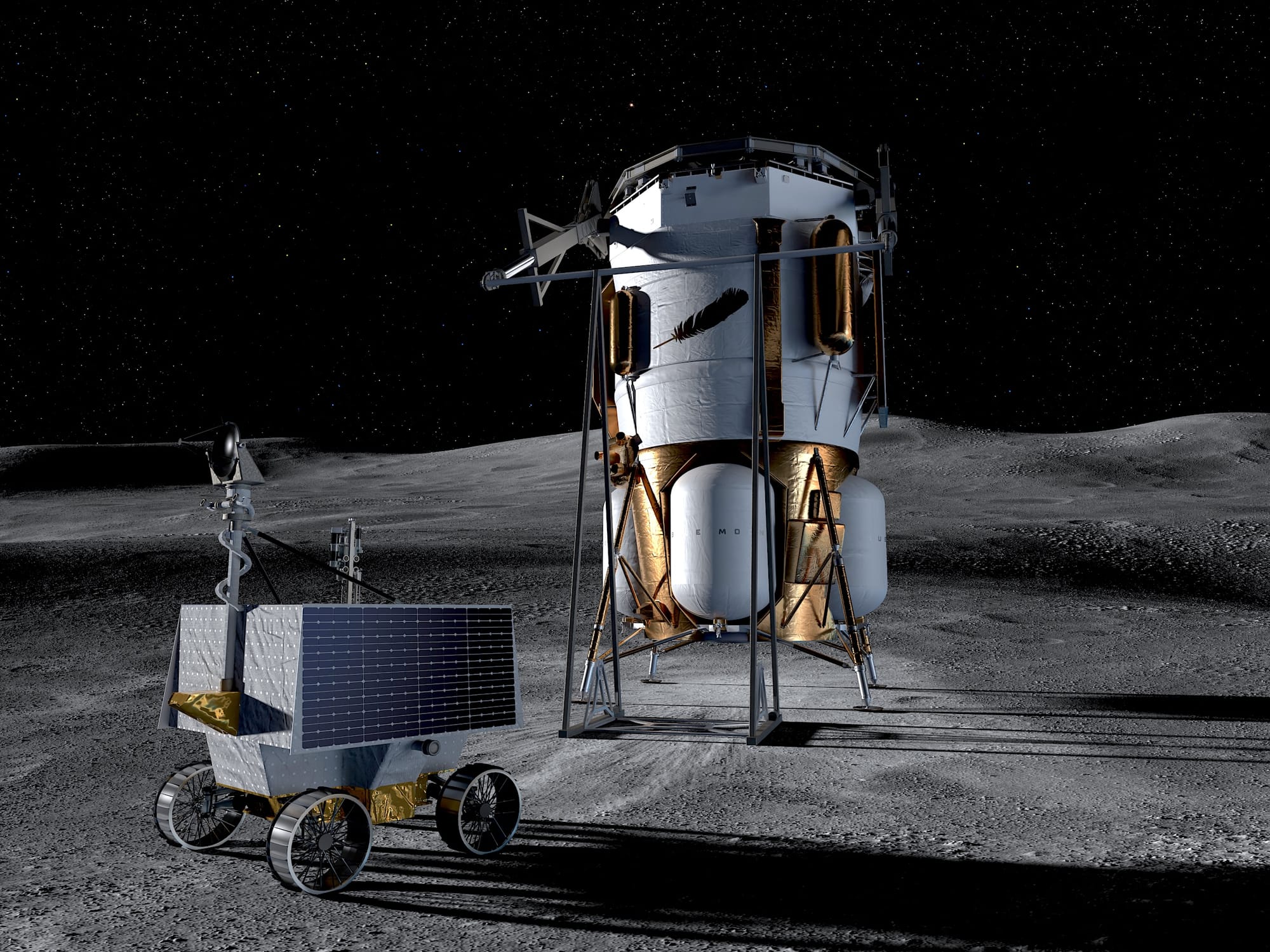
Last year NASA awarded a potential contract to Blue for delivering the agency’s VIPER rover to the Moon’s south pole in late 2027. This was contingent on the first Mark 1 flight going well, and also on Blue Origin separately demonstrating to NASA how the lander’s mechanisms can safely deploy the 450-kilogram VIPER rover onto the lunar surface post landing. Assuming these milestones are passed, NASA planned to award Blue a $190 million CLPS contract for delivering VIPER to the Moon on the second Mark 1 lander.
The VIPER rover’s long-planned mission to study and characterize polar water ice has been critical yet deprioritized by NASA, resulting in the US failing to explore lunar water as the principal goal of Artemis. In the meanwhile, China is on track to execute a comprehensive water-studying mission with the launch of Chang’e 7 later this year. Flying VIPER on the second Mark 1 in late 2027 was supposed to help manage this strategic failure for the US. But given Blue’s situation now, NASA might choose to keep the VIPER delivery contract tentative-only until the first Mark 1 flies and successfully so. VIPER too requires landing and operating during certain times of the year when lighting conditions along its planned traverse routes are favorable. As such, it’s difficult to imagine the second Mark 1 lander carrying VIPER any sooner than the second half of 2028. That too only if the first Mark 1 succeeds.
Constrained choices
NASA could consider moving VIPER’s flight up on the first Mark 1 lander to make up for lost time while better utilizing the massive ~3000-kilogram payload capacity available. But that would be a substantial monetary risk and potential geopolitical blunder given the unproven state of the lander. Moreover, a successful VIPER delivery is in itself necessary to achieve before the aforementioned crew-capable LTV rovers contracted by NASA can be delivered to Luna by two more Mark 1 landers. Even if these cutting-edge rovers are somehow developed and ready to fly by 2028, the Mark 1 landers meant to carry them will likely not fly until 2029 at the earliest. Let’s hope that VIPER’s resource prospecting mission actually happens, and that the rover lands in one piece.
The Mark 1’s ~3000-kilogram payload capacity is its biggest selling point. Most CLPS landers like Firefly’s Blue Ghost with their entire fueled mass weigh less than that. Upcoming heavier CLPS landers like Astrobotic’s Griffin, Intuitive Machines’ Nova-D, and ispace’s ULTRA all have payload capacities in the ~500-kilogram range, which is only half the mass required to transport any of the LTV rovers being built by teams led by Astrolab and Lunar Outpost. Flying the LTVs through SpaceX’s Starship rocket is also not an option given Starship’s own setbacks while flying Blue Moon on a Falcon Heavy is unlikely as well due to the sour Bezos-Musk relationship. As such, NASA now finds itself in a delayed situation presenting only risky options in the best case with the potential to backfire.
Ultimately, all the robotic Mark 1 missions are meant to aid or be complementary to crewed & cargo lunar flights of Mark 2 landers, which will also see delays because of the domino effects of New Glenn’s explosion.
Lunar pitfalls
While NASA has been pushing for commercializing the Moon instead of using a centralized approach to ensure meeting strategic goals first, China has progressed much faster through its state-controlled plans. The country bagged a quicker succession of milestones in 2025 than expected, spanning prototype tests of its Moon rocket, the crew capsule, the lander, and supporting navigation and communications infrastructure. This year, China conducted an in-flight abort test of the crew capsule, provided new details on the planning and development of various elements of China’s crewed Moon missions, and is on track for more planned tests. China’s simple two-launch approach is proving itself to be more realistic and more strategic than even the simplified four-launch approach Blue proposed when Starship was being slow to ship.
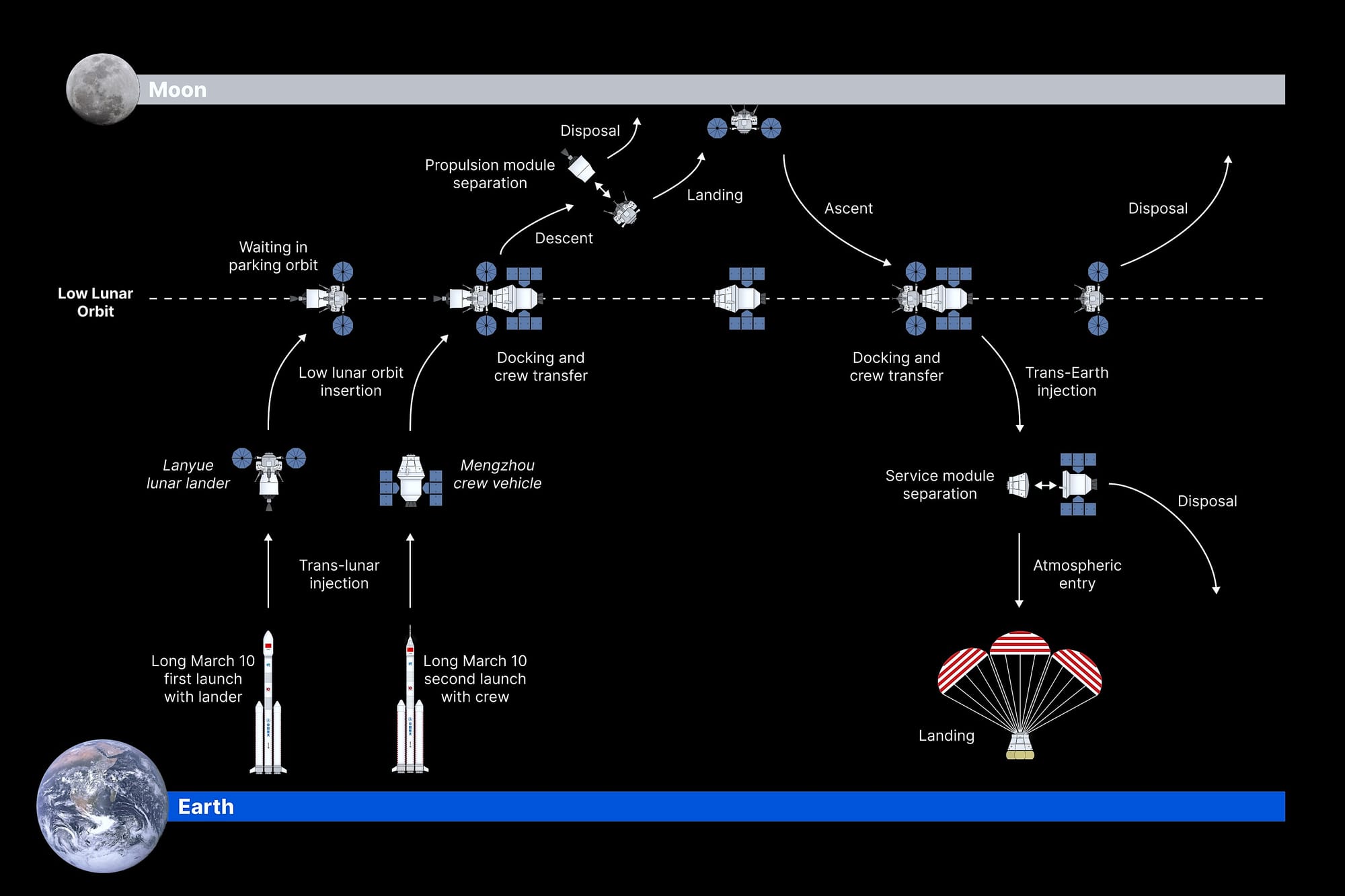
In response to China’s pace, portrayed by the US as a “race”, NASA has been trying to remove or reduce requirements to allow both Starship and Blue Origin to meet the agency and its Orion craft somewhere in between. For example, the effective cancellation of the NASA-led Gateway lunar orbital habitat earlier this year removed the requirement for Starship or Blue to orbit the Moon in Gateway’s specific NRHO orbit, allowing them to dock with the crew-hosting Orion spacecraft in other potentially feasible shared orbits. Relatedly, Marcia Smith reported that NASA is considering the first Artemis landing to not be amid the treacherous terrain of the Moon’s south pole and lie more equator-ward instead. Targeting a non-polar landing improves safety from a terrain perspective while also enhancing communications and power availability to carry out the mission. However, the relaxation of these requirements by itself does not solve the majority of the challenges and delays faced by even Blue, whose minimum-4-launch-mission-profile is simpler only when compared to SpaceX.
NASA’s Office of Inspector General (OIG), which formally functions as an agency watchdog, released a scathing report in March pointing out various shortcomings and risks in Blue’s crewed Mark 2 lander [alongside Lunar Starship]. Notably, Blue too is targeting a lower fidelity uncrewed mission demonstration prior to carrying crew, excluding important milestones such as the Mark 2 getting back to lunar orbit after the surface mission. As such, the uncrewed flight wouldn’t simulate the full-scale mission profile of Artemis IV, failing to test the full envelope of the landing mission with astronauts.
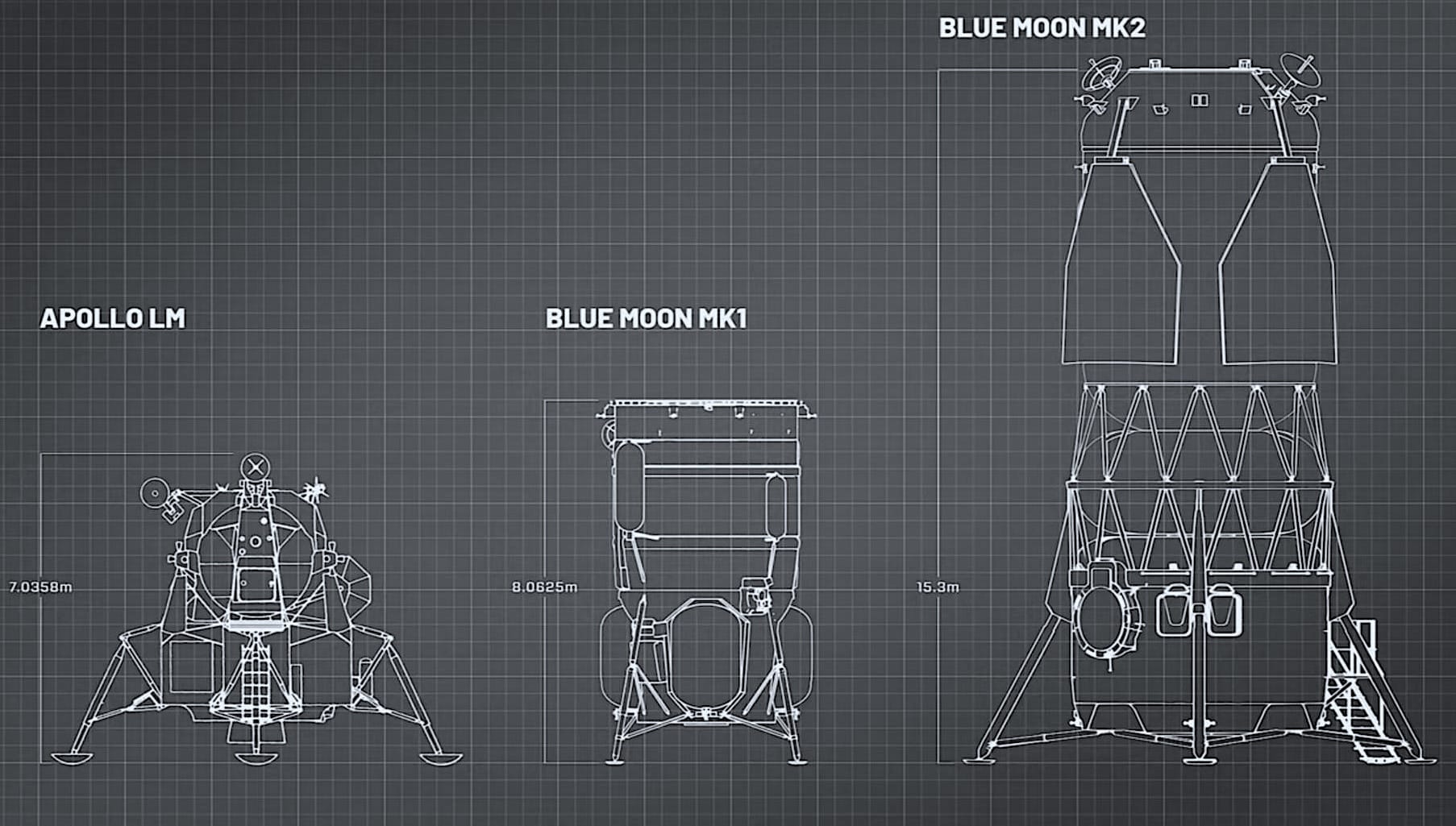
The OIG also noted that Blue hasn’t yet decided to what extent the Mark 2 will tout manual control options of the vehicle by astronauts, if at all. Relatedly, Blue Origin and NASA did setup a full-size mock Mark 2 crew cabin sometime this year for ground-based astronaut testing and feedback. NASA says the mockup will evolve to support multi-phase mission simulations ahead of crewed flights. In contrast, Chinese taikonauts have already been training for various landing scenarios in a Lanyue lander simulator, which has manual control options to override autonomous touchdown. This training in itself is providing astronaut feedback to engineers for iterating on the lander’s development.
All these challenges are present for Blue while the uncrewed Mark 2 cannot fly even test missions until its now-further-delayed predecessor Mark 1 is itself proven. [Hey, at least Blue now has the time to rework the interface for Axiom-Space-provided spacesuits to meet new NASA requirements.]
Following New Glenn’s explosion, Eric Berger noted a similar unfortunate conclusion for the Mark 2 lander’s delivery timeline:
As for Artemis IV, the lunar landing mission, this failure further complicates that plan. It is difficult to imagine a scenario in which a crew-rated Blue Moon lander is ready at any point in 2028 now. Even if the hardware is far along, Blue Origin still needs to fly test missions with Blue Moon Mark 1, which are on hold indefinitely
Such clarity in reporting for the public is mysteriously absent in the case of SpaceX, where Starship’s setbacks are not presented to be all but certain to miss the Artemis IV Moon landing timeline in 2028 despite the sea of untouched milestones.
Competition and “commercialization” overstep national priority and public transparency
Even as Blue and NASA had been aiming to accelerate New Glenn launches and lunar landings to make up for Starship’s lapses since the past year, May’s New Glenn explosion and its aftermath has set the Sun on that sliver of hope. How quickly Blue flies New Glenn again, the timing and outcome of the first Mark 1 lander flight, and what NASA shares about the crewed Mark 2 are the key things to watch out for.
It’s necessary that NASA starts to attach and share firm timelines for key milestones being targeted by Blue going ahead, providing the missing public information transparency on the $3.4 billion contract dolled out to the company. NASA has not been public about any major milestones and associated payments made for the Mark 2’s development. We haven’t even had a firm enough launch target for the Mark 2’s uncrewed lunar landing demonstration either from Blue or NASA. Beyond media reports, we also don’t have official public information on what Blue’s supposed accelerated proposal in response to NASA’s reopening of the astronaut landing contract looks like. Such basic mission information and promised progress on taxpayer funded programs is crucial to have from NASA at least, instead of incessant optimism pulled out of a vacuum.
In hindsight, it would seem that the US’ focus on corporatization & commercialization in the name of competition at the Moon, rather than embracing national collaboration, has caused the deluge of delays in getting anywhere close to a crewed Moon landing. Had NASA chosen a simpler mission profile for the Artemis Moon landing contract in 2021, when it questionably selected the promising but utterly complex Starship program as the primary provider instead, the US could’ve been further along in its development. Especially so when you consider Blue’s originally proposed architecture as a reference, which allowed its crewed Mooncraft design to fly in modules across multiple launch vehicles instead of being tied to the company’s own New Glenn rocket. Here’s an illustrative excerpt from NASA’s source selection statement at the time of Lunar Starship’s selection acknowledging Blue’s simpler launch proposal:
Blue Origin proposes to use a launch approach that provides flexibility and minimizes risk. Blue Origin’s initial HLS mission requires only three commercial launches. This very low number of required launches lowers the risk of mission failure due to launch anomalies. This risk is further reduced by the fact that Blue’s HLS elements are capable of interfacing with multiple commercial launch vehicles (CLVs), leaving Blue Origin with near-term options regarding choice of launch vehicle. Finally, Blue Origin’s proposal demonstrates that its architecture closes with an existing CLV. This gives the Government greater confidence in Blue Origin’s approach to launch and 16 mission operations. I find that overall, these attributes of Blue Origin’s approach meaningfully reduce launch-related risks and therefore increase its likelihood of successful contract performance.
Fast forward to 2026, and the time to act on any such proposal from Blue or otherwise has long gone. NASA’s crewed lunar lander program has turned out to have a different kind of a blue origin.
While prioritizing privatization over all else, the US has:
- ended up failing to explore lunar water as the principal goal of Artemis, to then feed the findings into planning sustained lunar exploration
- butchered its decade-long “lead” in the self-defined “race” against China to land humans on the Moon while the promise of sustained landers remains far into the future
- and nevertheless come no closer to sustaining robotic lunar exploration outside of taxpayer money as the acclaimed goal of CLPS either, considering the program’s outcome being a single nominal, successful landing so far.
It’s all but certain now that barring a major technical failure, the kind Blue has suffered, China will land humans on the Moon before the US does this century. It will take a miracle to have an outcome otherwise at this point. Regardless, it will be amazing to have China as the second nation from Earth to have achieved the feat of landing humans on Luna. We should be happy that we now have two distinct efforts to sustain crewed and robotic exploration of our Moon. It gives humanity a better chance, especially one that’s at least not driven by fear-mongering.
Many thanks to Catalyx Space and Gurbir Singh for sponsoring Moon Monday.
If you too appreciate my efforts to bring you this curated community resource on global lunar exploration for free, and without ads, kindly support my independent writing. I don’t use AI to write a single word and cite everything.