Artemis III, test like you won’t fly?
Moon Monday #279: “Artemis updates inside”, like “intel inside”. All puns intended.

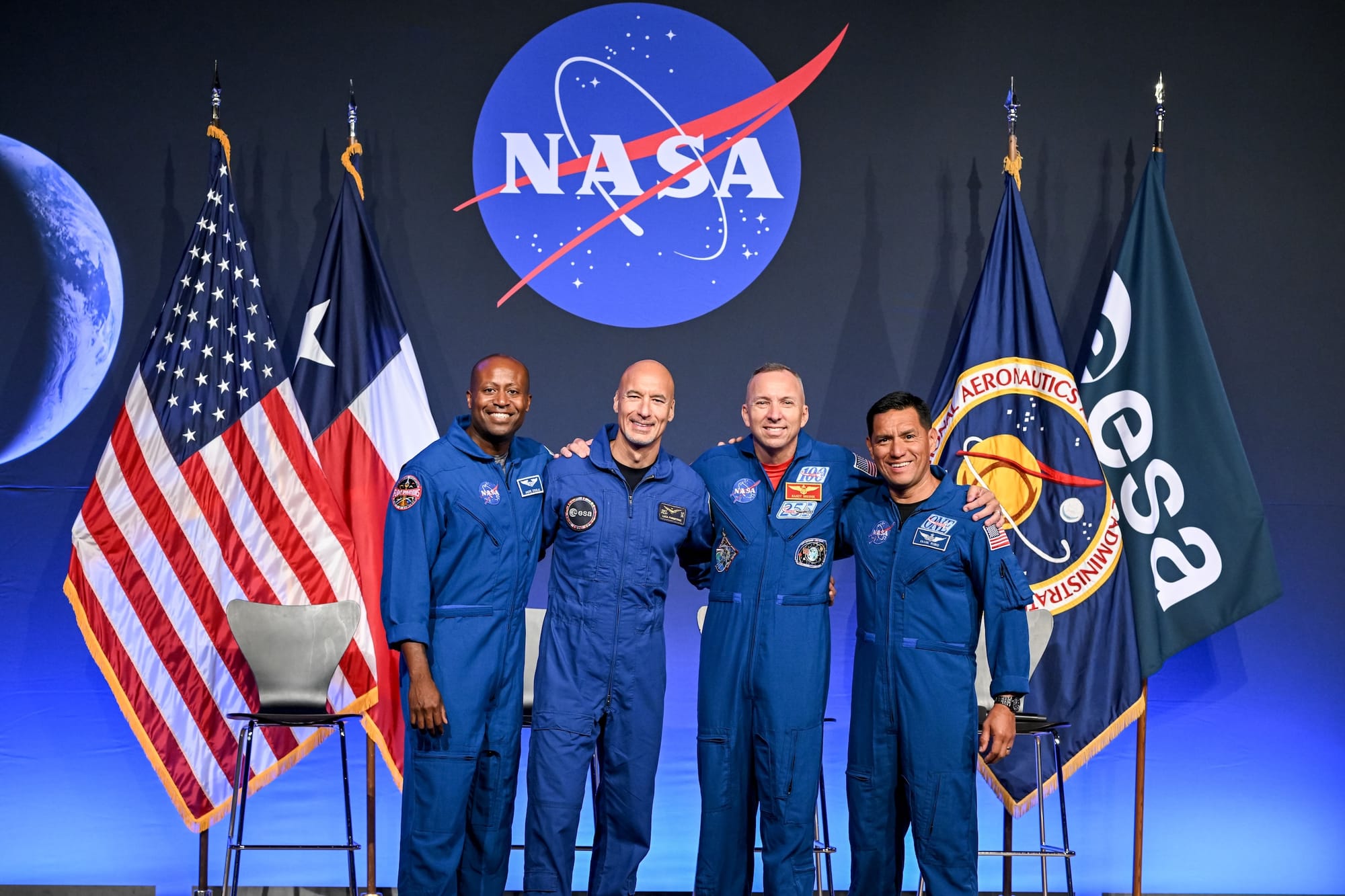
On June 9, NASA announced an all-male crew for the upcoming Artemis III mission, which aims to dock the crew’s Orion spacecraft with prototype lunar landers from Blue Origin and SpaceX in low Earth orbit to test several key systems and reduce risks ahead of a crewed Moon landing attempt with Artemis IV. The Artemis III crew comprises three NASA astronauts and one from ESA:
- Randy Bresnik, commander
- ESA astronaut Luca Parmitano, pilot
- Andre Douglas, mission specialist
- Frank Rubio, mission specialist
Notably for the mission, SpaceX’s Lunar Starship prototype will not fly with life support systems, and so unlike with Blue Origin’s Blue Moon lander prototype, the astronauts will not enter Starship from Orion after docking. The SLS rocket and Orion spacecraft are on track to be ready by mid-2027 for the mission. The SLS will not use nor need the upper stage, instead carrying just a structural “spacer” which replaces the upper stage and keeps exterior interfaces in tact. It’s expected to ready by the end of the year, and saves a functional upper stage for use on Artemis IV. On the Orion side of things, its European Service Module (ESM) passed launch acoustic testing in May.
However, neither of the landers will be ready until late 2027 at least due to SpaceX’s setbacks and Blue Origin’s explosive delay amid slower development than promised & touted. Eric Berger reports NASA’s Artemis program manager Jeremy Parsons saying that in Blue’s case, the lander prototype will not fly with cryogenic fuel. Parsons also noted that the lander may even launch on a ULA Vulcan rocket or SpaceX’s Falcon Heavy if Blue’s own New Glenn doesn’t come back online in the required timeframe following the company’s recent on-pad explosion.

All of these “changes”—or rather “requirement removals”—are being done to meet the 2027 deadline for Artemis III. But NASA originally stated Artemis III’s goal as reducing risks for systems that will land astronauts on the Moon with Artemis IV. Between no life support on Starship, lack of cryogenics on Blue Moon, and a non-New-Glenn launch of a crewed vehicle and its architecture meant for New Glenn, how much of Artemis III is really a “test like you fly” for Artemis IV?
Add to this the scathing March report by NASA’s Office of Inspector General (OIG), which formally functions as an agency watchdog, which pointed out various shortcomings and risks in the planned development of both the Artemis landers. Notably, both Blue and SpaceX are targeting lower fidelity uncrewed mission demonstrations prior to carrying crew. In Blue’s case, excluded are important milestones such as the Blue Moon ‘Mark 2’ lander not having to get back to lunar orbit after the surface mission. With SpaceX, excluded are things like hosting a complete life support system or the astronaut elevator. The OIG also noted that both of their missions would not simulate the full-scale profile of their respective crewed landing flights.
And so even with a successful Artemis III test mission in 2027 and the uncrewed lunar landing and takeoffs, whose timeline is still left unspecified by NASA, the flights may not cover a sufficient envelope of the landing mission with astronauts. The uncrewed flights don’t even have a formal name in the Artemis program! Let’s call them Artemis 3.5S and Artemis 3.5B respectively. We also still don’t have official public information on what Blue’s and SpaceX’s supposed accelerated lander proposals in response to NASA’s reopening of the astronaut landing contract look like. It’s necessary that NASA starts to attach and share firm timelines, milestones, and specifics being targeted by Blue and SpaceX going ahead, providing the missing public information transparency. Such basic mission information and promised progress on taxpayer funded programs is crucial to have from NASA at least.
Private sector freedom to government control?
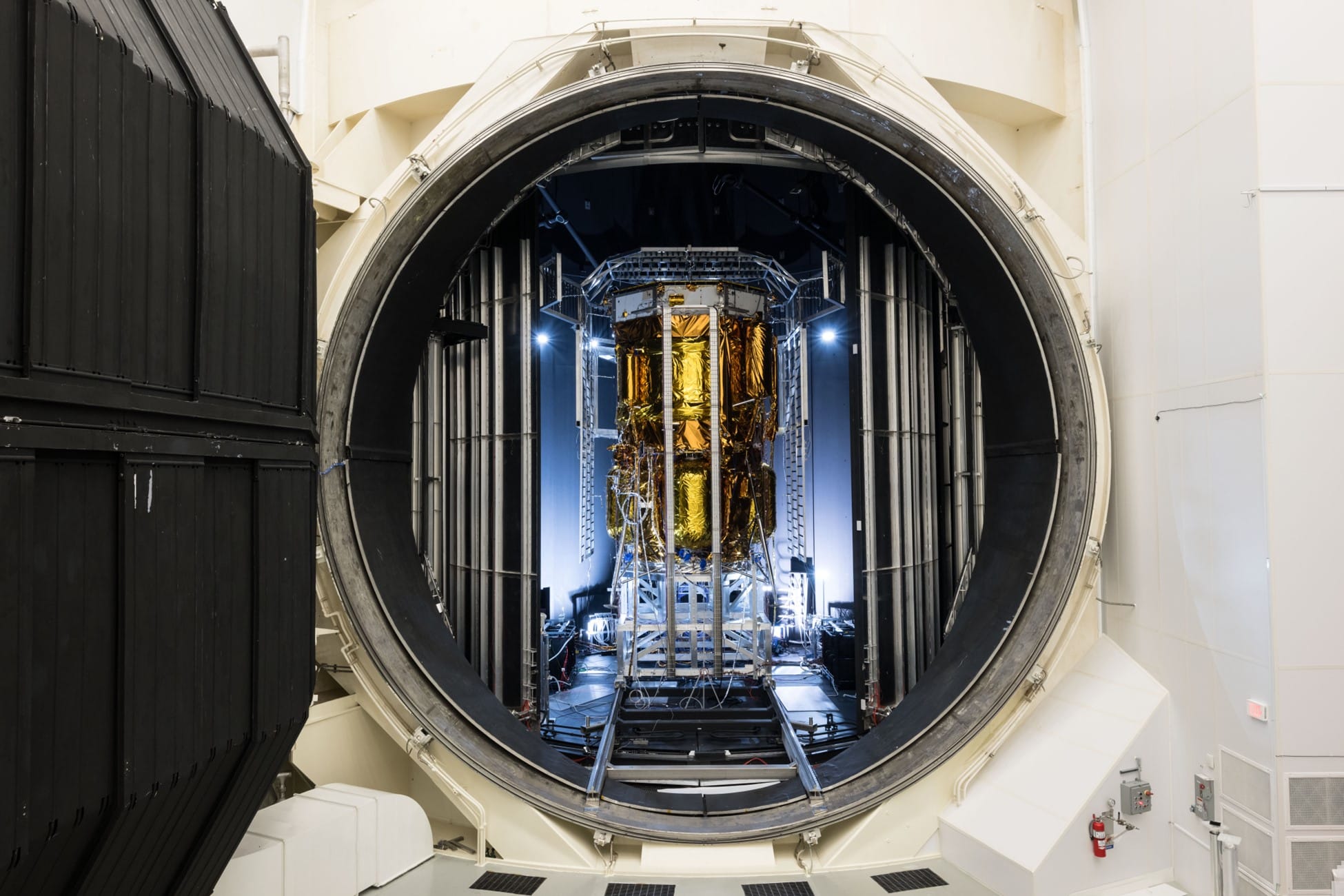
Spaceflight Now reports that given New Glenn’s explosive delay, NASA wants Blue Origin to launch its robotic ‘Mark 1’ Blue Moon lander on a rocket other than New Glenn. The lander was scheduled for launch later this year, which cannot happen with a New Glenn anymore. Compared to doing a launcher swap for Blue’s much larger, crew-capable Mark 2 lander, Mark 1’s proposition is more feasible and will avoid furthering the excruciating delays that have led to the US failing to explore lunar water as the principal goal of Artemis. The potential vehicles could be SpaceX’s Falcon Heavy rocket or a ULA Vulcan. The latter, however, is also grounded at the moment like New Glenn, leaving SpaceX as the only option. That seems like an uncomfortable situation for Blue given the sour Bezos-Musk relationship. However, even if Bezos agrees to such a launch by acknowledging national priorities over personal priorities, there are still technical challenges like fairing adjustments and having to redo rocket launch vibration and acoustic tests that could take several months at best.
Note that the Mark 1 is Blue’s own private mission. It has a payload capacity of 3000 kilograms of which NASA is utilizing less than 3% for a likewise small payment of $6.1 million. That NASA, with its new administrator revising the missions and Moonbase plans as well as re-re-orienting the agency’s structure, can influence Blue to change launch vehicles for the sake of the greater Artemis program is good for national goals but quite the blow for the freedom of the private sector touted to be central to creating a new era of “commercial” lunar exploration.
More Moon
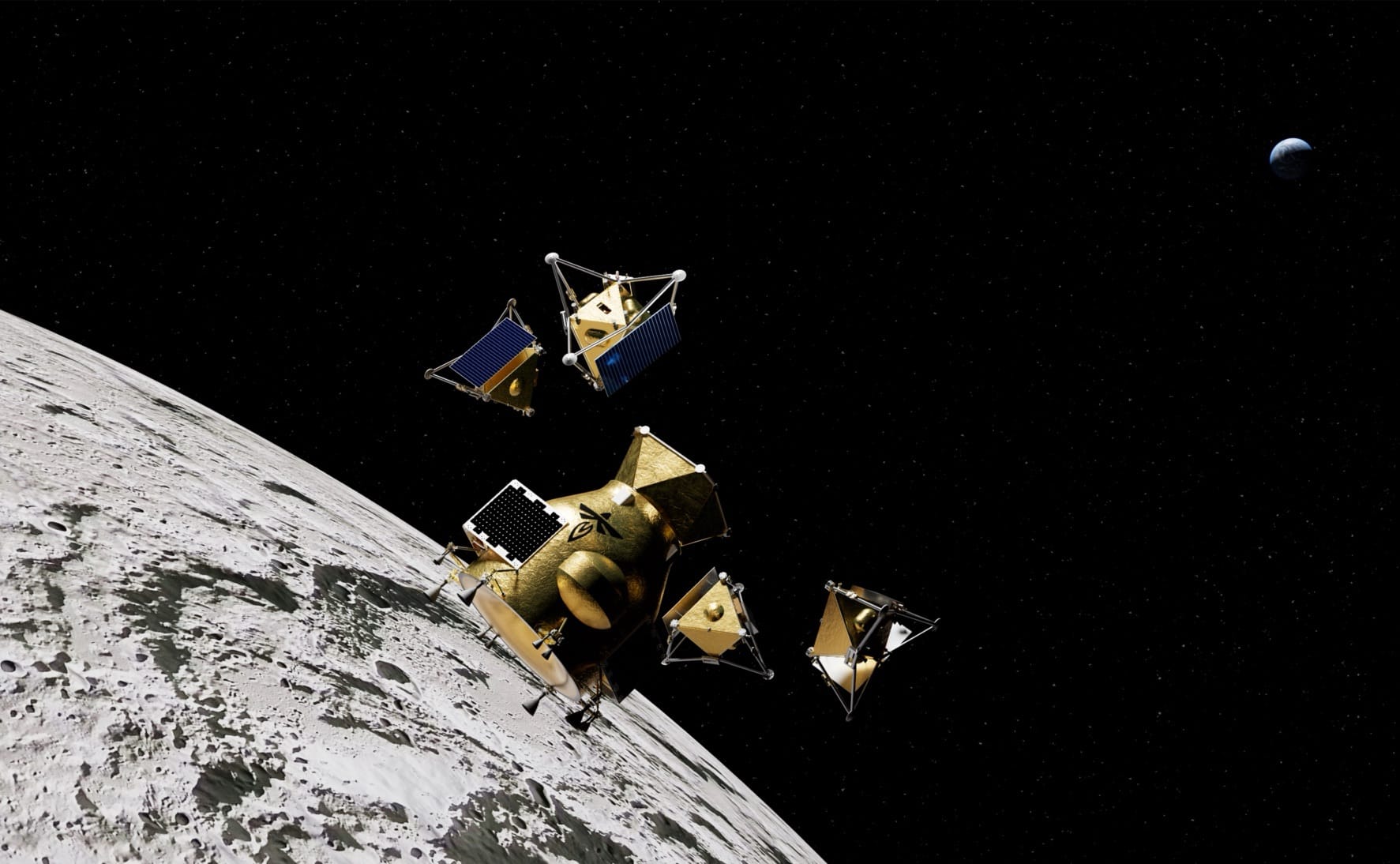
- NASA JPL is awarding a $75 million contract to Firefly to have its Elytra Dark spacecraft deliver 3-4 “Moonfall” hopper drones to ~50-kilometer lunar orbit in 2028. From this point on, each drone will land on the Moon by itself. At 225 kilograms each, these drones are really mini-landers. Each will carry a few instruments to study the lunar surface during hops. NASA aims to acquire lunar surface imagery with centimeter-level resolution ahead of crewed Artemis missions and to also use the drones to establish a Moonbase “perimeter”.
- Astrobotic’s large Griffin lander aims to land on the Moon’s south pole as part of NASA CLPS program later this year. It will deploy the FLIP rover by Astrolab (a Moon Monday sponsor), who onboarded last year after NASA decided not to fly the critical VIPER rover for studying water ice aboard Griffin. FLIP is yet to be integrated with Griffin. Astrobotic has so far shared that it has integrated two of the other lander payloads: NASA’s Navigation Doppler LiDAR (NDL) which will also aid Griffin’s navigation, and the company’s own CubeRover. Amid the company’s desire to position Griffin’s hoped-for success to bag more Artemis Moonbase contracts from NASA, Astrobotic has been acquired by Voyager Technologies, who wishes to accelerate said proposition.
Many thanks to Open Lunar Foundation and Nitish for sponsoring Moon Monday. If you too appreciate my efforts to bring you this curated community resource on global lunar exploration for free, and without ads, kindly support my independent writing, which is purely reader-funded. I don’t use AI to write a single word and cite everything.