Moon Monday #219: Results from India’s Chandrayaan 3 experiment benefit future missions eyeing lunar water
👀 🧊 🌘
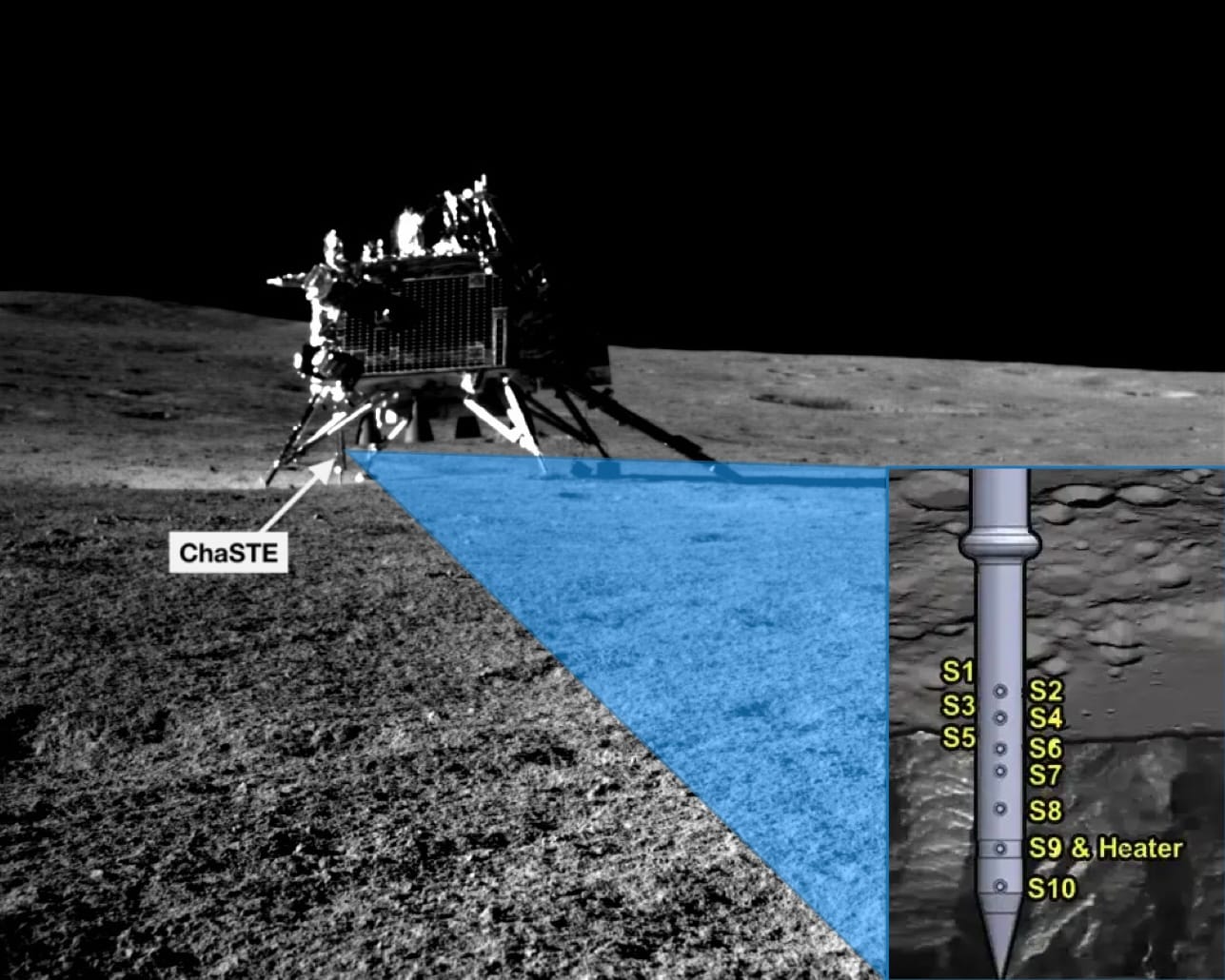
The Chandrayaan 3 Moon lander carried a payload called Chandra’s Surface Thermo-Physical Experiment (ChaSTE), developed jointly by two ISRO-affiliated institutions SPL and PRL. Shortly after landing, Chandrayaan 3 deployed and inserted the ChaSTE thermal probe almost 10 centimeters into the lunar soil. The probe touted 10 temperature sensors across its length, and took pristine measurements for each sensor-point from lunar morning to twilight. A study published in Nature in 2025 showed how the measurements helped scientists learn exactly how the Sun’s heat propagates downward from the Moon’s surface, which has key implications for the world’s planning of future polar missions scouting for water ice.
ChaSTE’s measurements from Chandrayaan 3’s near-polar landing site of 69°S are unique because earlier heat flow experiments on Apollo missions and most recently on Firefly’s Blue Ghost lander were in near-equatorial locations, thus tailoring to different objectives not related to understanding water ice deposits on the Moon’s poles. “ChaSTE is the first ever in-situ thermal profiling of the Moon’s near subsurface,” said planetary scientist and one of the experiment leads K. Durga Prasad for an article I wrote for Scientific American. ChaSTE sensors noticed a large temperature difference of 50–80°C between the two ends of the probe, showing that the Moon’s near-polar soil-surface is a poor conductor of heat.
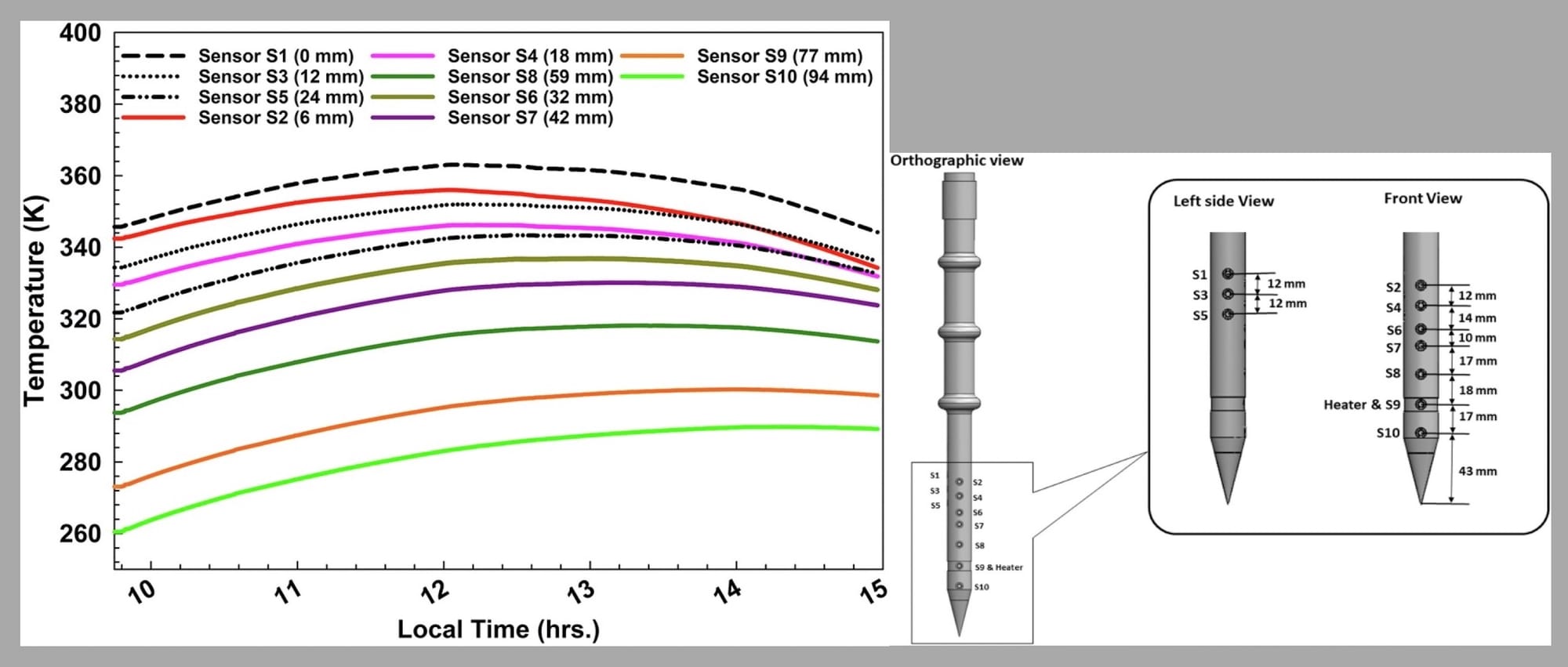
The thermal probe’s tip also carried a heater just above it. It warmed up the subsurface soil, measurements of which let scientists determine its thermal conductivity, and from that infer its density and physical properties. Future missions operating at or near the Moon’s poles need to account for these characteristics. Even though the ChaSTE experiment did not directly study water ice, its results have further relevant implications for future missions looking for said watery deposits. The aforementioned ChaSTE study combined multiple measurements and extensive modeling of Chandrayaan 3’s landed geometry, local topography, and actual observational conditions to derive high-resolution surface and subsurface temperatures across the landed region. This result was more accurate than temperatures inferred coarsely from orbit using the Diviner radiometer on NASA’s Lunar Reconnaissance Orbiter. It allowed for a conclusion in the paper which proved relevant to future water-ice hunting missions on or near the Moon’s poles:
ChaSTE observations have shown that at high-latitudes, sunward slopes are considerably warmer and poleward slopes just about a meter apart could be much cooler, providing an environment conducive for the presence of water-ice within the shallow sub-surface.
[...]
A relationship between the local slope and expected surface peak temperature has been derived. The interesting outcome is that the high latitude sites with local slope greater than 14° in poleward direction might offer similar environment as polar sites for accumulating water ice at shallow depths.
The ChaSTE experiment thus suggested that the local terrain and slopes play an outsized role in the ability of near-polar and polar areas to feed and accumulate water ice deposits into their subsurfaces. “Temperatures dictate the presence, stability, and mobility of water on the Moon,” said Durga. The paper elaborates:
Modeling studies showed that surface temperatures ranging from 110 K to 114 K [-163°C to -159°C] are suitable conditions for cold-trapping of water ice, particularly at polar regions. It is also suggested that water-ice can migrate to the subsurface due to strong thermal pumping, if the diurnal [daily] maximum temperature (Tmax) is above 120 K [-153°C] and the mean temperature (Tmin + (Tmax-Tmin/π)) is below 105 K. [-168°C] Also, the presence of a dry regolith layer can reduce sublimation rates, potentially burying water ice deposits (due to any transport mechanisms) under a few centimeters thick layer. Such buried water-ice can remain stay put as long as the temperatures are maintained below cold-trapping limits, especially during lunar nights.
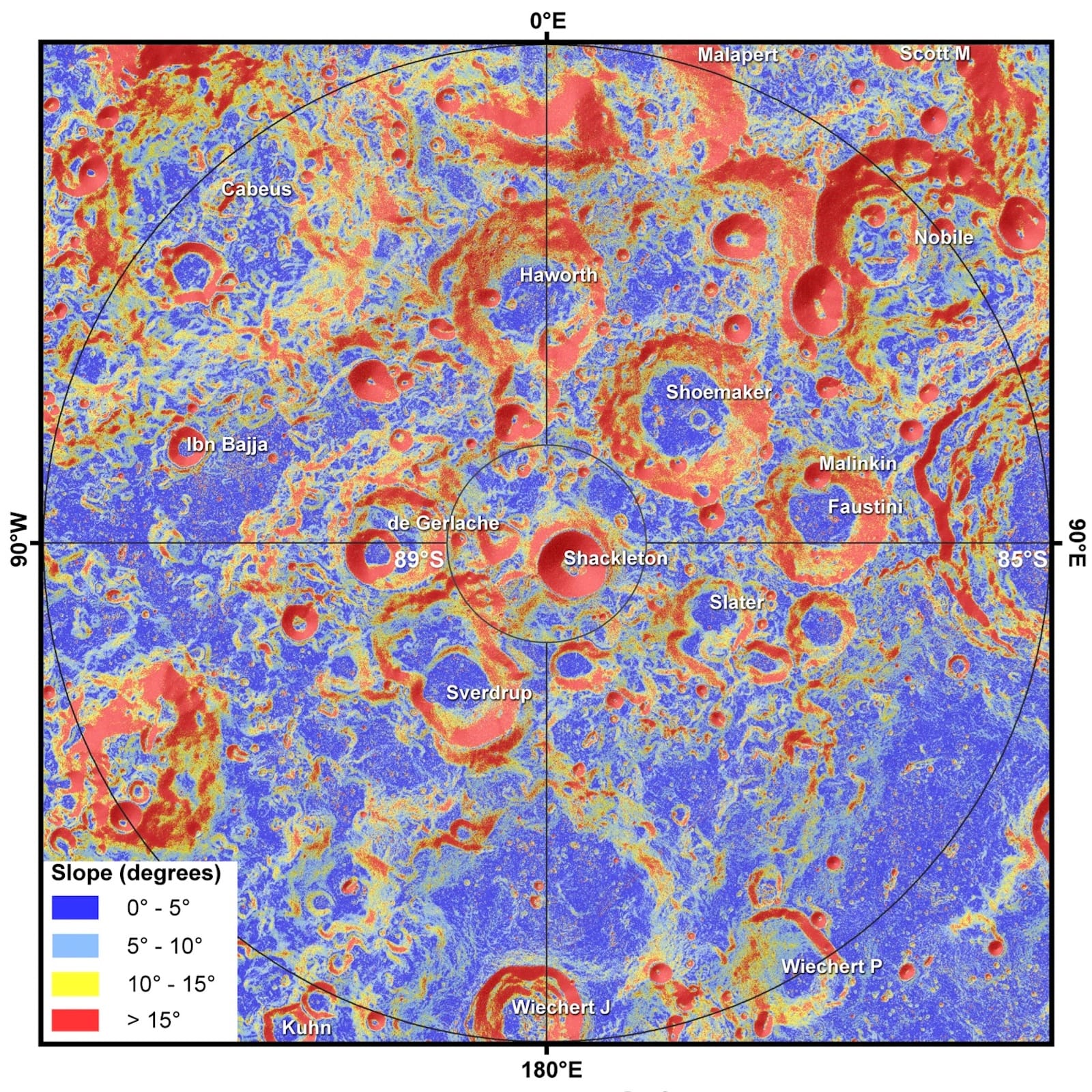
Considering that local surface temperatures at the Chandrayaan 3 landing site hovered around -168°C by nighttime, it’s possible that several sizable poleward slopes in the region are host to subsurface water ice. The findings thus lent mission planners more & broader areas to prospect for water ice instead of being limited to the treacherously rocky regions at 86-90°S. From the paper again:
High-latitude regions with larger poleward slopes can also be potential sites for water-ice prospecting for future exploration and in-situ resource utilization. Such sites would be technically less challenging for exploration in comparison to extreme polar sites, but scientifically equally interesting for enhancing our understanding about the water ice quantification, distribution and migration.
Now, exploring high-latitude lunar regions between 70–85°S is still more challenging in itself compared to the relatively benign near-equatorial and mid-latitude regions, especially in terms of temperature ranges, line of sights to the Sun and Earth, terrain, and slopes. But the high lunar latitudes are still not as extreme as 86–90°S. The Moon’s peak polar areas demand 100-meter precision landings and mission profiles optimized for local summer windows in order to survive and conduct long duration missions. As such, ChaSTE’s findings suggest that future missions with relatively lower budgets and moderate risk appetites could still explore water ice in less extreme near-polar areas, or even peak polar sites for a shorter duration.
Update from 2026: Towards the end of Chandrayaan 3’s surface mission, ISRO pulled a trick up its sleeve and made the lander hop about ~50 centimeters away; after ensuring that the deployed payloads and rover ramp were all stowed. During the hop, the briefly lit but powerful engine plumes blew away the fluffy top layer of lunar soil beneath. Chandrayaan 3 then deployed its instruments again, providing ChaSTE a chance to study the older, more pristine lower surface strata. Scientists published findings that this block was about twice as dense and about five times more cohesive than the topmost strata encountered pre-hop. ISRO described the result as the difference between an astronaut walking on dry flour versus damp, stiff clay. ChaSTE showed that even within seven centimeters of depth, the thermophysical nature of the Moon’s surface changes considerably. These cake-like layers need to be accounted for in the planning of long duration crewed and robotic missions.
Update from 2026: The post-hop ChaSTE measurements also coincided with the time of lunar twilight, which takes many hours on the Moon compared to minutes on Earth. During this time, the probe measured sharp drops in temperatures due to increasing local shadows. This told engineers that the local terrain and object shadows affect the ambiance for hardware operations more than the broader region’s environment does. And it told scientists that both local shadows and the distinct nature of inner lunar surface layers contribute to water’s presence, movement, and storage on the Moon. ChaSTE’s unique set of findings are thus relevant for water scouting, drilling, and even oxygen extraction activities planned by future near-polar and polar missions. The probe’s data is publicly available on ISRO’s ISSDC portal for planetary missions.
India’s next Moon mission Chandrayaan 4 aims to bring polar lunar samples. And the follow-on joint Indo-Japanese Chandrayaan 5/LUPEX rover mission aims to complement it by directly studying the nature, accessibility, and abundance of polar water ice on-site. ChaSTE’s work and science results from Chandrayaan 3 at large feed into both missions as India prepares to take another giant leap for its Chandrayaan program.
Many thanks to The Orbital Index, Astrolab and Open Lunar Foundation for sponsoring this week’s Moon Monday! If you too appreciate my efforts to bring you this curated community resource for free and without ads, support my independent writing. 🌙
More mission updates
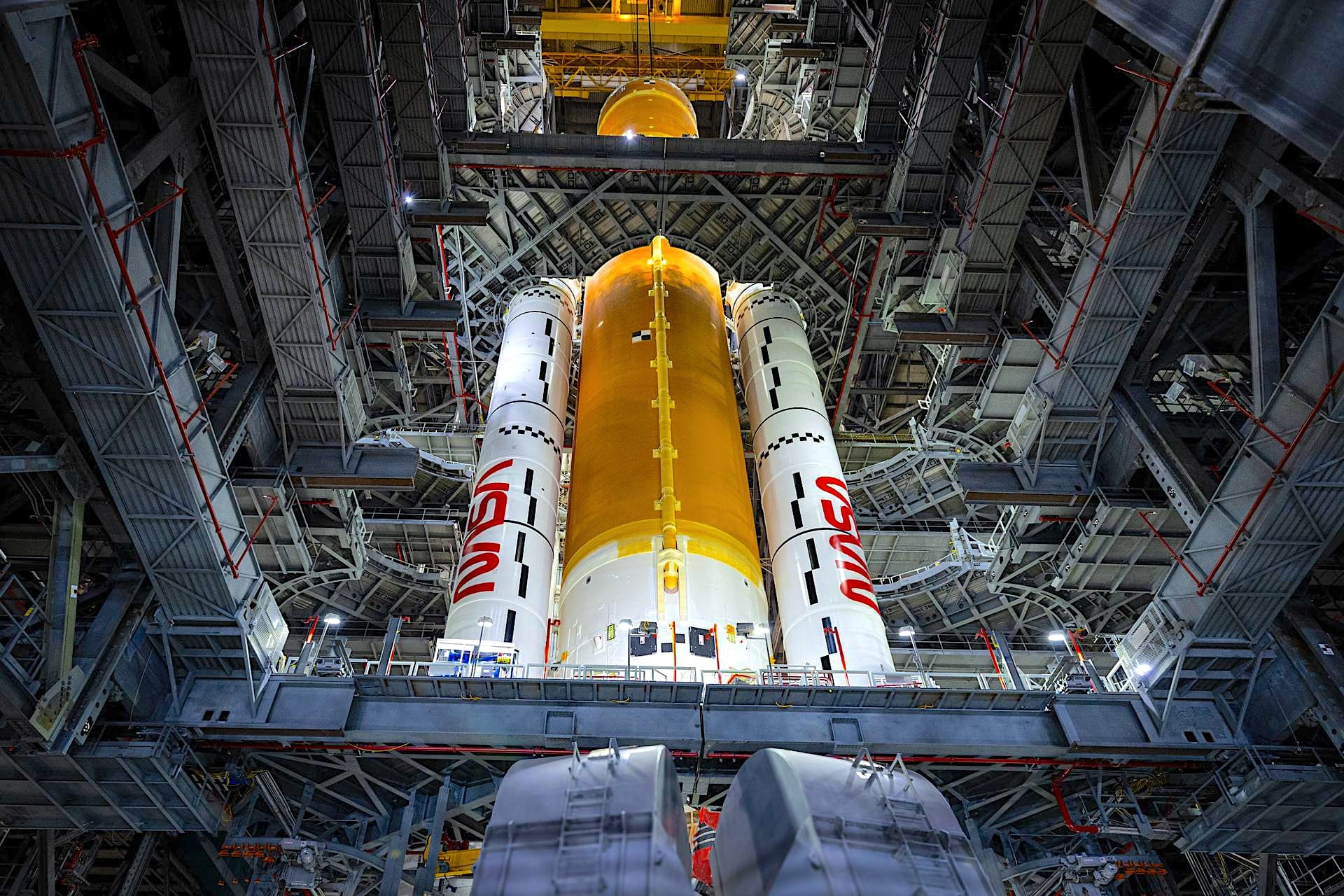
- On March 23, technicians at NASA joined the twin solid rocket boosters to either side of the SLS rocket’s core stage in preparation towards launching the crewed Artemis II Moon mission next year. On March 9, ULA delivered to NASA the upper stage of SLS, which technicians will fuel and later stack it atop the core stage via an adapter.
- Jeff Foust reports that lunar lander builder Intuitive Machines aims to diversify its offerings with orbital lunar communications and deployment services. This comes after the company faced another unsuccessful mission with IM-2 as part of NASA CLPS.
- To continue the development of its next two Moon missions, ispace Japan has secured a $10 million loan from Sumitomo Mitsui Trust Bank. This enables funding for the company’s US subsidiary’s first NASA CLPS mission through Draper—which interestingly highlights an intersection of CLPS, funding, and science.
More Moon
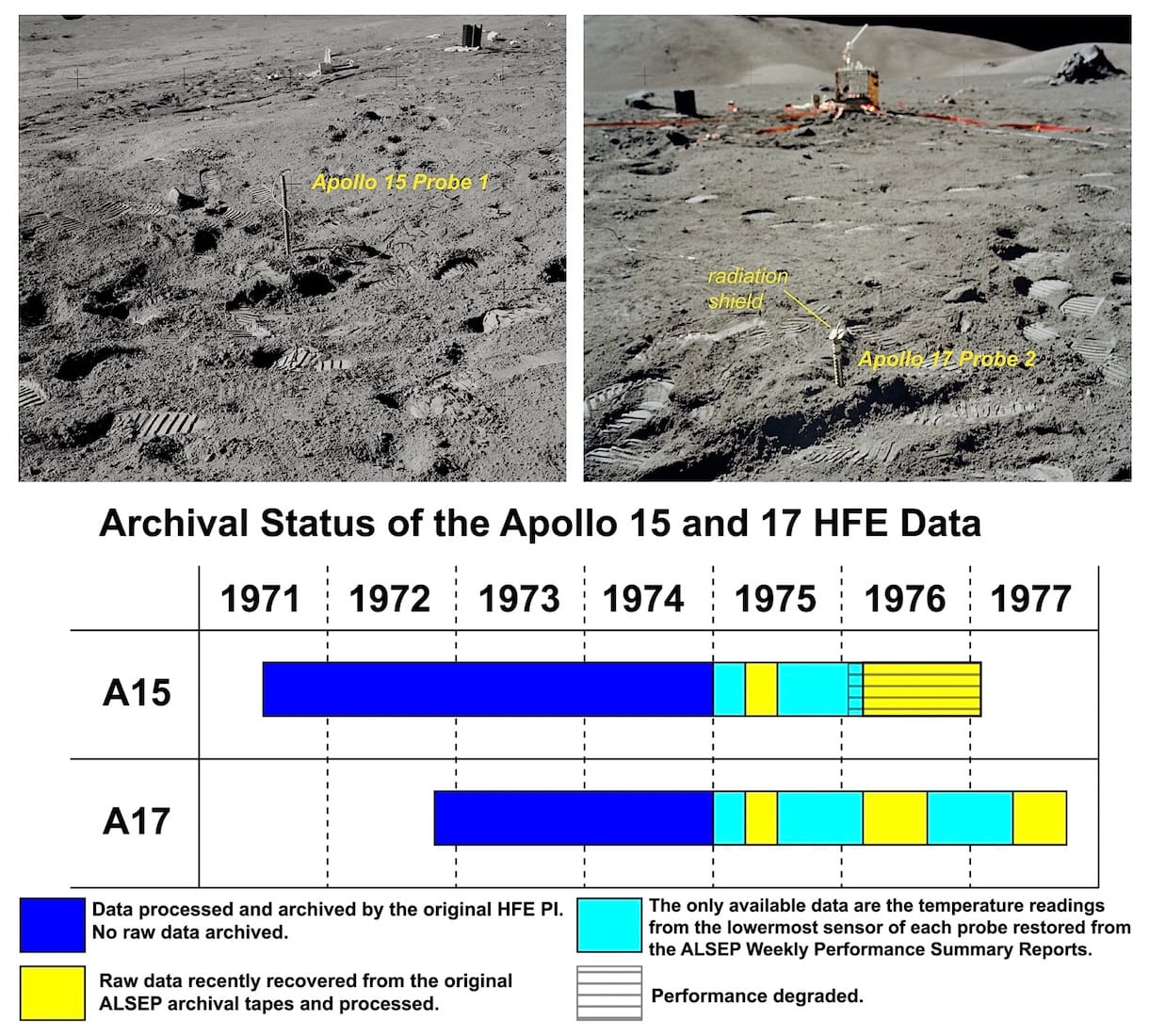
- A new study which recovered and restored previously unarchived data from the heat flow experiments on Apollo 15 and 17 found that the subsurface warming recorded during 1974–1977 was ultimately a result of prior astronaut surface activities slightly darkening the soil, which increased their absorption of the Sun’s heat.
- As background work to realize advanced technologies in the 2030s or 2040s, China has been working on aspects of versatile mining robots and giant lunar farside telescopes while Japan is eyeing self-adapting multi-robot explorers.