India and the dream of an orbital launch trifecta | Part 5 of ISRO’s rocket crisis
Indian Space Progress #39-40: How a multitude of causes slow down the pace of India’s launch vehicles, and what would it take for the country to achieve an optimum “hat-trick” state given its many needs and ambitions in space.

This article is Part 5 of my series on India’s launch vehicle crisis. A space program can only move as swiftly and flexibly as its orbital rockets, and India has been amid a grinding halt. As such, I’ve been focusing my Indian Space Progress blog & newsletter on fully exploring this situation before resuming coverage of national space activities at large.
- Part 1 of the article series reviewed the state of India’s orbital launch vehicles, revealing a bleak picture of ambitious goals sliding to the right, in stark contrast to the incessant chest thumping about efficiency.
- Part 2 analyzed the intricacies of ISRO’s launchpad infrastructure, showing how every PSLV rocket failure cascades effects to all Indian rockets in direct or indirect ways.
- Part 3 assessed and concluded that India’s rockets will not be able to meet its civil space and strategic launch manifest by 2030 even at peak performance.
- Part 4 shows how Chandrayaan 4 is deeply tied to India’s launch vehicle and human spaceflight programs, and how the specific rocket it needs is also the catalyst required to better manage India’s launch crisis.
- Part 5, this article, lays down a multitude of causes slowing down India’s launch vehicles, and what would it take for the country to achieve an optimum “hat-trick” state given its many needs and ambitions in space.
- Update: Part 6 explains how even if we see an optimistic progression of flights from Skyroot, banking on the success of its first flight, India’s growing gaps in orbital launch capacity and manifest will remain unresolved anyway.
Many thanks to The Takshashila Institution, PierSight, Catalyx Space and Gurbir Singh for sponsoring Indian Space Progress. If you too appreciate my efforts to capture nuanced trajectories of India in space, provided to space communities worldwide for free and without ads, kindly support my independent writing, which is purely reader-funded. I don’t use AI to write a single word and cite everything.
At ~4,000 words, this is a long one so make sure you have your beverage of choice in hand before starting.
India’s launch manifest 2031-2040
In Part 3, we established that India’s rockets will not meet the country’s launch manifest by 2030 even at peak performance. Now let’s see if the situation resolves itself for the manifest of 2031-2040 by which time the heavy-lift, reusable NGLV rocket is expected to come online alongside capacity or frequency upgrades for existing rockets. Below is the expected manifest based on known plans.
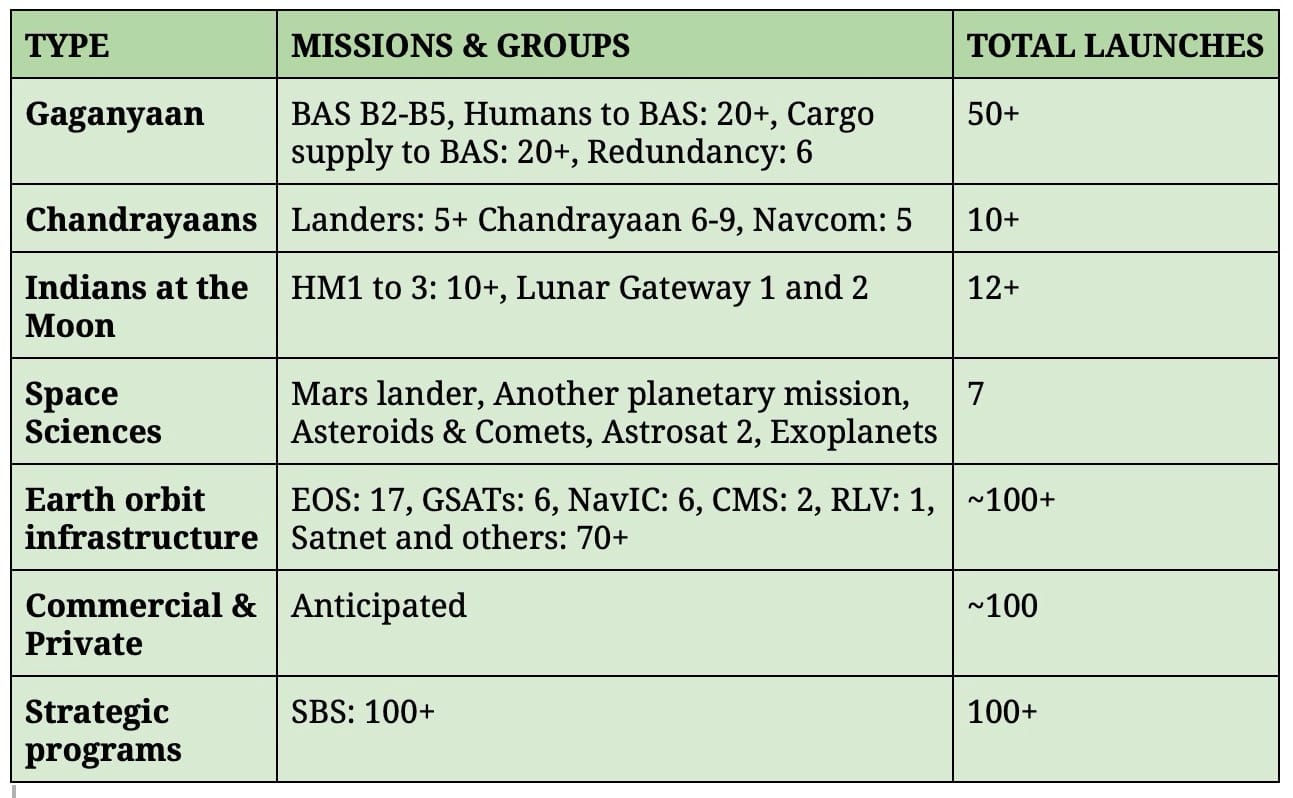
India thus needs 380+ launches between 2031-2040 to achieve all national goals across the spectrum of space missions. That’s 38+ launches/year from 2031. This is a conservative number since we’re assuming no launch backlogs from the last decade even though we’ve established it won’t be true. The number also doesn’t include a massive, global satellite internet constellation should India decide to have one too. That would only increase the frequency. Ultimately, the minimum manifest means India needs to increase its launch rate by at least eight-fold, and that’s excluding small-lift rockets which would skew numbers against meaningful mass lofted to orbit.
Now let’s look at our maximum practical launch capacity by 2035, if we meet all our rocket upgrade plans and also optimize their launchpad usage.
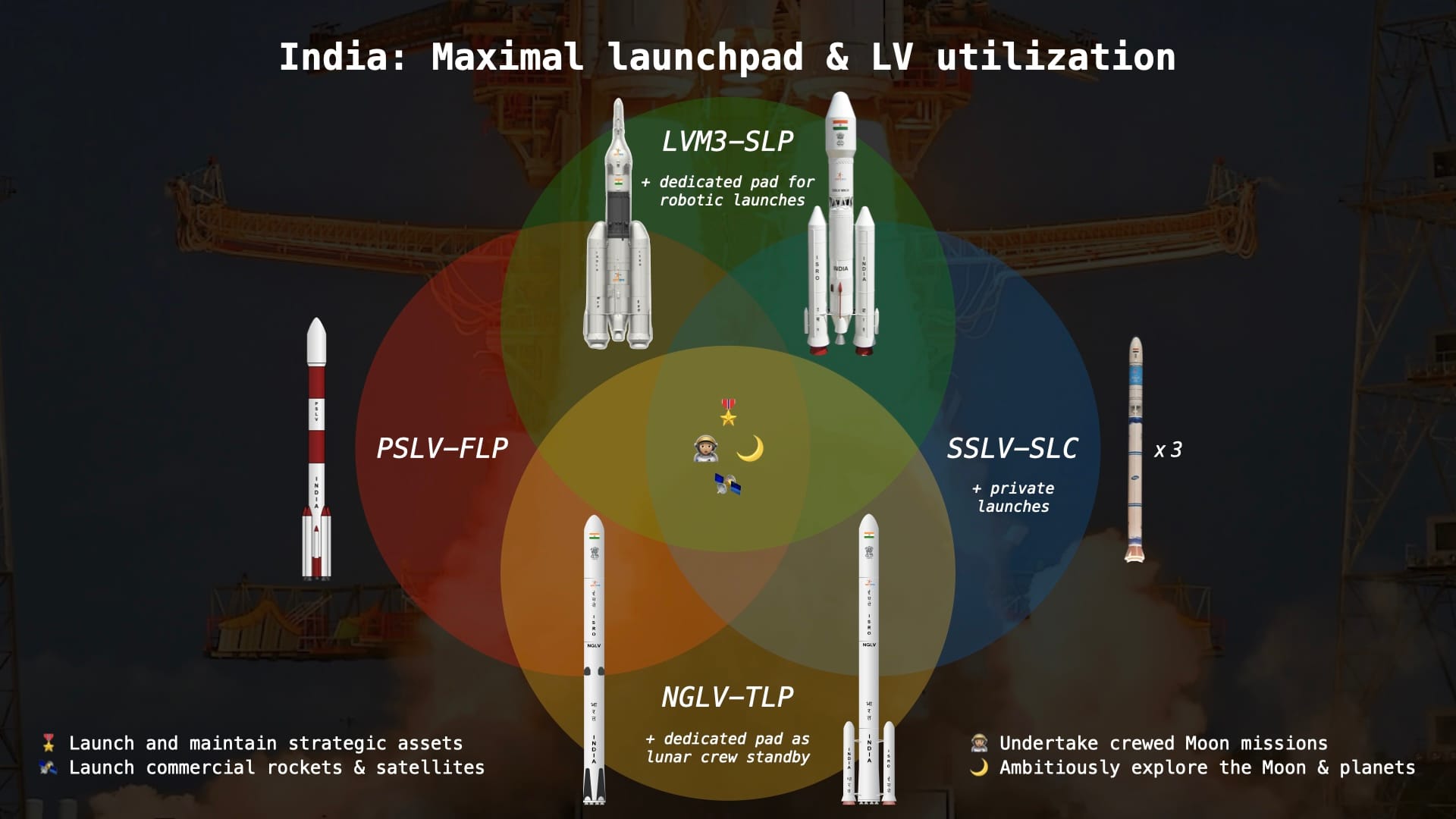
- PSLV = 12, when maximizing usage of the First Launch Pad (FLP) at Sriharikota
- LVM3 = 6, when maximizing usage of the Second Launch Pad (SLP) at Sriharikota
- NGLV = 2, when using its only compatible pad, the upcoming Third Launch Pad (TLP)
- SSLV & Private launchers = 25, when utilizing their upcoming dedicated launch complex in Kulasekarapattinam
While this may provide a peak theoretical launch capacity of 45/year, the one in practice will be closer to 20–25 launches/year, necessarily excluding most small-lift launches since the manifest leans squarely on the heavy-lift side in terms of mass of spacecraft. Importantly, this shows that India will reach the launch throughput it needs right now only in the second half of the next decade at best. ISRO’s currently demand-based philosophy for making launch vehicles needs to change to a supply-based one. Because of the critical nature of launch vehicles to a space program, a minimum viable throughput level is needed regardless of external satellite availability to meet our own demands first.
Now let’s look at a multitude of causes slowing down India’s launch vehicles.
ISRO’s budget, an overarching constraint
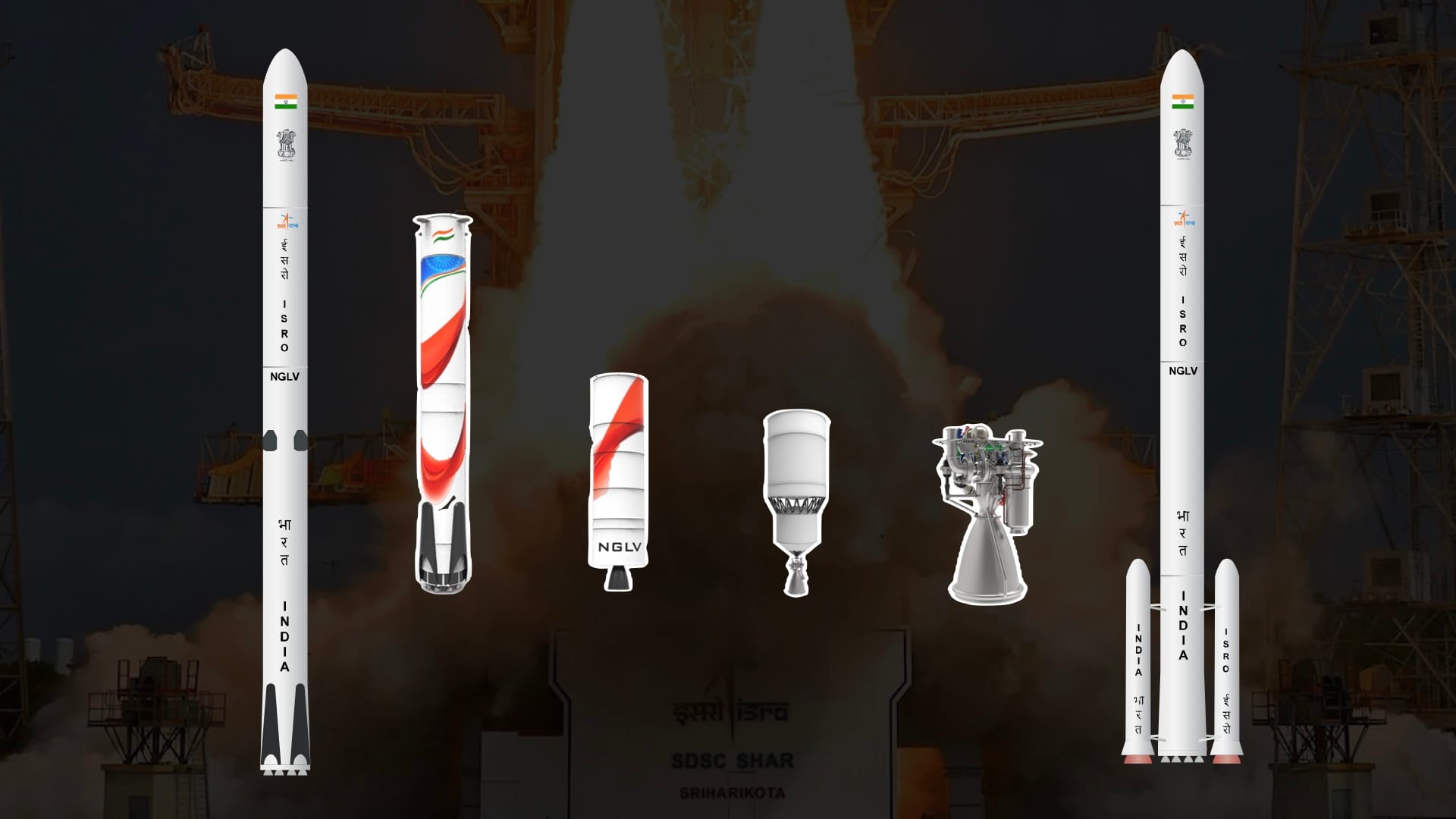
The FY2026 budget of India’s Department of Space, of which ISRO is a part, is ~$1.5 billion, roughly the same amount as approved by the Indian government for the last five years. China and the US allocate at least 10 to 20 times greater budgets respectively for their space activities. India’s small space budget forces it to adopt a linear execution model while the country’s space ambitions and payload manifest grow out of reach. The trouble is development of new rockets meant to reduce chokepoints themselves are built through the same model of linear execution. For example, ISRO is targeting only the first half of the next decade to realize the heavy-lift, reusable NGLV rocket and make it operational whereas we need that capability this decade itself. Even though the $982 million requested by ISRO to develop the NGLV is approved by the government, the money is being distributed across many years, stretching the realization timeline beyond the fastest viable technical path. In other words, ISRO’s engineering talent is not being utilized efficiently due to fundamental budget constraints that have no viable technological design alternatives.
Budgets assigned, however, are only part of the story. Notably, ISRO also consistently underutilizes its allocated funds every year. To illustrate, in FY2023 ISRO underutilized its space technology budget by about $150 million. That’s about 10% of the overall budget, a sizable amount that shouldn’t be lost. Curiously, the issue is present in India’s Ministry of Science & Technology as a whole. While increasing India’s space budget substantially is absolutely necessary, it’s also important to be efficient with the funds that are already being allocated.
The following chart illustrates notable delays in several key Indian space projects that could’ve been either avoided or significantly shortened with enhanced budgets coupled with increased efficiencies.
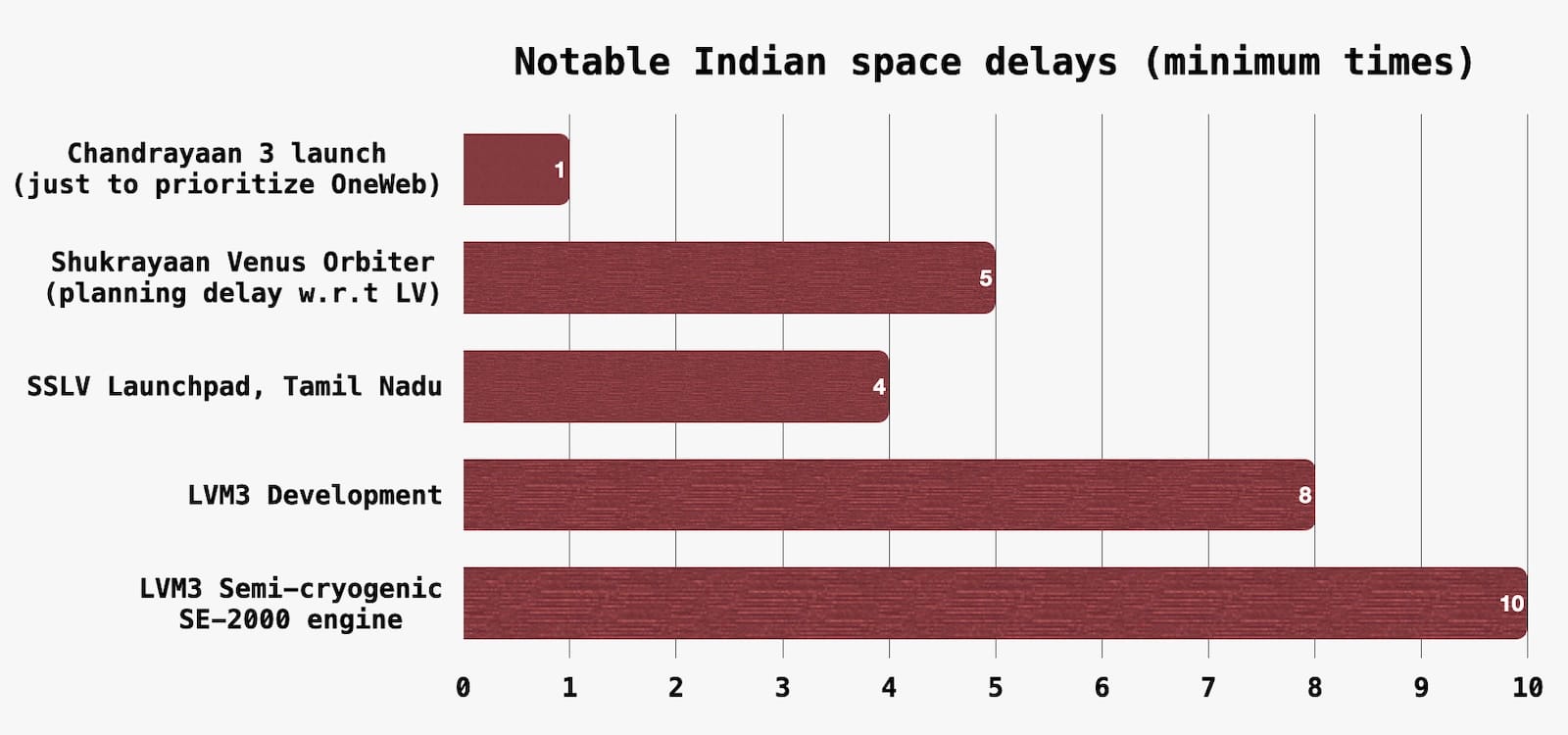
- The low production rate of LVM3 has previously already delayed the launch of Chandrayaan 3 in order to prioritize commercial OneWeb launches.
- The low rate also postponed India’s upcoming, scientifically important Venus orbiter mission by five years.
- The operationalization of the dedicated launchpad for the SSLV, and other such small launch vehicles, has been delayed from 2025 to at least 2028.
- The LVM3’s first full vehicle flight was planned for 2009 but took place in 2017.
- LVM3’s semi-cryogenic core stage engine upgrade is already delayed by a minimum of 10 years.
Furthermore, following orbital launch failures, India’s return-to-flight times for its rockets are slower than the global rate, even if we don’t normalize for factors like heavier lift capacities or first flights of foreign rockets. The chart below illustrates the gap India needs to close.
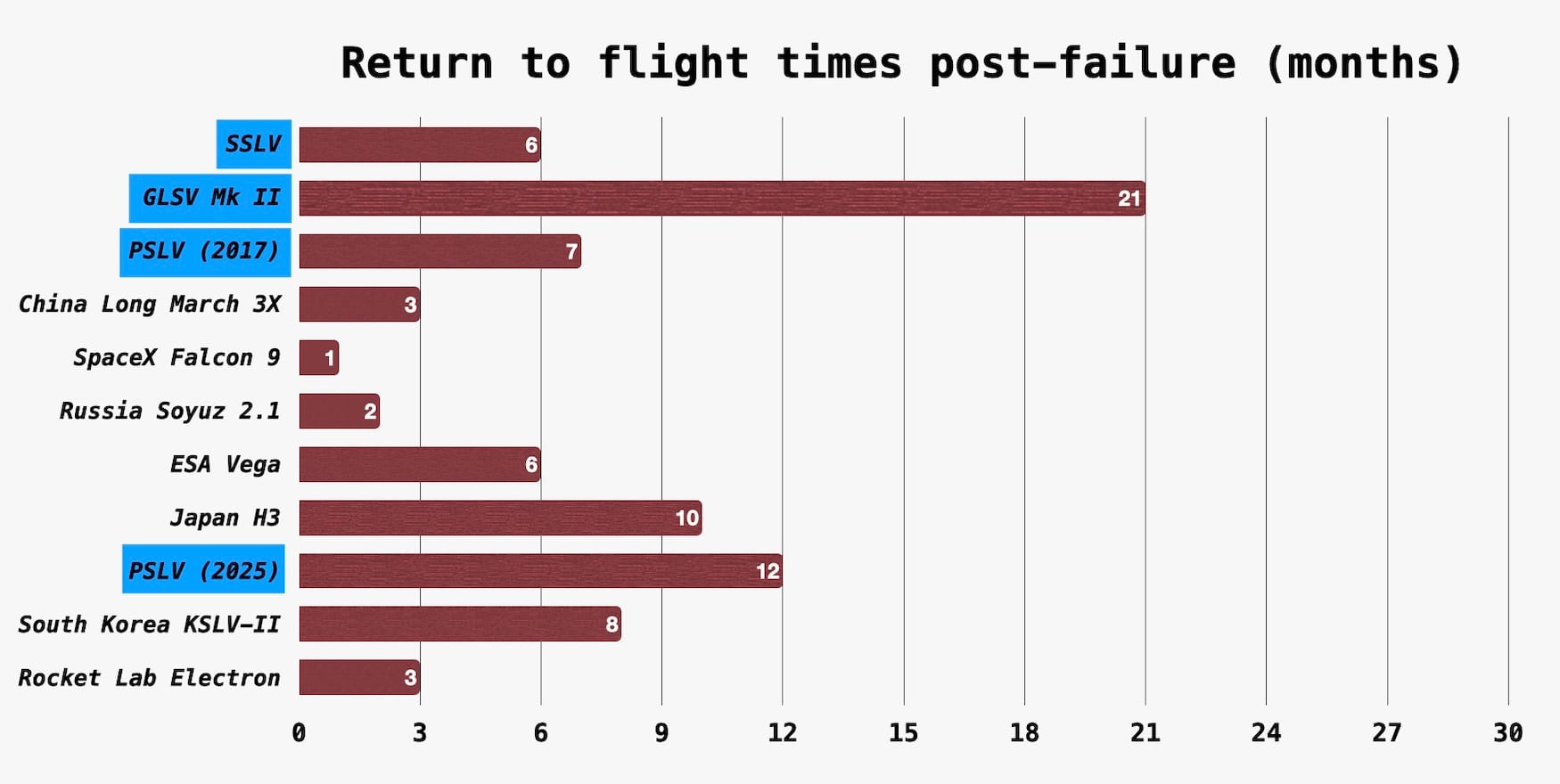
Moreover, the failure of India’s one rocket stalls or can stall launches of its other vehicles too, like the case of the recent PSLV failures because several of its modules and component designs are utilized by other ISRO rockets too.
The private sector is building in a vacuum
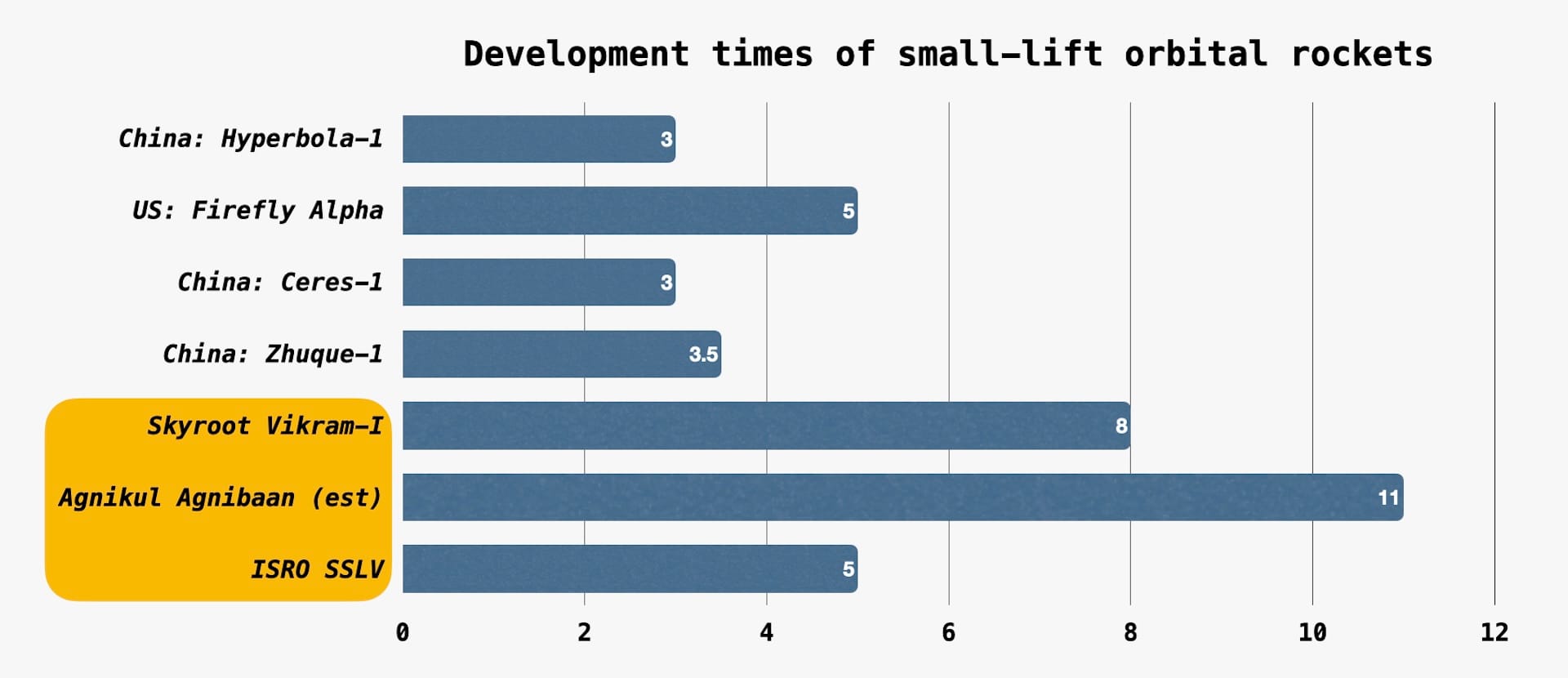
India’s orbital rocket companies like Skyroot and Agnikul have been building vehicles in a vacuum, with only minimal support from the government. The latter is majorly present only in two ways: the government’s enabling of launch companies to seek Foreign Direct Investments up to 49%, and ISRO providing launch reviews and other such technical help, though on an ad-hoc basis. Between low demand gaps for small-lift launch vehicles globally, and companies having to fight an uphill battle for customers without the government being an anchor node, India’s private rocket development timelines have been much longer than global competitors as the following chart shows.
Similar to how NASA fetches foreign commercial payload customers for its lunar CLPS companies, ISRO’s sister institutions NSIL and IN-SPACe meant to aid commercialization should fetch customers for India’s private launch companies other than only doing so for ISRO. Obviously, this is to be done only on a competitive basis rather than through nepotism.
Broadly in India, there’s also a lack of a thriving space research & development base across the industry and academia for the private sector or even ISRO to leverage talent from. For example, NASA funds and orchestrates the SBIR/STTR and GCD programs to provide a boost to the US commercial industry while tapping into emerging, advanced technologies early on. ISRO’s RESPOND program for academia offers orders of magnitude lower funding and lack of mission integration.
Achieving an orbital launch trifecta
As elaborated in Part 1, to fulfill India’s needs and ambitions in space, we need to achieve three conditions of launch capabilities simultaneously, an orbital launch trifecta achieved by the US and China:
- Have substantially greater lift mass
- Tout a high launch cadence at every launchpad
- Have dissimilar design redundancy in launch vehicles
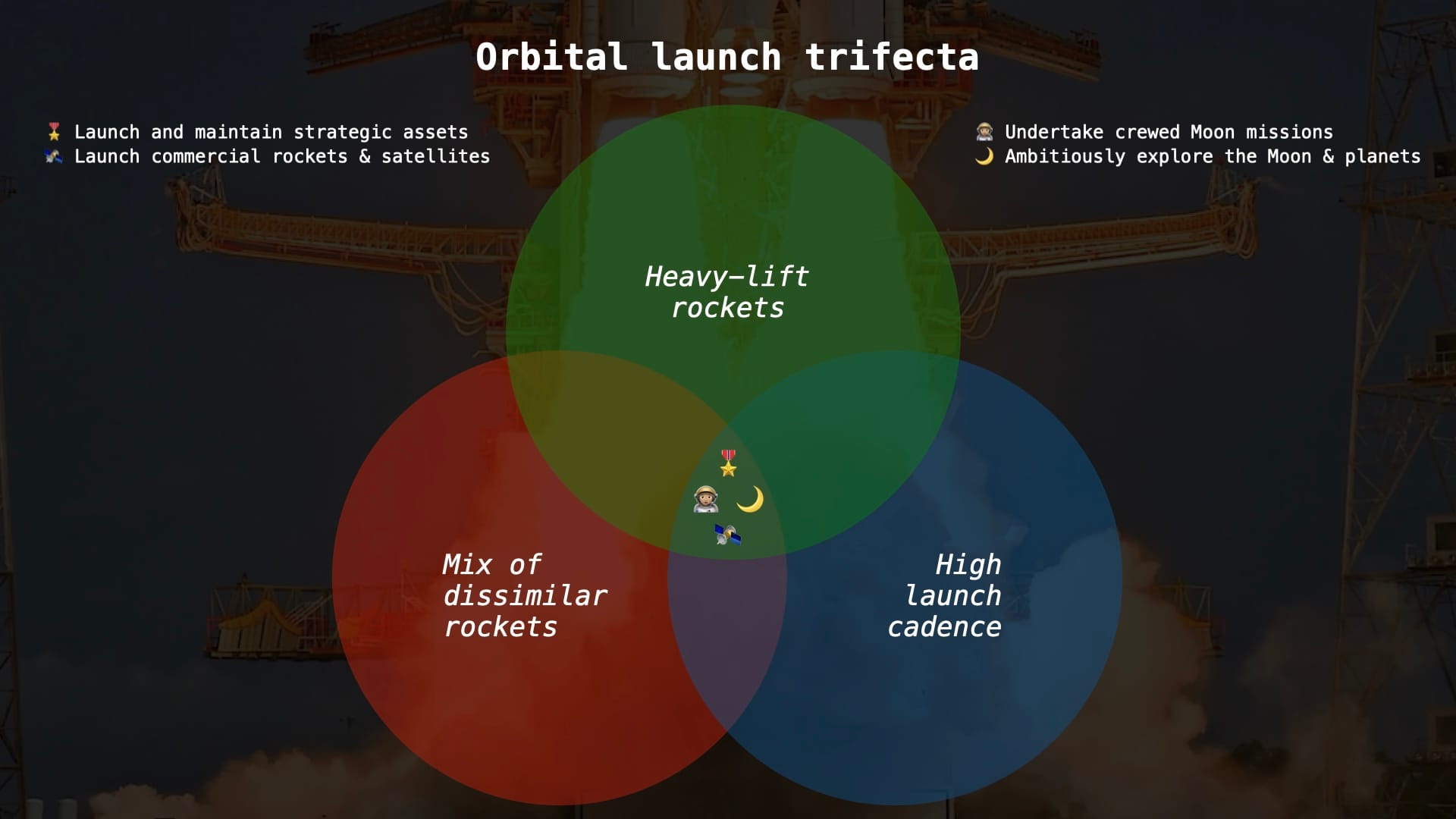
Even though India can theoretically attain a launch cadence of 20–25 launches per year by 2035 across medium-lift and heavy-lift rockets, our human spaceflight missions will actually periodically block the launchpads for robotics launches of the LVM3 and NGLV. Since Gaganyaan astronauts to be launched on human-rated LVM3s will do so from the SLP, with the upcoming TLP as standby, ensuring their safety means robotic missions of LVM3 could get delayed even if they are of national importance. Instead of the needed doubling of capacity to ~40 launches per year, we might just end up halving it.
It’s useful to look at how China solved this problem during an analogous time. China launched its first astronaut in 2003, with preparations beginning since the decade before. During this period, China’s launch output was roughly the same as India has today. Unlike the US and Russia, China was a squarely developing country like India. So China’s rise is proof that it’s possible for India to improve its launch throughput as well. A key decision India hasn’t made that China did is to have a dedicated launch site for human spaceflight missions. China made this decision for the Long March 2F, the country’s rocket of choice to launch astronauts, all the way back in the 1990s. Having a dedicated human spaceflight launch site or pad is not only safer for astronauts but also avoids launch pad congestion, thereby not blocking or delaying robotic national or even commercial launches. The last thing India needs amid a mounting national launch manifest backlog is to slog further on its robotic missions.
In fact, China has thoughtfully invested in four launch complexes. Each complex is optimized for specific needs, with some touting multiple pads. These include dedicated sites for not just human spaceflight but pads for commercial launches too, like at Wenchang.
As such for India, which has allocated SLP and TLP for human spaceflight usage as well, only the act of creating dedicated launchpads for LVM3 and NGLV robotic launches coupled with optimized launchpad usage across the board will let us achieve our minimum required launch capacity to fulfill the entire national manifest. This way, we can reach the optimum “hat-trick” state of our rockets to meet our many needs and ambitions in space.
To build the TLP, the Indian Government sanctioned $460 million. For two new pads, the cost can thus be estimated to be ~$1 billion. Even when including matching rocket production capacities, I suppose we’re looking at a one-time investment of ~$3 billion dollars. On the scale of 15 years, that amounts to just two extra years of ISRO’s annual budget, something India can very much afford. Besides, when India eventually pursues its intended crewed Moon missions, the NGLV rocket will need to perform back-to-back launches anyway, which would be easier to do when having an additional pad other than the TLP. It’s better to have the inevitable new launchpads sooner rather than later. A high national launch demand would also allow the vendors and contractors to actively support ISRO’s supply chain in a large volume, which would also reduce per vehicle costs.
Private companies do not, and should not, replace ISRO
As we discussed in Part 2, given the nascent stage of India’s private space sector, no place is currently building even a replacement to ISRO’s PSLV. Earlier in this article we also mentioned challenges faced by companies in even getting to the launchpad. As such, it’s impossible right now for Indian private companies to realistically think about building LVM3-and-NGLV-class rockets. Right now, to put it pithily, ISRO designs and the industry assembles. But planned technology transfers of ISRO’s launch vehicles to the industry and/or their production-ization through the industry will both help catalyze more possibilities in the future. However, the onus of orchestrating both increased launch capacity of national vehicles and catalyzing industrial innovation remains with the Indian government’s Department of Space.
A key thing the Indian government can do at some point is to let ISRO and private players compete for national launches to ensure that critical national missions are not delayed too much. The US Space Force’s National Security Space Launch (NSSL) program and NASA’s Launch Services Program (LSP) have enabled innovative commercial launch vehicles to be built and flown frequently. SpaceX’s Falcon 9 is the most well known example but there are others too like the New Glenn and Vulcan Centaur. The US government acts as an anchor customer for launching both NASA’s civil space missions and the country’s strategic ones. Companies vie for these lucrative contracts, in turn competing, innovating, and accelerating.
However, it’s important to note that India doesn’t have enough parallels with the US for this solution to make direct sense here. ISRO was not structurally built to be scalable like Western space industries. And India’s unique defense needs, the kind the US doesn’t have, cannot be reliably outsourced to private companies without ensuring the government is in command of the loop of which ISRO is one part. Blindly following the US model would risk India losing national capacity to private firms altogether, firms that may not even remain Indian. But having ISRO itself compete with Indian private companies or even other national organizations for national space launches could work. In other words, we should eventually decouple national space satellites from necessarily launching on ISRO’s rockets.
Here people may want to note that this already happens when India uses foreign launchers for lofting its heavy spacecraft. But that’s out of necessity, not by design. ISRO itself has demonstrated that there can be better ways to manage this reliance. For the upcoming Chandrayaan 5 / LUPEX Moon mission, JAXA’s heavy-lift H3 rocket will launch the spacecraft as part of the deal between India and Japan as symmetrical partners on the mission. Without the H3, India cannot launch such a heavy craft today, at least not in a single launch. Extending the idea of this kind of a deal, some key civil launches or even just scientific payloads can be offloaded to foreign partner launches or commercial rockets to ease the load on our own rockets and national priorities. For decades, NASA has regularly flown scientific payloads on foreign missions, including on our Chandrayaan 1 orbiter.
In the last few years, China has offered much greater support to its private launch sector than India has to its own, including personnel and tech transfers, having clarity on standards and legal regulations, access to infrastructure like ground networks and nationally-built launchpads, and even state-supported investments in companies and provincial & policy support. This has allowed operational commercial launchers to enter the turf, which have successfully supplemented the country’s launch capacity and frequency. In turn, companies too have invested in infrastructure facilities near national launchpads like in Wenchang.
Indian companies lack such strong incentives to build their own infrastructure due to lack of national co-investments. India should also encourage, allow, and incentivize the private sector to build dedicated, independent launch infrastructure of their own outside of ISRO’s complexes. Furthermore, leveraging India’s position as a geopolitically neutral-enough nation, the government can coordinate external launch deals for private companies with foreign partners for commercial launches from their country.
In the meanwhile, China has announced that it’s also planning to expand competition for national launches from the current internal state competition—which has already produced good outcomes—to soon between state-led companies and the private sector companies, greatly expanding the pool of options and incentivizing fierce innovation. More importantly, this will allow China to maintain high national launch capacity while touting a flourishing private sector, avoiding the pitfalls of having mostly only commercial launch vehicles like in the US. India too needs to ensure that ISRO’s own launch capacity stays alive and is competitive while the private sector is being nurtured. Instead of relying on a single flagship rocket like the Falcon 9, China’s resilient, multi-launcher orbit access approach is more suitable and desirable for India to draw aspects from.
An Indian on the Moon
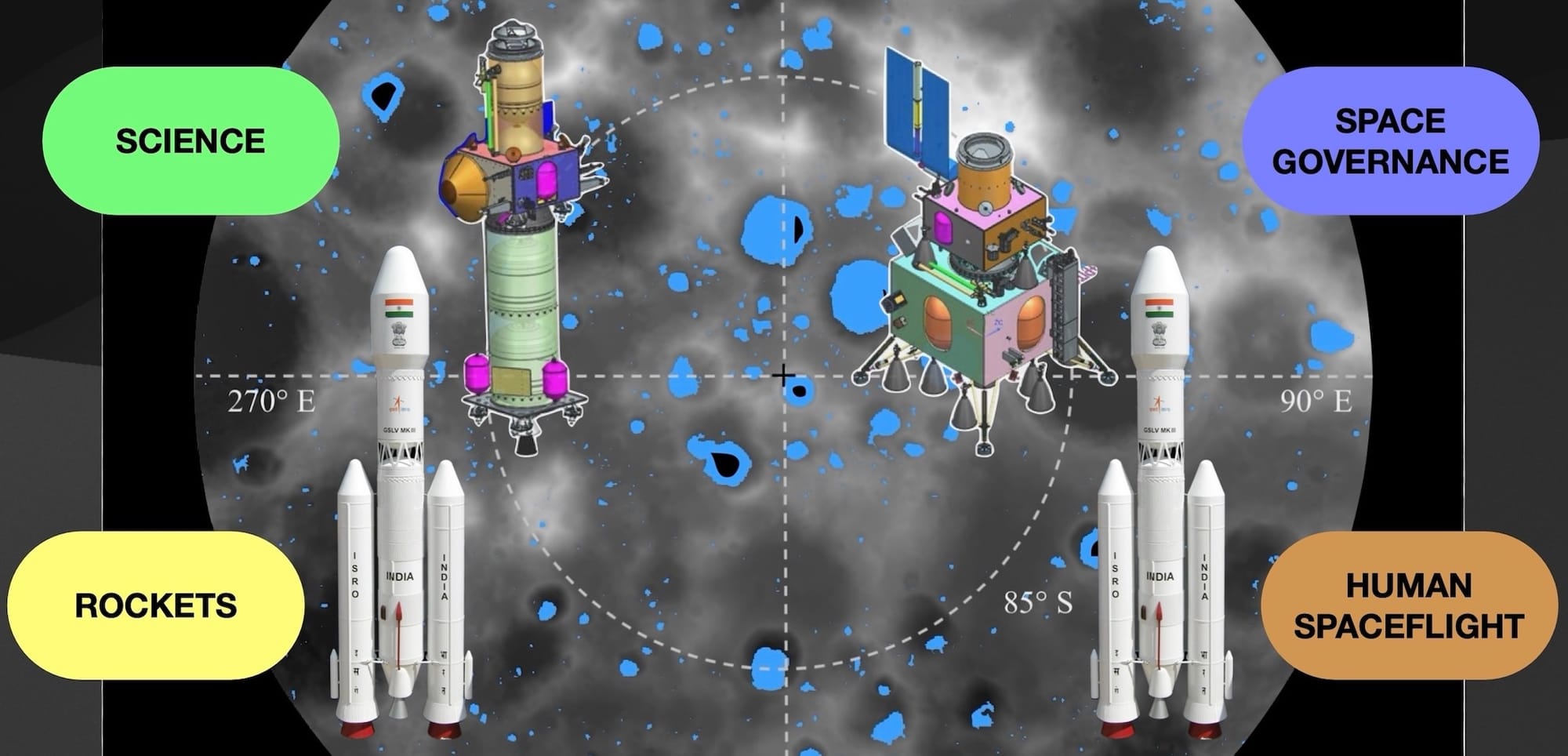
China landed its first robotic spacecraft, Chang’e 3, in 2013. India achieved the feat 10 years later in 2023 with Chandrayaan 3. China launched a human spaceflight mission on its own in 2003. India is still getting to its Yuri Gagarin moment. China aims to land humans on the Moon by 2030, representing a scaled version of their past programs, including having a dedicated launch complex for the vehicles involved. India has announced the goal of landing humans by 2040, without any such announced commitments. China got its first samples from the Moon in 2020 with the robotic Chang’e 5 missions. It’s a precursor to their multi-module crewed lunar missions. India wants to fetch lunar samples too with Chandrayaan 4 by the end of the decade. As established in Part 4, Chandrayaan 4 is not an isolated planetary mission but is deeply tied to India’s launch vehicle and human spaceflight programs, and how the specific LVM3 rocket it needs is also the catalyst required to better manage India’s launch crisis. The same dynamic will be true for the NGLV rocket, a heavier variant of which will be the vehicle of choice for sending Indian lunar astronauts.
Realizing monetary and technical constraints, ISRO’s Moonshot approach is to explicitly not make an ultra expensive, single-purpose Saturn V class mega rocket. Instead, ISRO will utilize docking of multiple spacecraft elements that are launched separately on maxed-out heavy-lift rockets to then achieve the same goal. This is a scaled up version of the docking-based architecture that Chandrayaan 4 will employ to fetch lunar samples later this decade. With this approach, the same rocket that launches humans to the Moon can also serve other projects in India’s space program, saving costs and ensuring efficient use of taxpayer money.
However, getting to repeatedly and reliably launching India’s largest rockets will still cost substantially more money by itself than is available to ISRO. Per the current but morphing plan, Moonbound Indian astronauts will blast off from Earth in a capsule atop a maxed out NGLV rocket variant. As will their lander in another such launch. Developing this central crewed Moon rocket in itself relies on the baseline NGLV launch vehicle coming online and becoming operational faster than its current official projections. Moreover, using a scaled up Chandrayaan 4 architecture implies having reliable back-to-back launches of the largest rocket India will have ever flown.
As such, even without a super heavy-lift rocket to blow money onto, the minimum viable cadence and scale of heavy-lift launches necessary for sending crew safely to the Moon and back can neither come for cheap in itself nor can it be achieved with any amount of pure efficiency attained with subpar hardware. Let’s not forget that the small robotic Chandrayaan 3 spacecraft alone filled LVM3’s medium-lift payload capacity to the brim. For a crewed Moon rocket, a giant leap is an immutable requirement.
Given India’s ambitions vis-à-vis the Moon being similar to China in scope, and the time periods between the self’s mission milestones and future ambitions being comparable as well, India needs to switch from a linear execution approach to an ambitious multi-lateral mode that China has demonstrated with its complex launch vehicle, human spaceflight, and planetary programs this decade.
The point of drawing all the analogues to India’s potent neighbor is not to chase China and its exact execution, which would be a strategic mistake as elaborated by Adithya Kothandhapani, but to seek ideas and elements that are relevant to India in various ways. Certainly more so than the distinct US and Russian space structures formed and shaped during the Cold War era. As you may note from this article, even after maximally optimizing launchpad usage for ISRO’s rockets and having additional pads, India’s launch rate for medium-and-heavy-lift rockets will not surpass 50 annually, something China and the US can pull off even today. But India doesn’t need that many launches to meet all of its civil and strategic goals, including all the way up to a crewed Moonshot. Meeting the goals is all that matters.
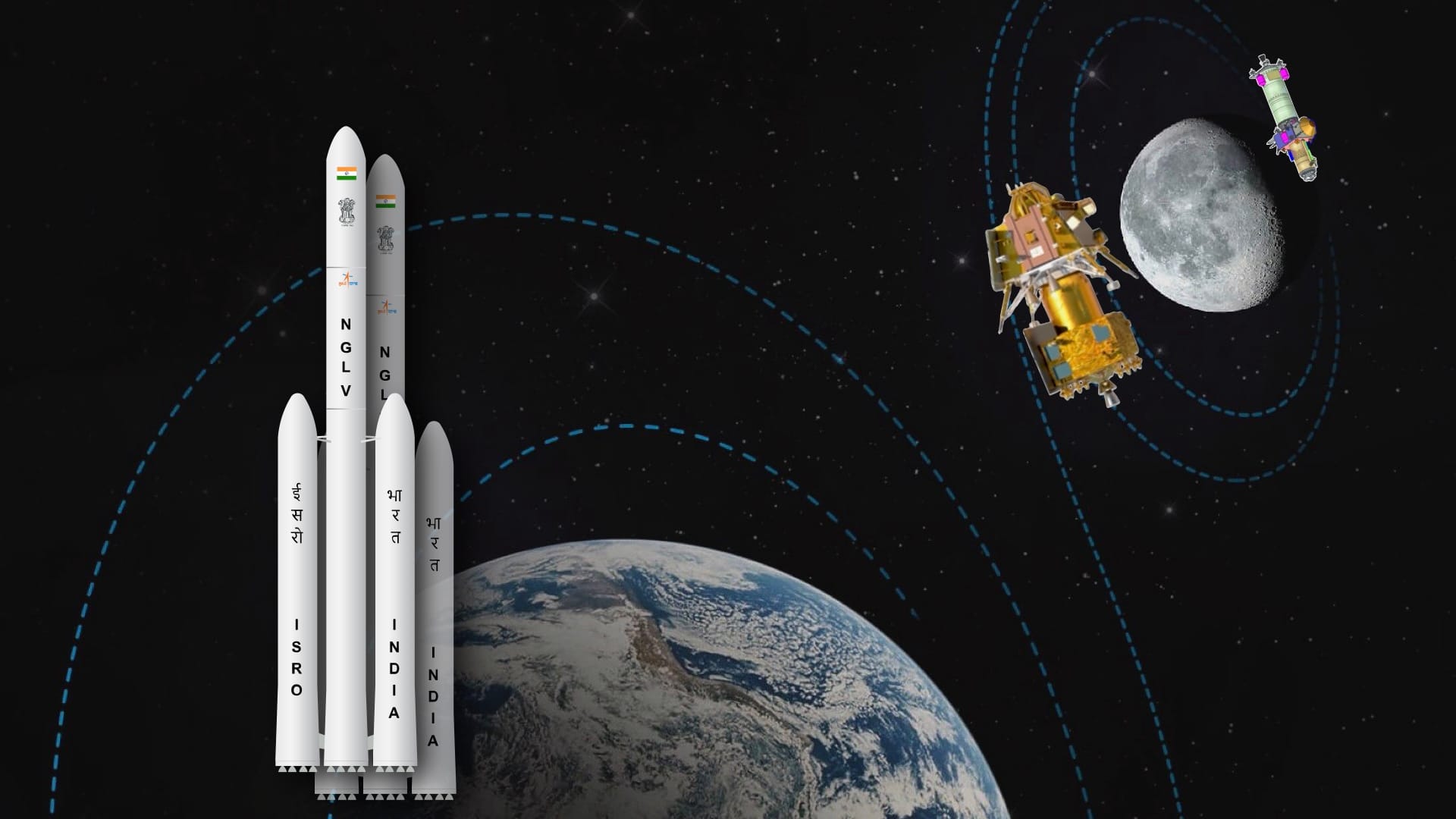
Just like India bagged Chandrayaan 3’s triumphant touchdown on the Moon by cutting through the cloud of Chandrayaan 2’s failure with an approach of expansive testing coupled with uncompromising performance, the time is here again to reinforce and scale that philosophy to the largest playground in space this century. Make no mistake, it will be the pinnacle of India’s space program if it launches humans to the Moon circa 2040, or even later on if we’re being realistic.
Imagine that future for a moment. The only country in the world after the US and China to achieve the immense feat, and one bagged within around 100 years of independence from colonial claws. China’s rise in space this century culminating in landing humans on the Moon by 2030 shows that an Indian on Luna by 2050 is also not an outright impossible dream. However, the crisis facing ISRO’s rockets makes the prospect far fetched at the moment. But it’s a goal worth pursuing just as Chandrayaan the program was. Apollo inspired many even in India but it took a robotic Chandrayaan 3 to fire the imagination of a much larger populace here. An Indian with flesh and blood on Luna would be much more impactful worldwide in various ways. Had ISRO’s founder Vikram Sarabhai been alive, he’d probably tear up at the sight of this feat. He’d also know that a scalable heavy-lift rocket investment was indispensable so that India could orchestrate the increasingly complex sprawls of its space program.
My series of articles on India’s launch vehicle crisis spans an analysis timeframe of two decades. It has taken me about a year of work to research and publish. Like all my writing, it’s completely free to access by everyone, with zero ads. I don’t use AI to write a single word and cite everything. If you found the series useful or insightful, please support my independent writing to keep such kind of work going since it’s purely reader-funded. Sharing the series or its articles also helps.