Everything you should know and track about NASA’s Apollo-style Artemis rejig in its chase of China to the Moon
NASA is also borrowing the “manned” from Apollo while at it. | Moon Monday #264
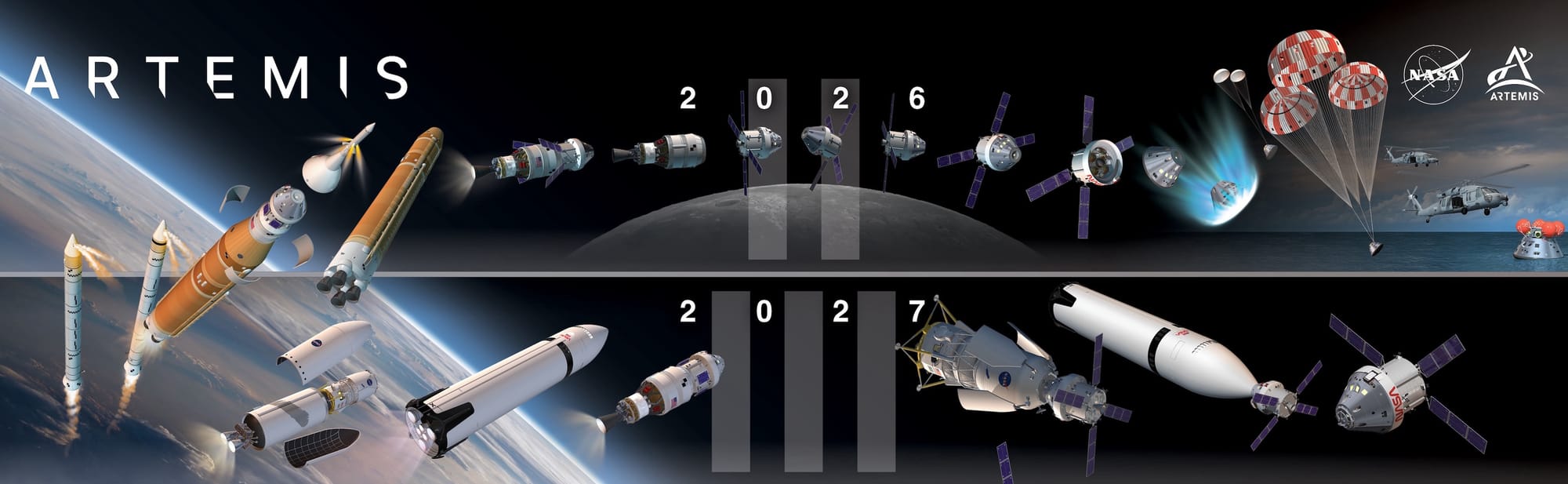
After years of the US government, American space companies & industry, NASA, and associated media raving about how the country’s Artemis program will be a sustained return of humans to the Moon by explicitly not being Apollo-style, and having repeatedly called China’s crewed lunar ambitions only Apollo-esque, NASA on February 27 announced an Artemis rejig which touts and takes an Apollo style approach to land humans on the Moon again. The changes are as follows:
- Artemis III will no longer be a crewed Moon landing mission. Instead, the SLS & Orion spacecraft will fly astronauts to Low Earth Orbit in 2027. There separately launched prototype lunar landing systems from SpaceX and/or Blue Origin will test docking with Orion, Apollo 9 style. Astronauts will then transfer over to the lander(s) to check life support systems. If possible, NASA would also like to test the Axiom Space provided lunar spacesuits onboard, including conducting a spacewalk if feasible. The delayed suit development is still undergoing critical design review as we speak.
- Artemis IV is now the earliest targeted crewed Moon landing, with NASA hoping for an early 2028 lunar touchdown. The next landing with Artemis V is being moved ahead with hope from 2030 to late 2028. The Artemis IV and V landers will be based on unspecified accelerated proposals from SpaceX and Blue Origin (or Blue and SpaceX). The companies provided these fast-tracked proposals after NASA reopened the Artemis III landing contract last year due to SpaceX’s slow progress with Lunar Starship as well as China’s faster pace in its own crewed landing goal.
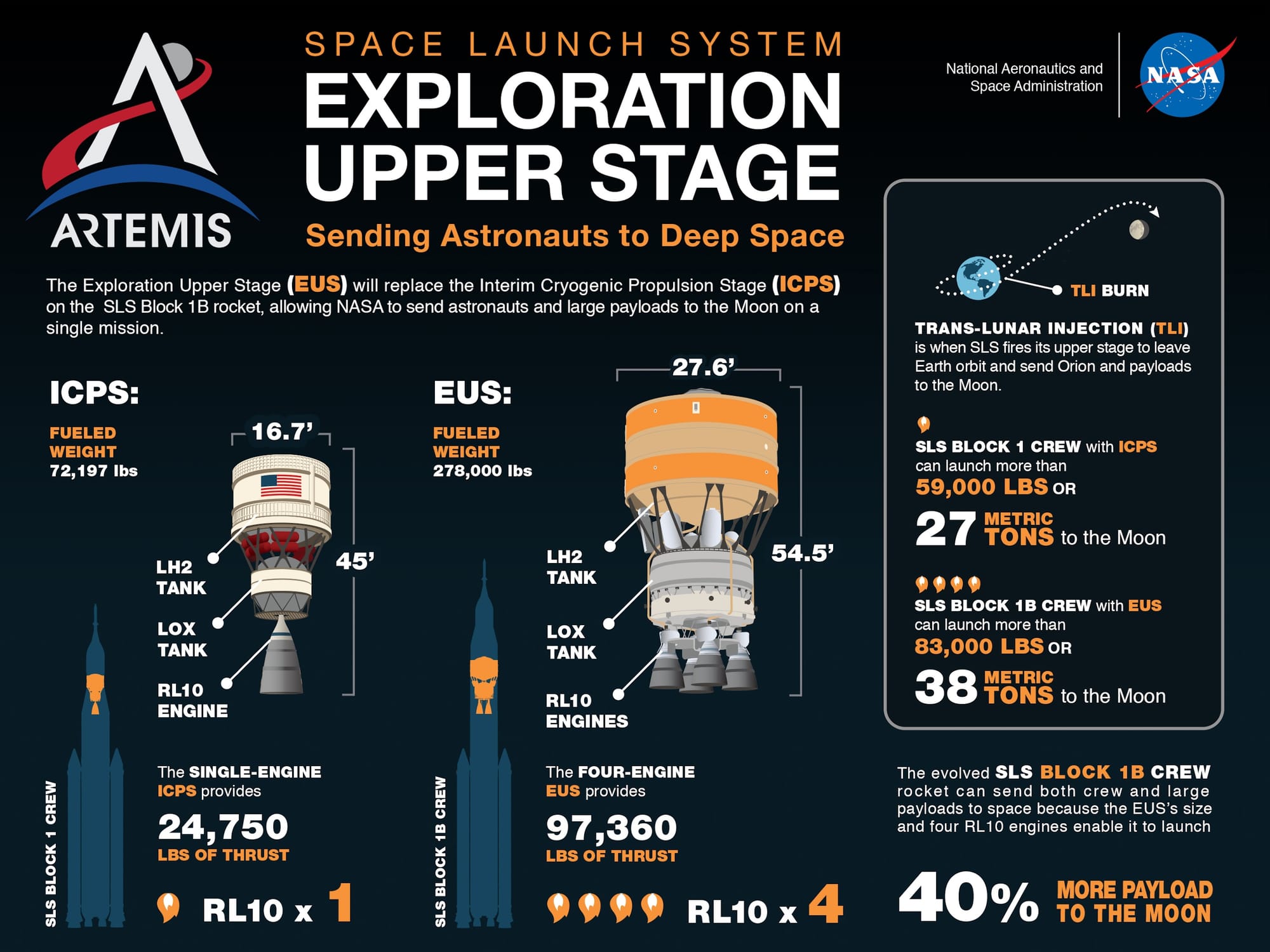
- The SLS rocket’s upper stage’s planned upgrade targeted for use Artemis IV onward will get canceled. Said upgrade requires a new mobile launch pad for SLS, which has seen inflating costs and timelines due to poor management. It will get cancelled too. NASA wants to simplify the Artemis mission architecture on the SLS side by having a “standardized” upper stage for the rocket that performs similarly to the current one. With this move, NASA also hopes to improve the SLS’ launch rate from one every three years to yearly.
China, which clinched yet another timely milestone last month in its quest to land humans on Luna by 2030, is the key catalyst for these changes. NASA Administrator Jared Isaacman said during the Artemis rejig:
With credible competition from our greatest geopolitical adversary increasing by the day, we need to move faster, eliminate delays, and achieve our objectives.
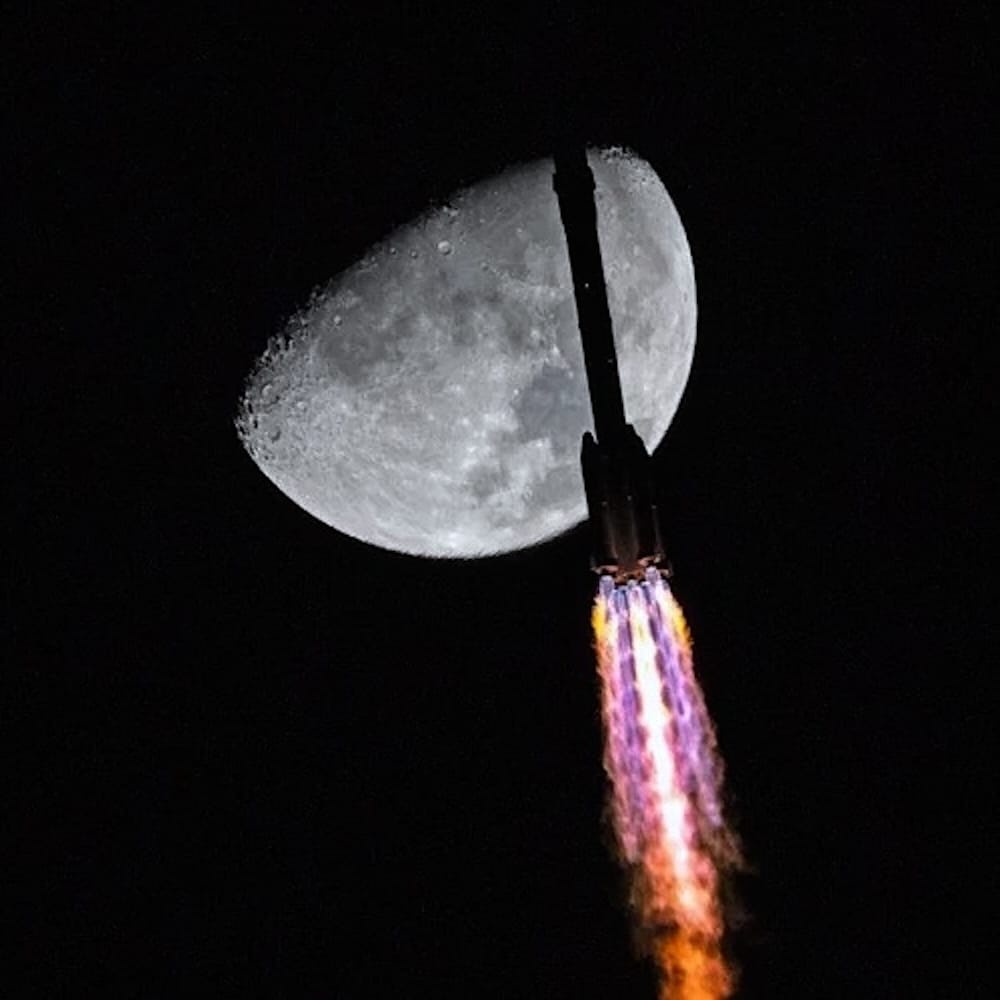
The layers below
What’s notable but missed in most of the coverage is that NASA has effectively expanded the scope of the reopened Artemis III landing contract over to the revised Artemis III, IV, and V missions. Isaacman and NASA’s Associate Administrator Amit Kshatriya have thus incentivized both SpaceX and Blue Origin to compete even more fiercely for landing Artemis astronauts on the Moon this decade. Remarkably, the agency leadership duo also seem to have managed to align the US Congress and NASA’s traditional prime contractors like Boeing in this new plan to fast-track the SLS rocket’s availability and streamline its operations. Isaacman says that for NASA to achieve this goal, it aims to hire the majority of its thousands of related contractors as agency employees instead. To fund these SLS improvements, NASA hopes to chiefly source the money from the supplementary ~$4 billion funding for SLS which the US Congress passed last year. These funds are separate from NASA’s annual budgets.
All that being said, here are things NASA has not yet shared but said in the announcement event it would later on, at unspecified times in the future:
- Details on the revised Artemis III mission and its exact objectives, and who its astronauts will be.
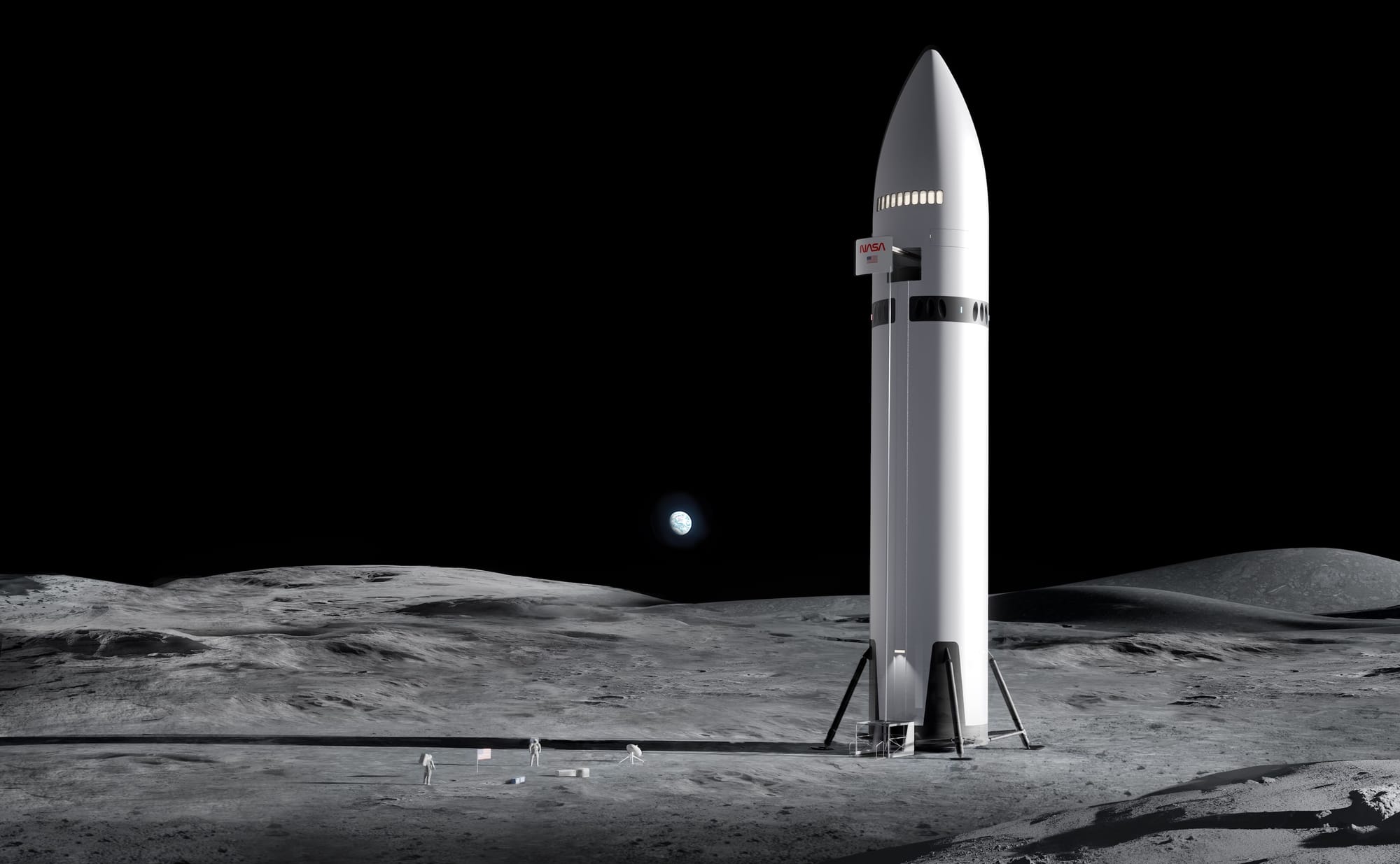
- What the accelerated crewed lunar lander proposals from SpaceX and Blue Origin actually look like, especially in the case of Starship where a sea of key milestones remain untouched.
- Specifics of the new, standardized SLS rocket upper stage, and how it will affect the planning, deployment, or existence of the upcoming US-led Gateway orbital habitat, which as originally planned needs the now-canceled SLS upper stage upgrade.
Add to this the aspect left unspecified at the event that we don’t even have firm launch targets for the uncrewed lunar landing demonstrations by either SpaceX or Blue Origin. Without such a demonstration, the respective lander cannot safely carry Artemis astronauts. Still, the overall development is welcome and long overdue. Simplifying mission objectives and the Artemis architecture as a whole is also exactly in line with what the Aerospace Safety Advisory Panel (ASAP) recommended NASA in its 2025 report released just two days before the Artemis changes were announced. ASAP formally advises NASA and the US Congress on spaceflight safety. Marcia Smith captured the crux of ASAP’s 2025 report well:
Among other things, ASAP is concerned about the number of “firsts” needed for the mission to succeed. That includes the first operational use of the HLS [Human Landing System] version of SpaceX’s Starship, which requires in-space refueling, another first; first use of Axiom Space’s [lunar] spacesuits; first lunar landing since 1972 and the first ever at the lunar South Pole; first lunar ascent [for the US] since 1972 and the first on SpaceX’s HLS; first docking of the Orion spacecraft and SpaceX’s HLS in lunar orbit; and more. ASAP found this “stacking of firsts” a problem because it “elevates mission risk and reduces margin.” It wants to ensure “schedule pressure does not override prudent risk reduction—particularly for the HLS development, spacesuit readiness, and cryogenic propellant transfer capabilities.” But it doesn’t see that in the existing architecture.
The report also doubts Starship’s ability to land humans on the Moon this decade:
The development and test progress necessary for a version of Starship that has not yet flown in time to support a human lunar landing mission within the next few years appears daunting and, to the Panel, probably not achievable. Beyond this, the physics of landing a six-to-one height-to-width ratio vehicle on the uneven, poorly lit polar lunar surface seems questionable at best.
Key developments to watch out for this year
- Tests China will conduct in prep towards landing humans on Luna
- Launch of China’s Chang’e 7 mission to the Moon’s south pole in the second half of this year to study water ice and other volatile resources.
- The pace at which SpaceX achieves Starship milestones since the company and founder Elon Musk have now prioritized the Moon following China, the US, and Blue Origin.
- The first lunar landing attempt by Blue Origin:
- Blue Origin’s successful launch of its New Glenn rocket last January followed by another in November finally opened up a second line of pursuit for NASA to send lunar astronauts vis-à-vis Blue Moon. Blue aims to launch its first robotic Blue Moon ‘Mark I’ lander by the end of this year to test and validate key design decisions and systems ahead of use in crewed flights.
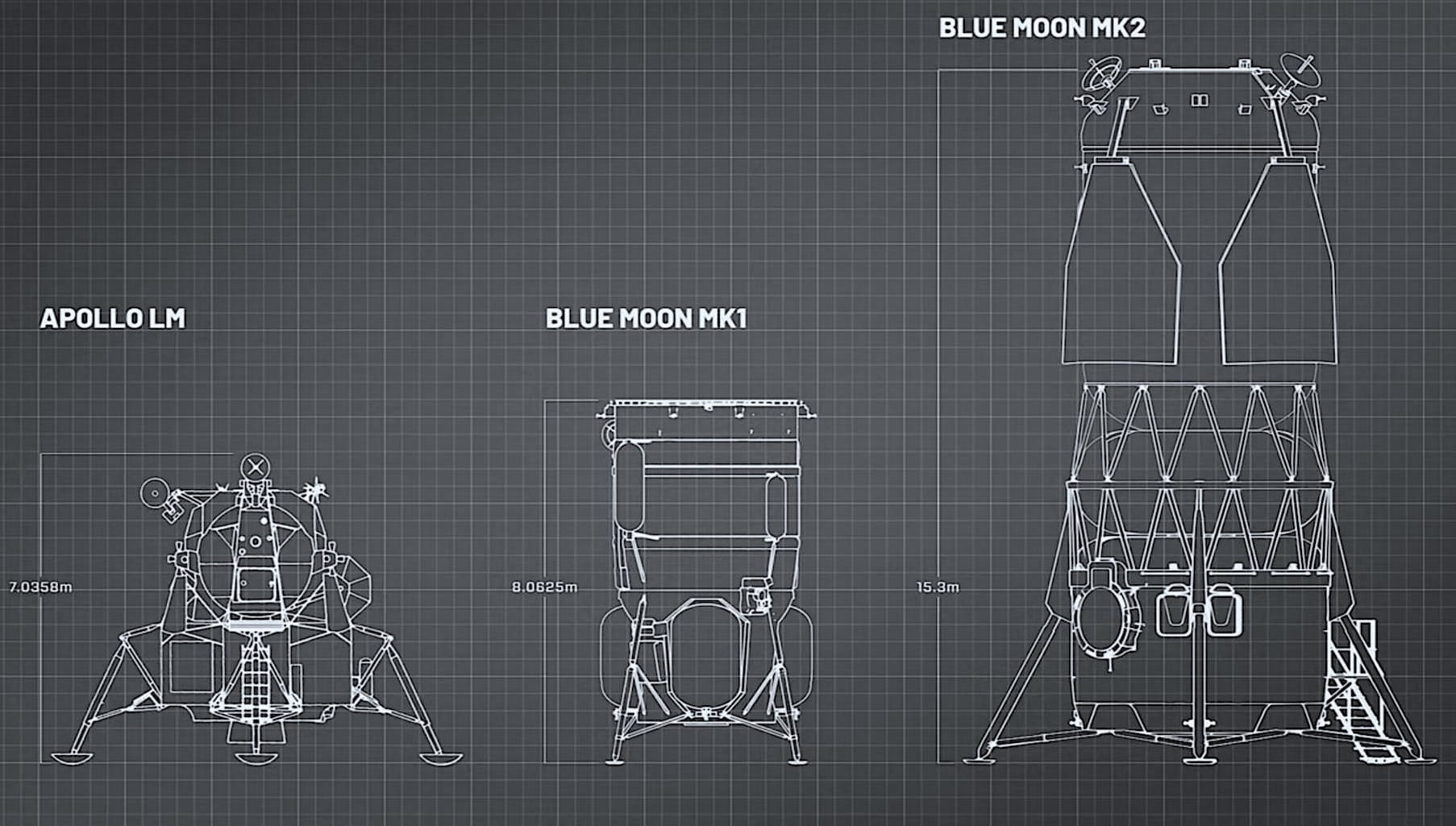
- Based on the first Mark I’s expected performance, NASA has tentatively chosen the second Mark I’s 2027 flight to carry the agency’s VIPER rover—whose mission to study polar water ice has been critical yet deprioritized. Any kind of crewed Blue Moon lander will depend on the Mark I succeeding, and swiftly so. Between NASA’s new focus on accelerating Artemis and the opportunity to sidestep Musk-owned SpaceX in landing US astronauts on the Moon, Jeff Bezos-owned Blue decided to pause its other internal projects to focus the company’s resources and efforts on Luna.
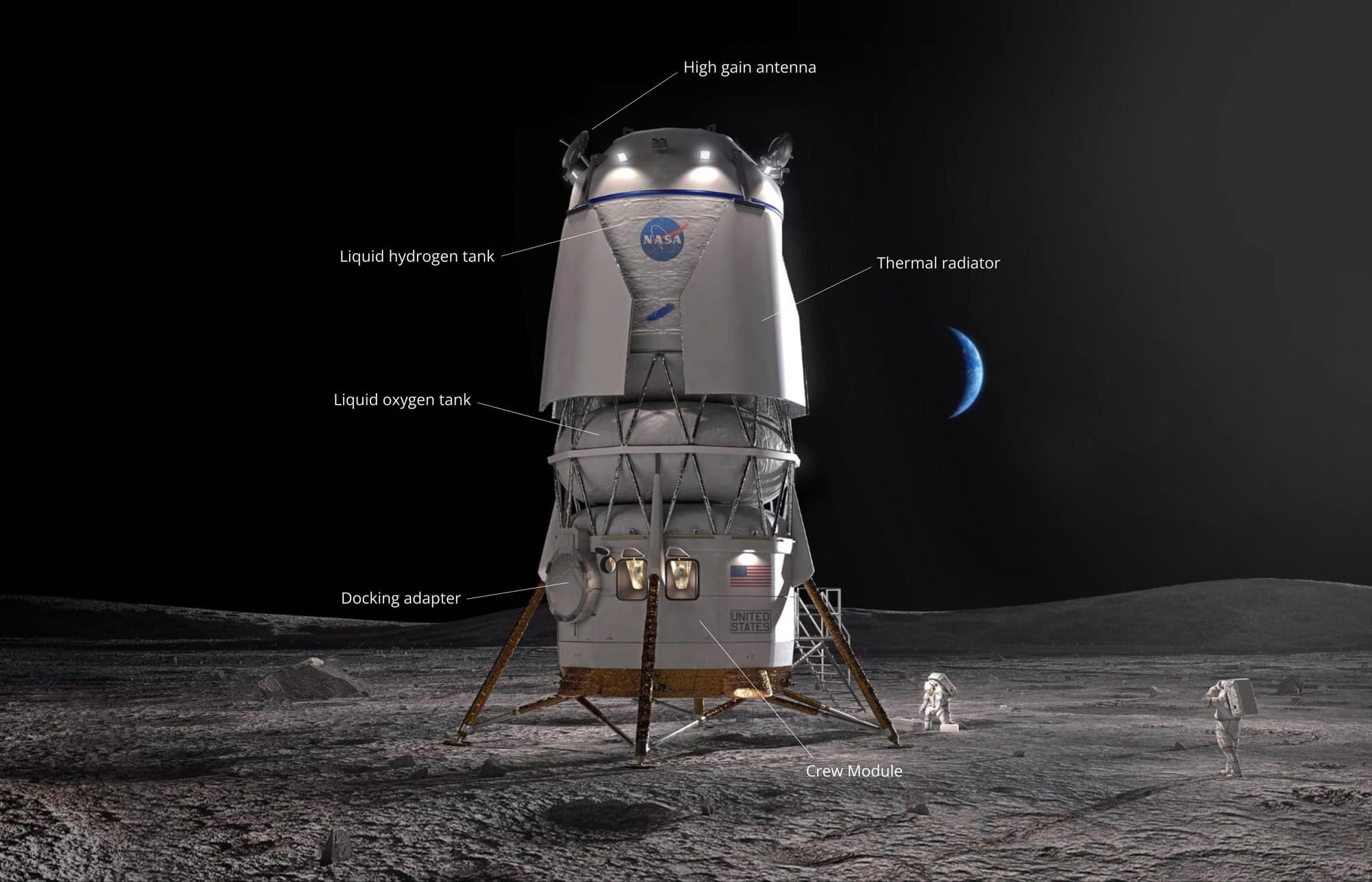
Despite Blue’s fast-tracked efforts and simplified architecture compared to SpaceX, the short timeline and still-present complexity comprising at least four launches compared to China’s focused two-launch approach means the US will likely not meet its self-imposed goal of “beating China” to the Moon. Either way, it’ll be amazing to have a second nation from Earth land humans on Luna. We should be happy that we now have two distinct efforts to sustain crewed and robotic exploration of our Moon. It gives humanity a better chance to do so since a dichotomic political system is apparently only able to do better under a competitive mindset driven by fear-mongering rather than collaboration.
Related reads:
- Western media narratives misrepresent Chinese space, which reduces trust and deters cooperation and collaboration
- Jack Congram: China is not racing to the Moon
- Erika Nesvold on the US not having presented a coherent argument for the imposing need to win the new lunar “Space Race” against China
From crewed Artemis to manned Apollo
Adopting an Apollo style approach to Artemis seems to have gone beyond the technical planning. NASA Administrator Jared Isaacman, who has previously flown to space alongside woman astronauts on both his private space missions, used the words “mankind” and “manned” in recent tweets evangelizing the Trump-created Artemis program while the same program is trying to send the female astronaut Christina Koch to the Moon on Artemis II in a matter of weeks. Just as importantly, the Artemis program from its inception itself has touted landing the first woman on the Moon with Artemis III, with the word Artemis itself being chosen to allude to that ambition. That social advancement now no longer explicitly matters to NASA while fluffy communications take greater charge. In fact, last year NASA deleted the following prominently presented language from the Artemis landing page on its website:
With the Artemis campaign, NASA will land the first woman and first person of color on the Moon, using innovative technologies to explore more of the lunar surface than ever before.
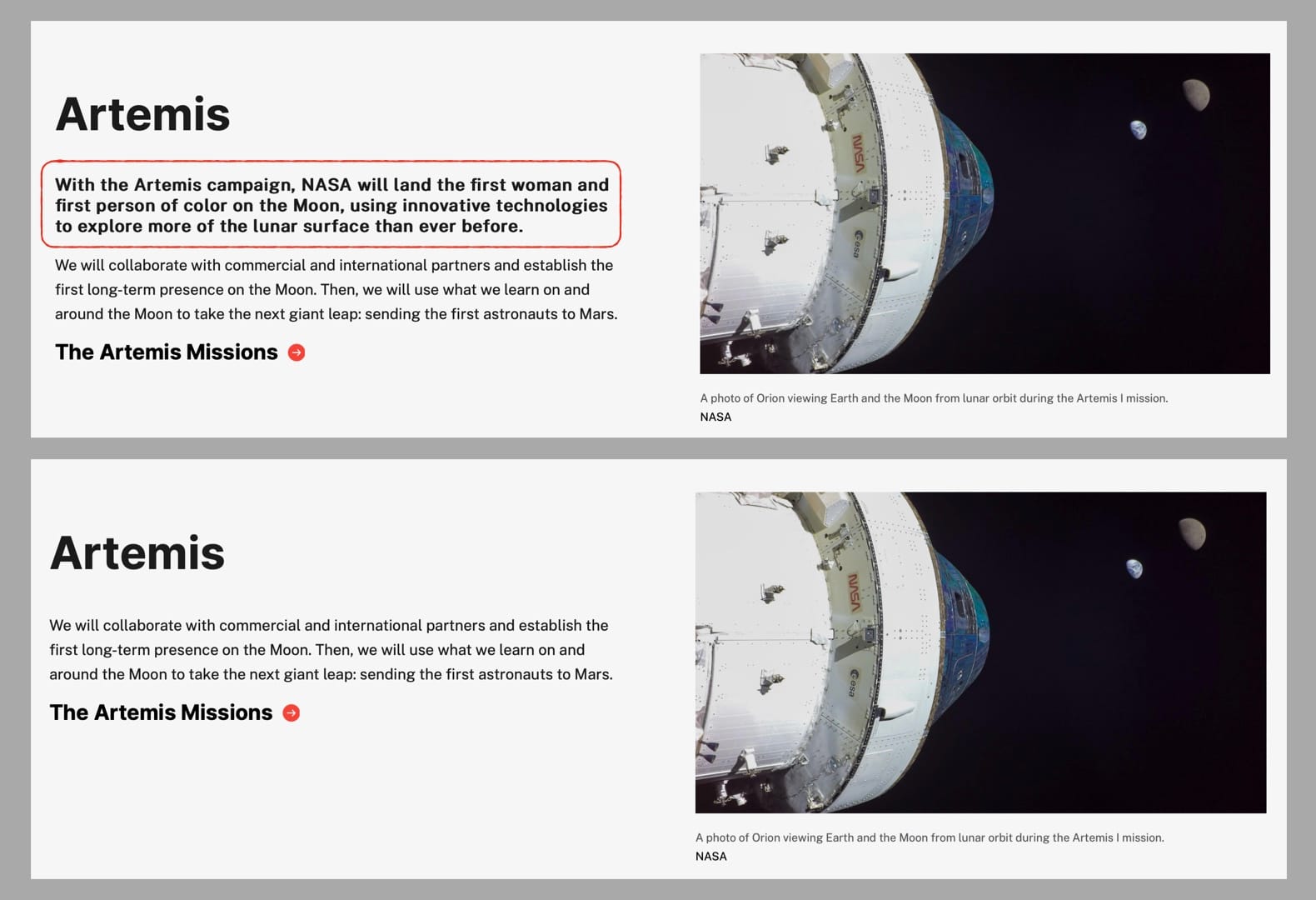
Eric Berger had then reported NASA’s response to the change as conveyed via an agency spokesperson:
In keeping with the President’s Executive Order, we’re updating our language regarding plans to send crew to the lunar surface as part of NASA’s Artemis campaign. We look forward to learning more from about the Trump Administration’s plans for our agency and expanding exploration at the Moon and Mars for the benefit of all.
Many inferred and reported this development as a change of mission crew plans but that’s not the case—not yet anyway. The reasonably diverse Artemis astronaut corps of 18 people hasn’t changed. It incudes women and people of color. Of course, the selection criteria for Artemis IV and V could very well change going ahead or be selectively interpreted given the US-wide inclusion purge since last year. In any case, when you have a female astronaut going to the Moon on Artemis II, and when NASA’s 6 out of 10 latest astronaut candidates for future missions are women, it should not be hard to simply use the words crewed or human instead of manned.
In the meanwhile, China’s CASC is using the phrase “crewed lunar landing” and “crewed lunar exploration” despite the country’s human spaceflight agency itself being named the China Manned Space Agency (CMSA) by its original English translators.
Many thanks to The Orbital Index, Louis-Jérôme Burtz, Gordon Roesler and Sonia Tikoo for sponsoring this week’s Moon Monday. If you too appreciate my efforts to bring you this curated community resource on global lunar exploration for free, and without ads, kindly support my independent writing:
P.S. Thank you to all who have so creatively and kindly signed my blog’s public guestbook. 🌝