Moon Monday #151: On Astrobotic‘s first lunar landing, Chandrayaan 3 blasting away lunar material, an older & cooler Luna, and much more
If you’re reading this blog+newsletter, you’re likely in a position of privilege. Please consider donating for the affected innocent kids in the Hamas-Israel war. The Palestine Children’s Relief Fund is the option I’ve supported via since the non-political non-profit is providing basic necessities to children regardless of their religion. There’s also Save the Children.
Astrobotic’s first CLPS Moon lander gets a launch date; will carry 5 NASA payloads instead of 11
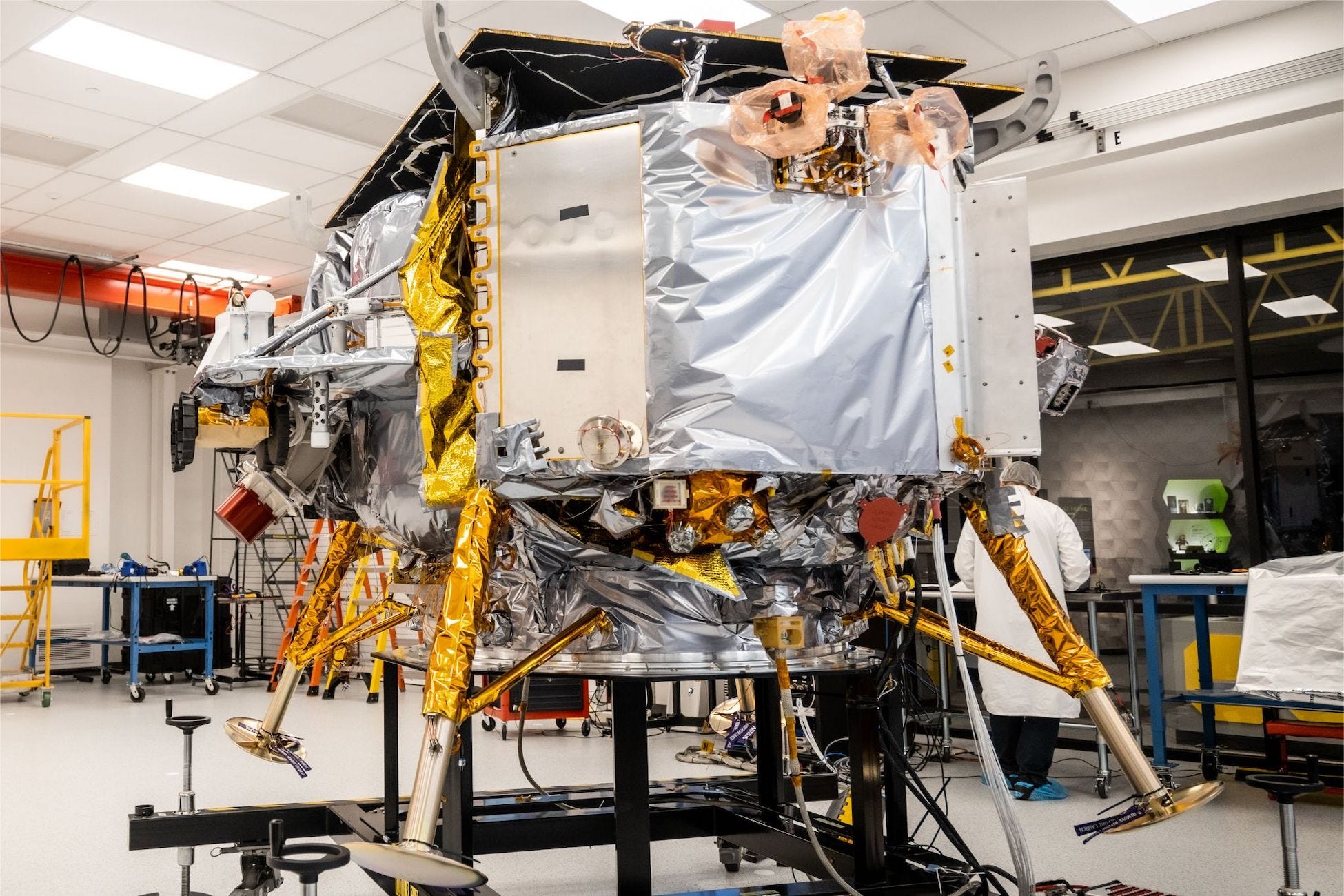
ULA announced that the company is targeting the inaugural launch of its Vulcan rocket on December 24. It will carry Astrobotic’s first lunar lander, part of NASA’s CLPS program, to Earth orbit. The launch window extends up to December 26, with a similar backup window available in January. Shortly after on October 27, as Stephen Clark reports, Astrobotic’s 2-meter tall Peregrine lander left the company’s headquarters in Pittsburgh for Cape Canaveral, Florida to undergo pre-launch checks and processing.
Peregrine will attempt to touchdown in a lunar lava plain just outside the Gruithuisen volcanic domes, carrying more than 12 payloads from 8 countries, including a bevy of micro-rovers from 3 countries. Peregrine was also supposed to carry 11 NASA-funded instruments but according to NASA’s webpage on the agency’s payloads aboard Peregrine, only five instruments are now listed. NASA says on said page that the other six instruments have been “reallocated to future missions to maintain performance margins in Peregrine’s descent to the lunar surface.” NASA doesn’t specify to which missions the payloads were moved to but says they will be “delivered by CLPS [missions], international missions, or Artemis human landing system missions.”
Note that NASA didn’t publish a press release or even a post on the official CLPS Blog for this change. Neither did Astrobotic on their equivalent channels. Recall that NASA changed Peregrine’s target landing site from the northeastern lava plain of Lacus Mortis to an unspecified lava plain near the Gruithuisen domes in the northwest. The announcement was titled “New Landing Site Will Upgrade Science Returns for Astrobotic Flight”, referring to but not specifying how the science there would complement a future CLPS mission landing in one of the two Gruithuisen Domes in 2026.
As I covered during the landing site swap, the previous higher latitude location was more suitable to study how water gets transported from the Moon’s equator to permanently shadowed regions on the poles where it can remain preserved for billions of years. Combined with the dropping of six payloads from Peregrine’s mission, two of which were to study local lunar water, the nature of the move is even more perplexing based on publicly available information, especially when considering that CLPS is managed by NASA’s Science Mission Directorate. I hope we can get some details from the agency clarifying the rationale behind these decisions.
More mission updates
- Intuitive Machines and SpaceX are targeting the launch of the former’s first CLPS Moon lander on January 12, 2024. Eric Berger has previously reported that the lander will take five to seven days to reach the Moon, after which it will spend a day lining up with its near-polar landing site of Malapert A crater at 80°S before attempting a landing. The mission, named IM-1, will carry six NASA science & technology payloads as part of CLPS. A separate, commercial telescope called ILO-X from Hawaii-based ILOA will also be aboard. I blogged more about recent CLPS Moon mission updates on Moon Monday #146.
- Hardware progress continues for NASA’s Artemis II mission to fly four astronauts around our Moon and back circa early 2025. On October 19, technicians mated the 9,000-kilogram Orion capsule with the 15,000-kilogram European Service Module. The former will host the astronauts while the latter will provide propulsion, power, water, oxygen, and thermal control to Orion. In the meanwhile, NASA is also conducting water flow tests with the mobile launcher of the SLS rocket atop which Orion will sit during launch. During liftoff, mechanisms push 1.5 million litres of water to the launchpad to protect the rocket, Orion, and its crew from overpressurization and extreme sounds.
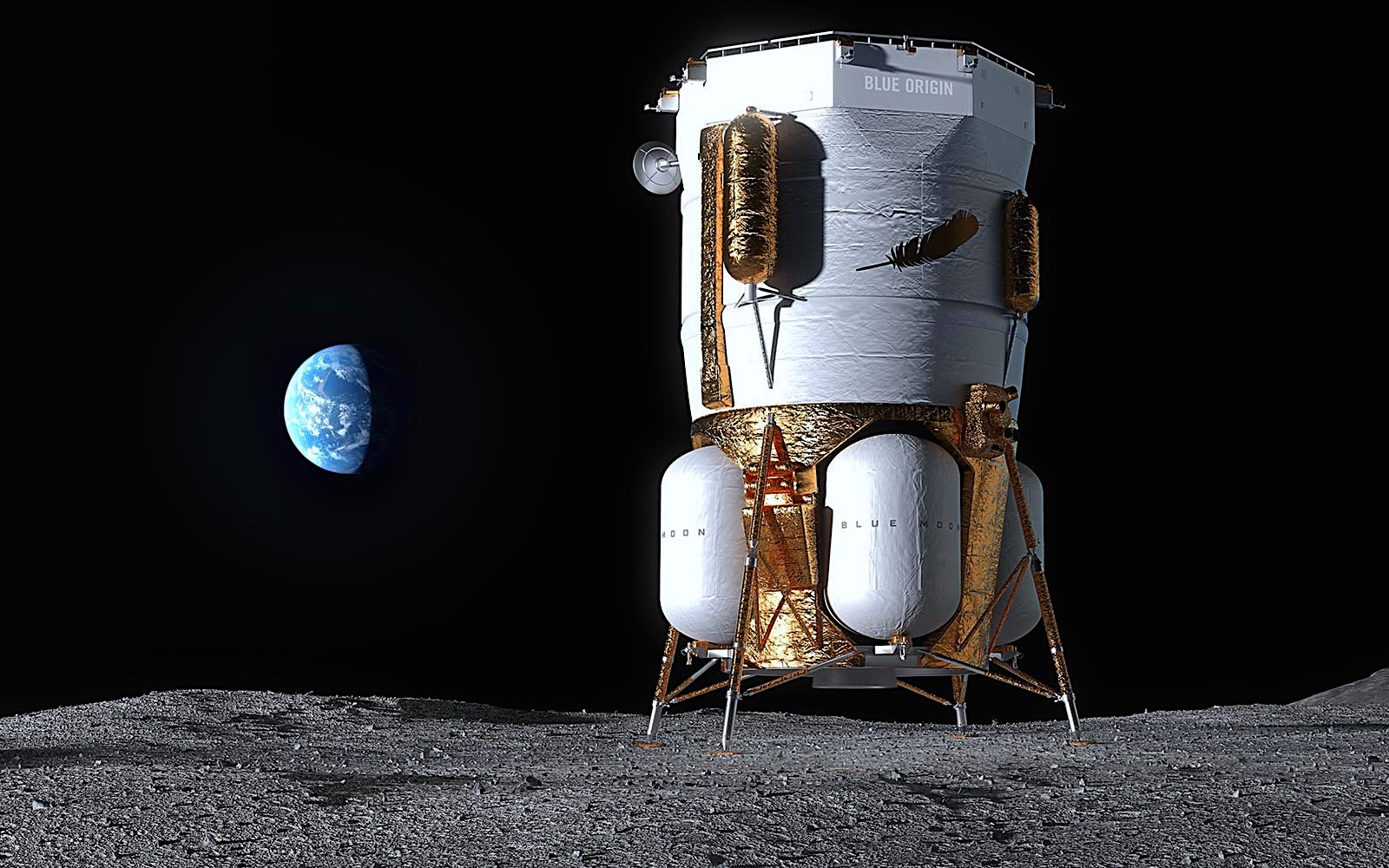
- Last week Blue Origin showed NASA officials a low-fidelity mockup of its Blue Moon ‘Mark 1’ lander, Stephen Clark reports. Blue Origin is targeting a lunar landing demonstration with Mark 1 no earlier than 2026, aiming to test and refine critical landing systems before graduating them to the Mark II lander, which will land astronauts on the Moon for NASA with Artemis V end of decade. Since Blue Origin is also a NASA-approved commercial lander provider for the CLPS program, the company intends to pitch and fly more Mark 1 landers as well, carrying the agency’s science & technology payloads to the Moon. Mark 1’s payload capacity of 3,000 kilograms surpasses all current CLPS landers but SpaceX’s Lunar Starship, whose crew variant is currently targeting landing astronauts for NASA with Artemis III and Artemis IV in late 2025 and 2028 respectively. Note that NASA requires both Blue Origin’s and SpaceX’s crewed landers to touchdown within 100 meters of the targeted spot on the Moon’s rocky south pole, which is something the robotic Mark 1 will attempt. It’s also precisely what JAXA’s robotic SLIM lander will try to achieve as soon as January 2024.
- Following the Russian Luna 25 lander’s August 19 crash on the Moon, Roscosmos Director General Yury Borisov says that the agency now plans to launch the Luna 26 polar orbiter in 2026 instead of 2027. The primary goal of Luna 26 is to map the distribution of water ice and minerals on the Moon.
Chandrayaan 3 blew off two tons of Moon material while landing
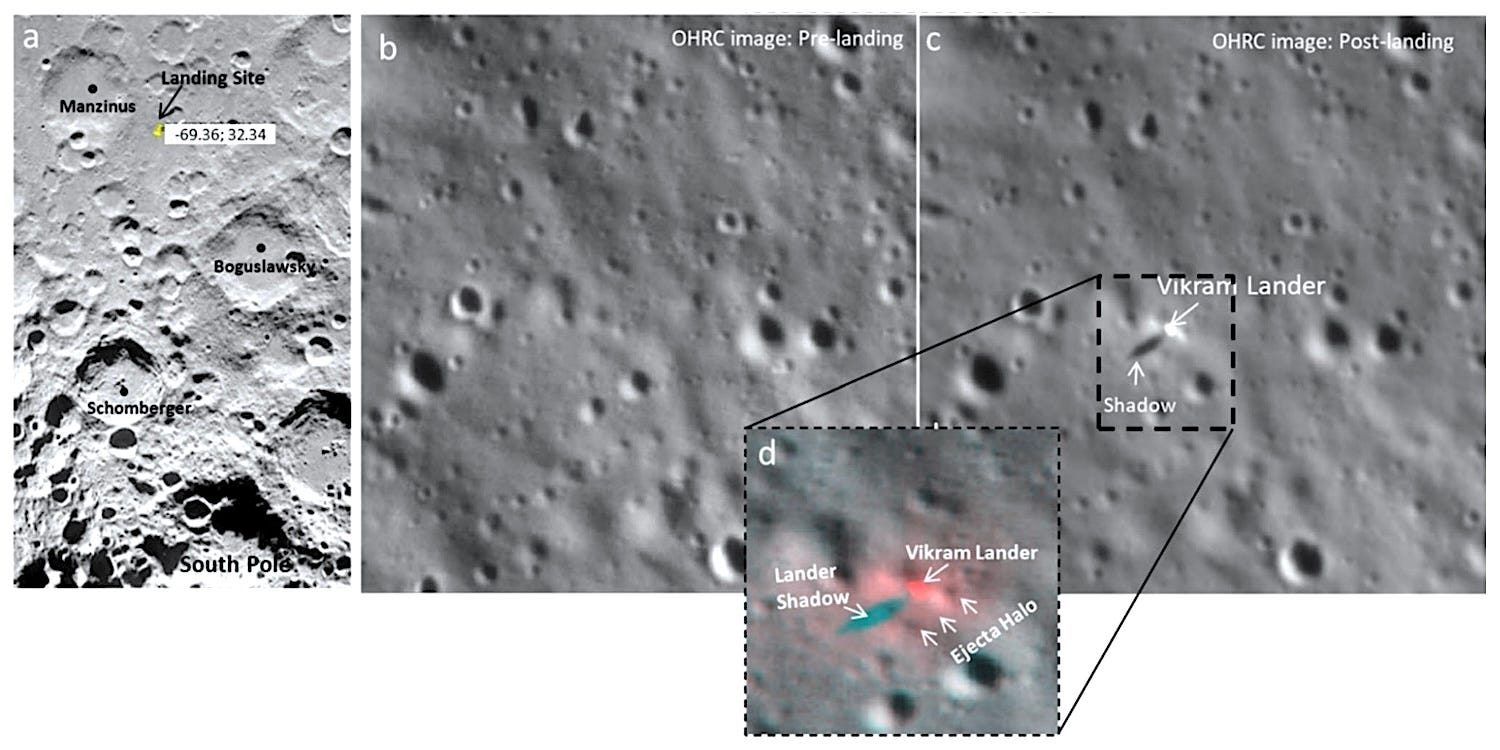
ISRO-affiliated scientists at the National Remote Sensing Center have estimated that India’s Chandrayaan 3 lander ejected 2060 kilograms of surface material in the process of its touchdown on the Moon. This left behind a bright halo surrounding the lander, spanning an area of about 100 square meters. The scientists calculated these numbers by comparing and analyzing pre-and-post-landing pictures of the site from the Chandrayaan 2 orbiter, which hosts the world’s sharpest lunar orbital imager.
Looking at other missions, the latest estimate by US scientists says that NASA’s Apollo 12 lander blasted away about 2600 kilograms of lunar material during its touchdown whereas Chinese researchers calculated the Chang’e 5 lander to have displaced only about 336 kilograms of material. That’s a non-obvious, non-linear discrepancy between the amount of Moon material dislodged by the three landers; why is that? Well, that’s exactly what such studies want to understand!
Originally, the Chinese researchers attributed the bulk of this dissimilarity to the thrust difference between the 13,300-newton, high thrust Apollo 12 engine and the 2900-newton, low thrust Chang’e 5 one. But with only two lit 800-newton engines during its final landing phase, Chandrayaan 3 generated a total thrust of only 1600 Newtons, which makes it difficult to harmonize the amount of ejected material across the landers. Of course, there are other factors at play too, such as varying thicknesses of the loosely bound material at the different landing sites of each of these landers. The initial estimate based on image comparisons is also likely to get revised with more advanced studies.
Ultimately, understanding rocket plume effects on lunar soil from both low thrust as well as high thrust engines is important. It will help us quantify and characterize risks posed by lander plumes to various kinds of nearby lunar hardware and future habitats as we mount an increasing number of missions to the Moon. Analyzing ejecta data from Chandrayaan 3’s last minute lunar hop will also contribute to that end.
A big thank you to Epsilon3, Dany Waller and Gordon Roesler for sponsoring this week’s Moon Monday!
Apollo sample studies reinforce that our Moon formed earlier and cooled faster than we thought
Modern studies of lunar samples brought to Earth by NASA’s Apollo missions continue to bend our understanding of the origin of our Moon. An international group of researchers better dated elements like Uranium within zircon crystals embedded in Apollo 17 sample 72215 to find the crystal’s age to be 4.46 billion years old. Since our Moon coalesced from the orbital remnants of the titanic collision of a Mars-sized object with the newborn Earth, it had a thick global magma ocean. Since these crystals could’ve only formed and survived after the global magma ocean began cooling, their age anchors a minimum number for the formation of our Moon. The finding thus implies our Moon is about 35 million years older than previously thought.
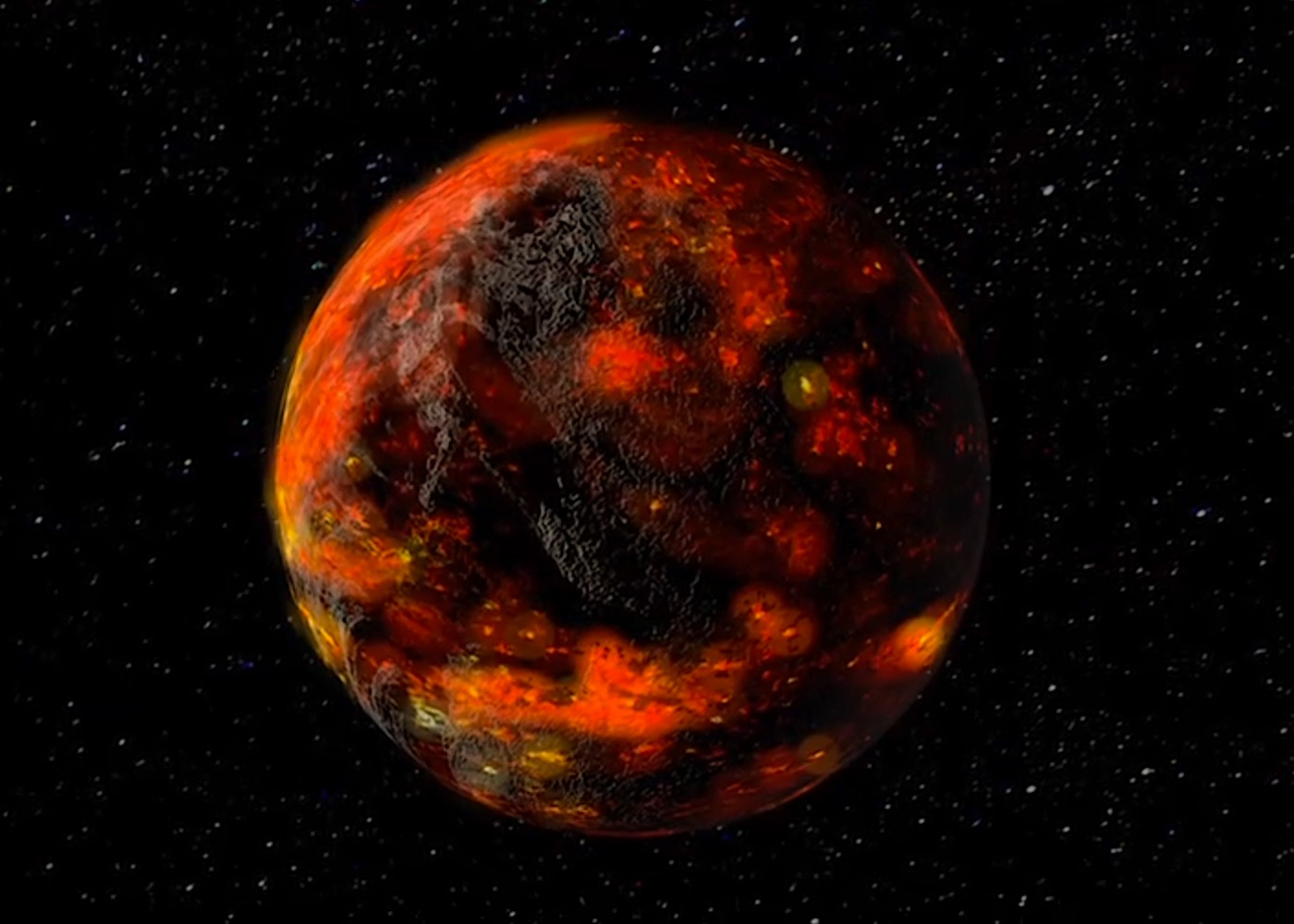
The result also implies that the magma ocean must have solidified much faster than we thought to forge the mantle and crust. Recent re-research on the Apollo 17 rock sample 76535 supports this conclusion. Abundant lunar samples from future missions like NASA Artemis and CNSA crewed ones will help us meticulously analyze pristine mantle and crust samples from geologically diverse locations on the Moon. These will bring us closer to knowing the exact origin scenario of our cosmic companion.
More Moon
- Singapore-based Qosmosys raised $100 million in seed funding to build and launch—with help from Airbus—its ZeusX lunar lander, hopefully by 2027.
- On October 23, Belarus joined the upcoming China-led long-term scientific base on the Moon’s south pole called the International Lunar Research Station. This agreement comes shortly after many countries joined the project recently, including Pakistan, Thailand, South Africa, and Venezuela.