India’s rockets will not meet its civil space and strategic launch manifest even at peak performance
Part 3 of India’s space launch crisis | Indian Space Progress #37

Before we begin, I’m glad to note that my Indian Space Progress reports completed three years last month, and have crossed 10,000 globally spread readers. Thank you very much for reading and supporting the only such overarching coverage of India’s space activities over and above my flagship Moon Monday writing. 🚀

This article is part 3 of my ongoing series on India’s launch vehicle crisis. A space program can only move as swiftly as its orbital rockets, and India right now is amid a grinding halt. As such, I’m focusing my Indian Space Progress blog & newsletter on fully exploring this situation before resuming coverage of national space activities at large. There’s a common misconception among the public at large that ISRO’s rockets are among the best in the world. As great as that would feel, it’s unfortunately not the truth. Part 1 of the article series reviewed the state of India’s orbital launch vehicles, revealing a bleak picture of ambitious goals sliding to the right—in stark contrast to the incessant chest thumping about efficiency. Part 2 analyzed the intricacies of ISRO’s launchpad infrastructure, showing how every PSLV rocket failure cascades effects to all Indian rockets in direct or indirect ways. All this while, ISRO’s responses to India’s space access shortcomings has maintained the usual fare of dangling upcoming upgrades to existing launch vehicles as the all-in-one solution. And so for Part 3, I assess if India can meet its planned payload manifest by 2030 while assuming the best case scenario where every Indian orbital rocket gets its touted upgrade on time. The short answer is an unfortunate no. Let’s start by establishing India’s present launch rate and capacity, and enhancements to the same expected in the near future.
Present launch rate and capacity
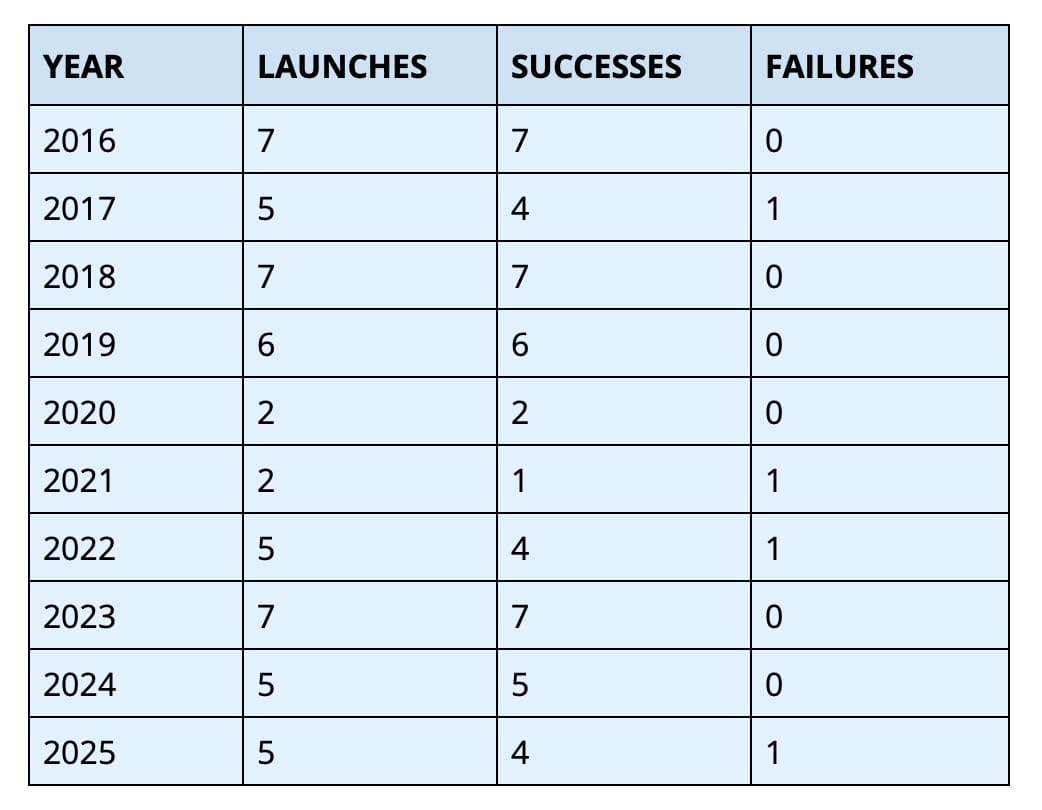
Here are India’s orbital launch stats during the last 10 years (2016 to 2025) by year and launch vehicle respectively.
Launches per vehicle:
- PSLV = 31 (India’s space workhorse)
- Launch Vehicle Mark III (LVM3) = 8 (India’s most powerful rocket)
- GSLV Mk II = 9
- SSLV = 3
That’s a total of 51 launches, including four failures. India has thus launched around 5 times a year across the last 10 years.
Placing India’s launch output in context
I charted the time it takes the top three space powers of the world—China, the US, and Russia—to reach the same 50 launches India did over 10 years. Because the exceptional launch rate of the SpaceX Falcon 9 would skew every other number, I also include the US’ average decadal-scale yearly launch rate before the Falcon 9.
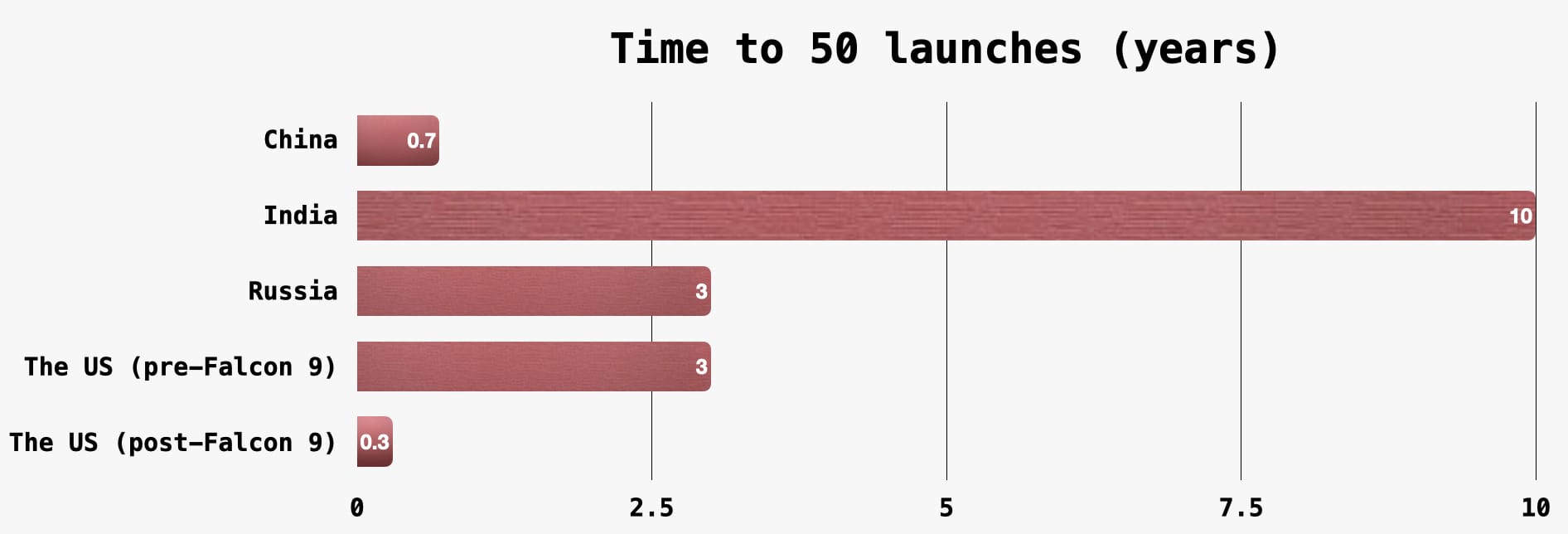
Russia takes only 3 years to match India’s decadal launch count of 50 despite an overall decline of their space program amid politically driven restructuring. The US launches the most globally right now thanks to the Falcon 9 but even if we discount this majority driver as an industry anomaly or primarily a case of self-demand through Starlink satellites, US launch vehicles still took only 3 years to launch 50 times before the Falcon 9’s ramp-up. Notably, this cadence was despite the US facing its lowest launch rate in decades.
India’s launch output today matches China’s from the 2000s, which is when the latter was pursuing human spaceflight, something India is also doing this decade. Today, China launches far more frequently. In the last five years alone, China has launched at least 50 times or far more every single year, outperforming India by 10–20 times. In the last few years, state-catalyzed operational commercial launchers have also entered the turf, successfully supplementing the country’s launch capacity and frequency. In fact, space launch statistics from 2024 and 2025 show that these non-national Sino orbital rockets alone have launched more times than India could manage across its entire ISRO and private fleet during that period. Claims by Indian private rockets companies like from Skyroot and Agnikul about their orbital launch readiness have sadly been in Elon Musk times. Both companies missed the year 2025 as well for their first orbital launch attempts against their own revised projections.
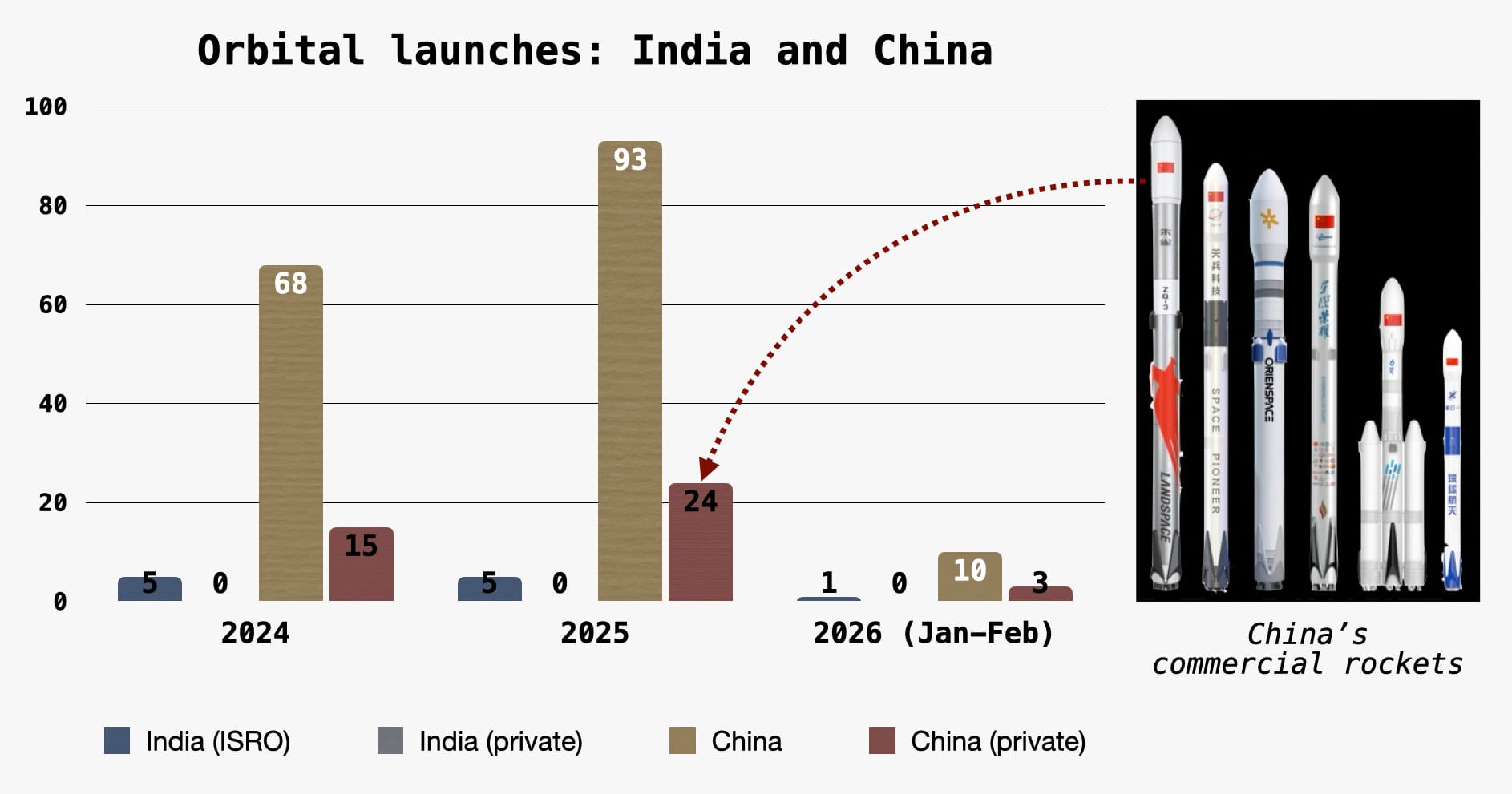
Comparing India’s launch output to China, the US, and Russia is necessary because these are also the only nations in the world with independent human spaceflight capability, one India has said it aims to build and master to the point of announcing an ultimate goal of landing humans on the Moon. The following graph of yearly launches per country illustrates how the orbital launch gaps between India and the human spaceflight powers has grown, which India needs to close or manage effectively.
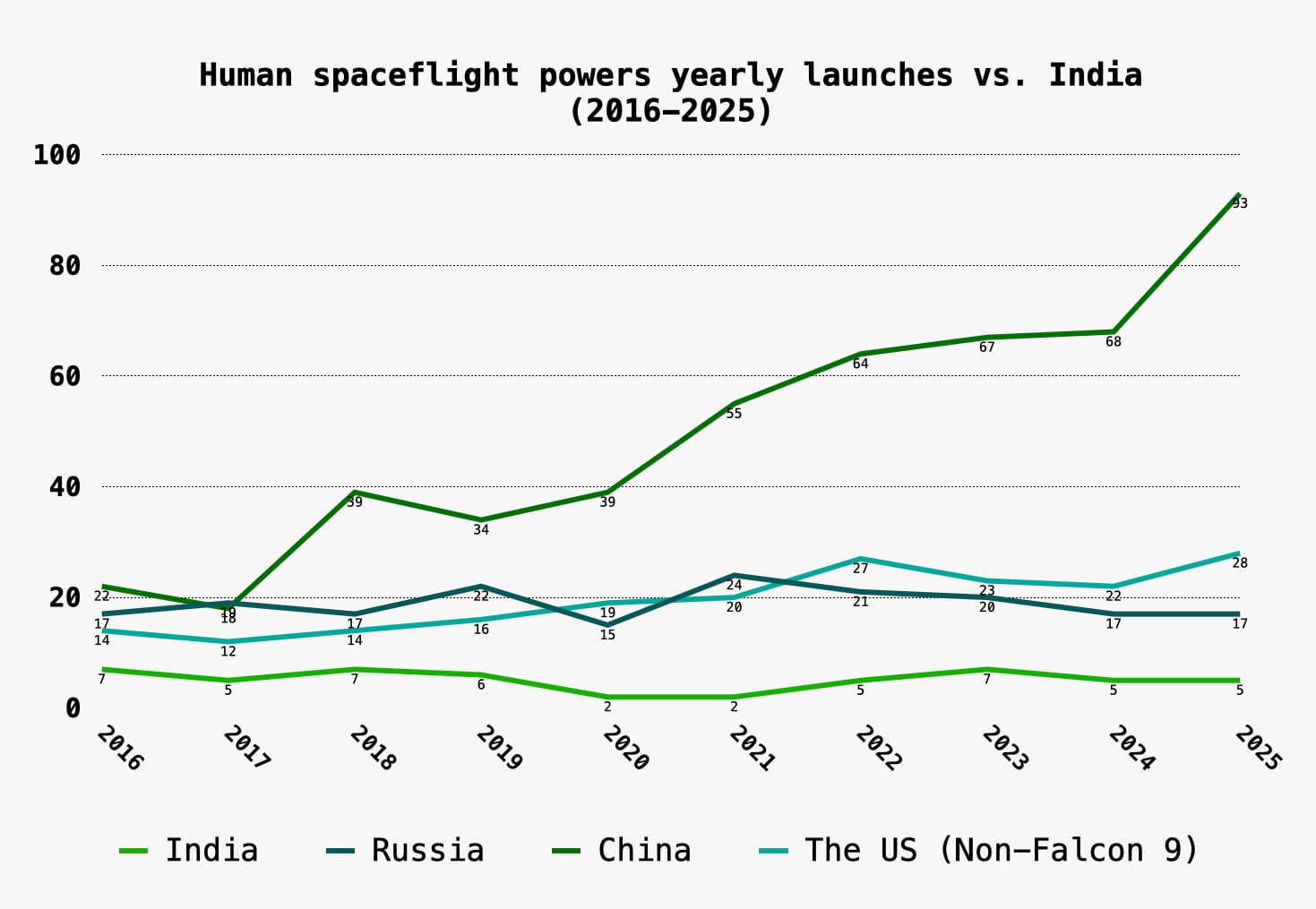
There’s more bad news since the real gap is even more pronounced. The US, China, and Russia all tout heavy-lift launch vehicles, something India lacks. As such, the space access gap widens by two to three orders of magnitude when accounting for deployed ‘mass to orbit’ numbers. Complex or enduring space missions require more mass as a starting point. The following table from Jonathan McDowell’s Space Activities (2025) report lists delivered ‘mass to orbit’ per country/region during that year, showing a stark gap for India.
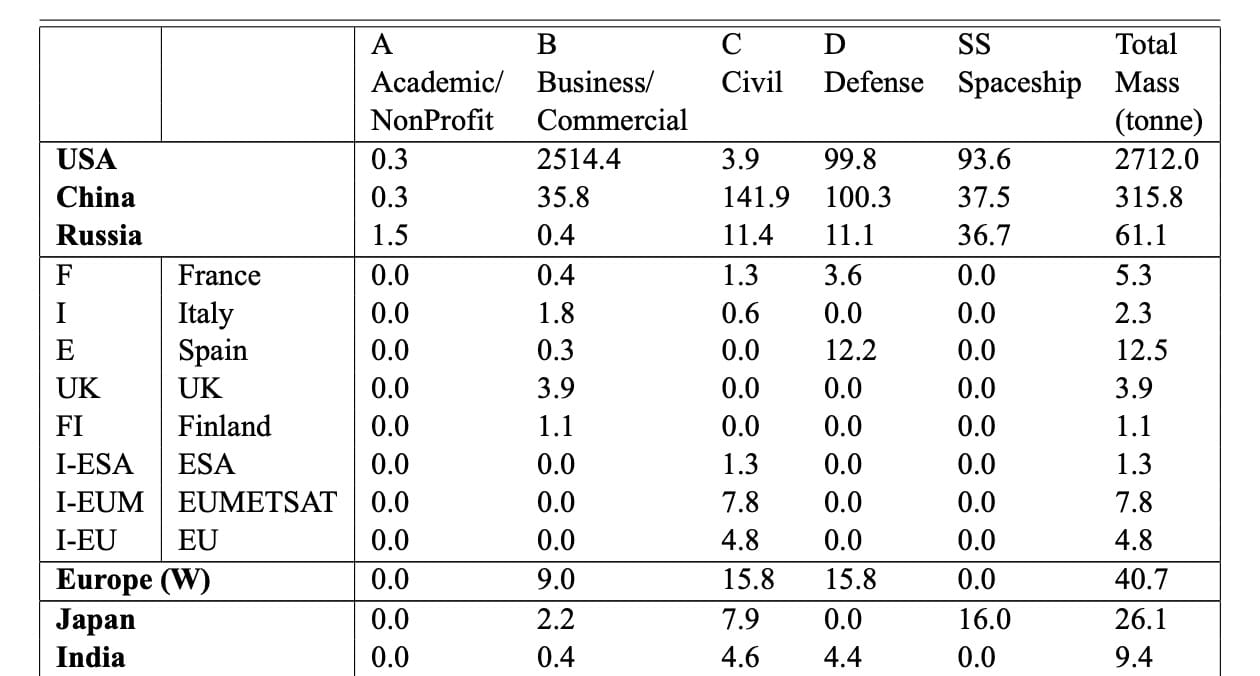
When a nation aims to execute multiple big ticket space projects at once while wanting to maintain lapsing space infrastructure, taking a giant leap in mass to orbit performance is just as important as improving launch frequency. India has no plans to have a heavy-lift rocket operating this decade since the NGLV isn’t coming online until the 2030s. In fact, even the planned payload capacity upgrade to the LVM3 as a transition phase to heavy-lift capabilities has seen delays of over 10 years at this point.
Maximum launch rate by 2030
First, let’s see what India’s peak space launch potential is right now in 2026 across each rocket.
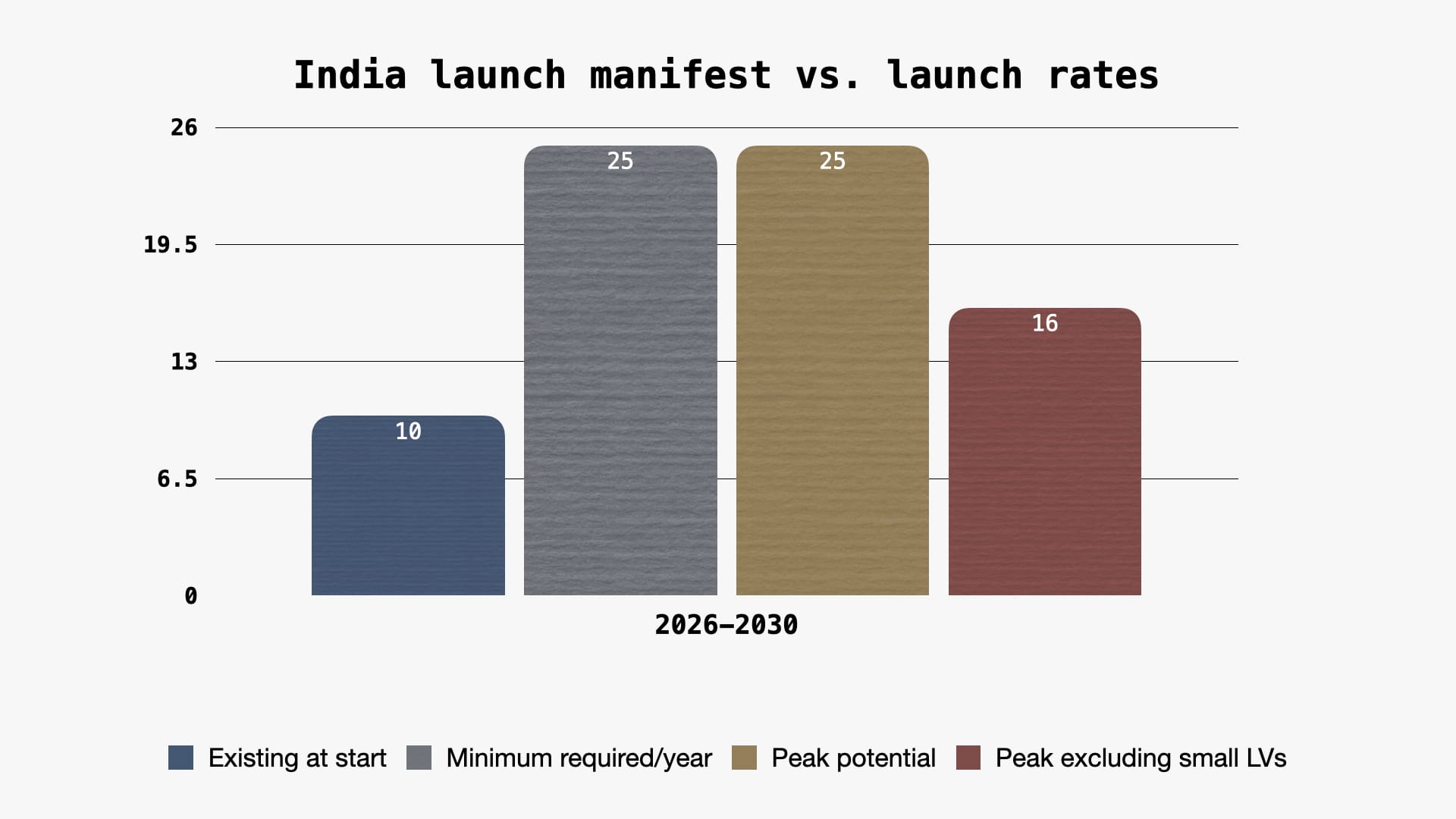
While this shows ISRO has a current peak launch capacity of 15 per year in theory, in practice the capacity should be considered to be around 10 per year until that ceiling breaks. This practical capacity number includes accounting for payload delays, pad refurbishments post-launches, safety considerations, and other such mission execution factors.
Now let us review the maximum launch rate India can achieve by 2030 based on all announced plans to upgrade its launch vehicles or their pads and production in various ways, optimistically assuming all the enhancements manifest.
- LVM3 = 4
- GSLV Mk II = None; will retire in favor of LVM3
- PSLV = 12
- SSLV = 12
- Private = 2 (assuming full success for private small launch vehicles in India)
That gives us a peak launch capacity of around 30 per year. Like in the previous case, the practical capacity will be closer to around 20 per year, especially because of sharing of the First Launch Pad. It’s also worth noting that there have already been delays in increasing the launches of the PSLV and SSLV rockets as promised.
Now let’s review the launch manifest India needs to clear through during the same period to meet all its national space goals.
Launch manifest 2026-2030
The following table estimates the minimum number of launches India requires for every major space segment, spanning satellite programs, space science missions, human spaceflight, and so on.
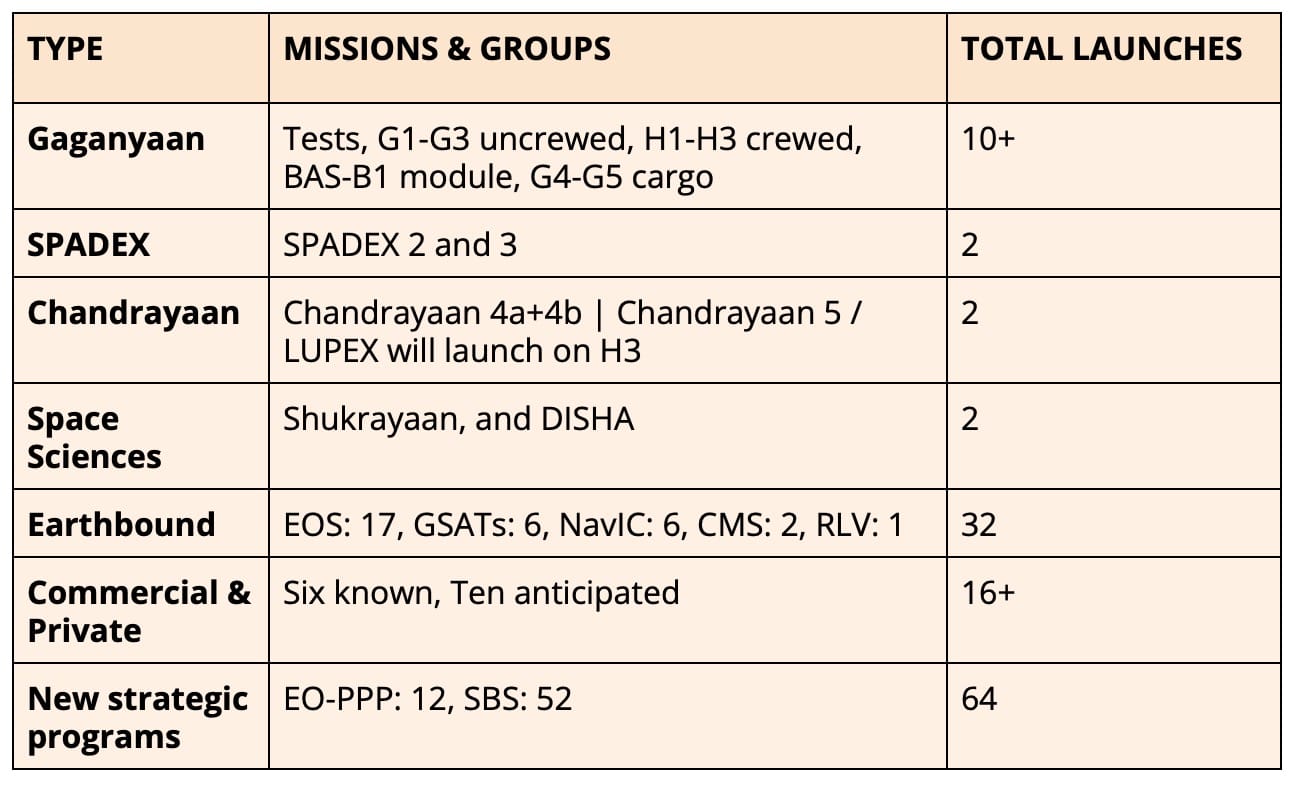
India thus needs to conduct at least 128 space launches by 2030 to achieve all of these national goals. That’s 25+ launches/year from this year onwards. In other words, it’s five times greater than the nation’s current launch rate averaging at 5, two and a half times more than the current maximum potential, and 25% higher than the peak capacity by 2030. Even when we include ISRO’s occasional use of foreign launch vehicles to meet some of India’s pressing civil space needs, this gap does not close in any significant way.
Now yes, some small satellites and payloads can be launched as rideshares but note that on the other hand, a major chunk of the launch frequency increase by 2030 is attributed to the SSLV rocket, which cannot lift anything other than small satellites. Moreover, commonalities with the PSLV affects SSLV’s flight rate. The operationalization of the dedicated launchpad for the SSLV, and other such small launch vehicles, has also seen delays, from 2025 to at least 2028. Private sector contributions to India’s launch capacity in the near term through Skyroot et al. will only be on the small lift side.
In any case, the reality is India’s launch manifest leans squarely on the mass-heavy side for most of its national goals, leaving the need for small rockets largely on the margins. Indian private sector satellites launching on foreign rockets like the Falcon 9 do not account for the majority of launches by volume or mass right now. For strategic launches, the private sector too has to utilize Indian governmental or private rockets anyway so we’re back to square one. No country can claim to be a space power while relying on foreign rockets.
Slow to relapse
Another issue is that following orbital launch failures, India’s return-to-flight times for its rockets are slower than the global rate, even if we don’t normalize for factors like heavier lift capacities or first flights of foreign rockets. The chart below illustrates the gap India needs to close.
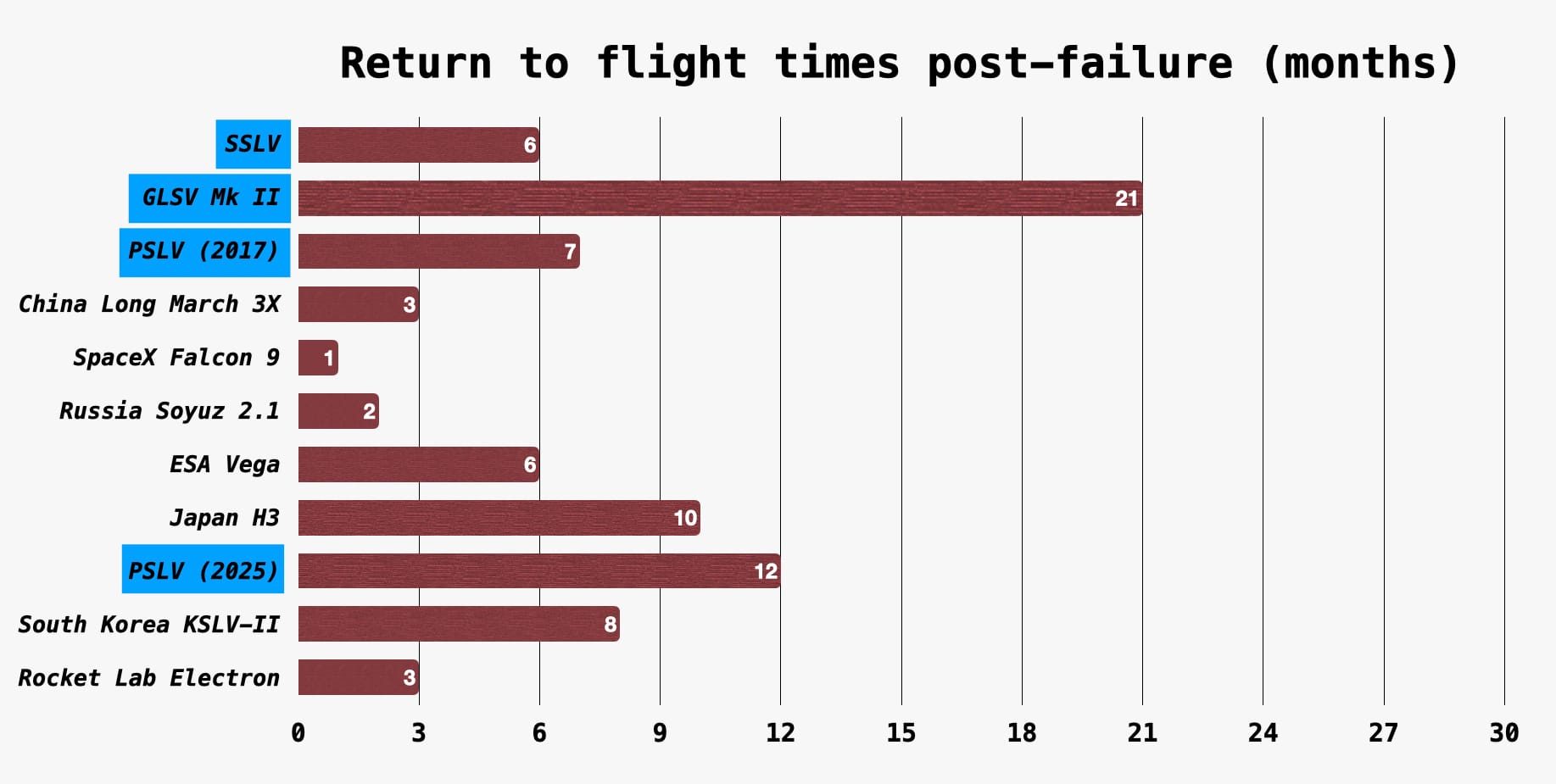
Moreover, the failure of India’s one rocket stalls or can stall launches of its other vehicles too, like the case of the recent PSLV failures due to its modules and component designs also being utilized by other ISRO rockets.
There’s a worrying chasm between the planning and execution of India’s space missions even when considering best case scenarios. Any more delays or shortfalls, generally expected in spaceflight, will only deepen this fissure further. India is in a launch vehicle crisis, which extends beyond the PSLV failures.
Many thanks to Takshashila Institution, PierSight and Gurbir Singh for being sponsors of Indian Space Progress. If you too appreciate my efforts to capture nuanced trajectories of India in space, provided to space communities worldwide for free and without ads, kindly support my independent writing: