How ISRO continues to build its own spaceplane

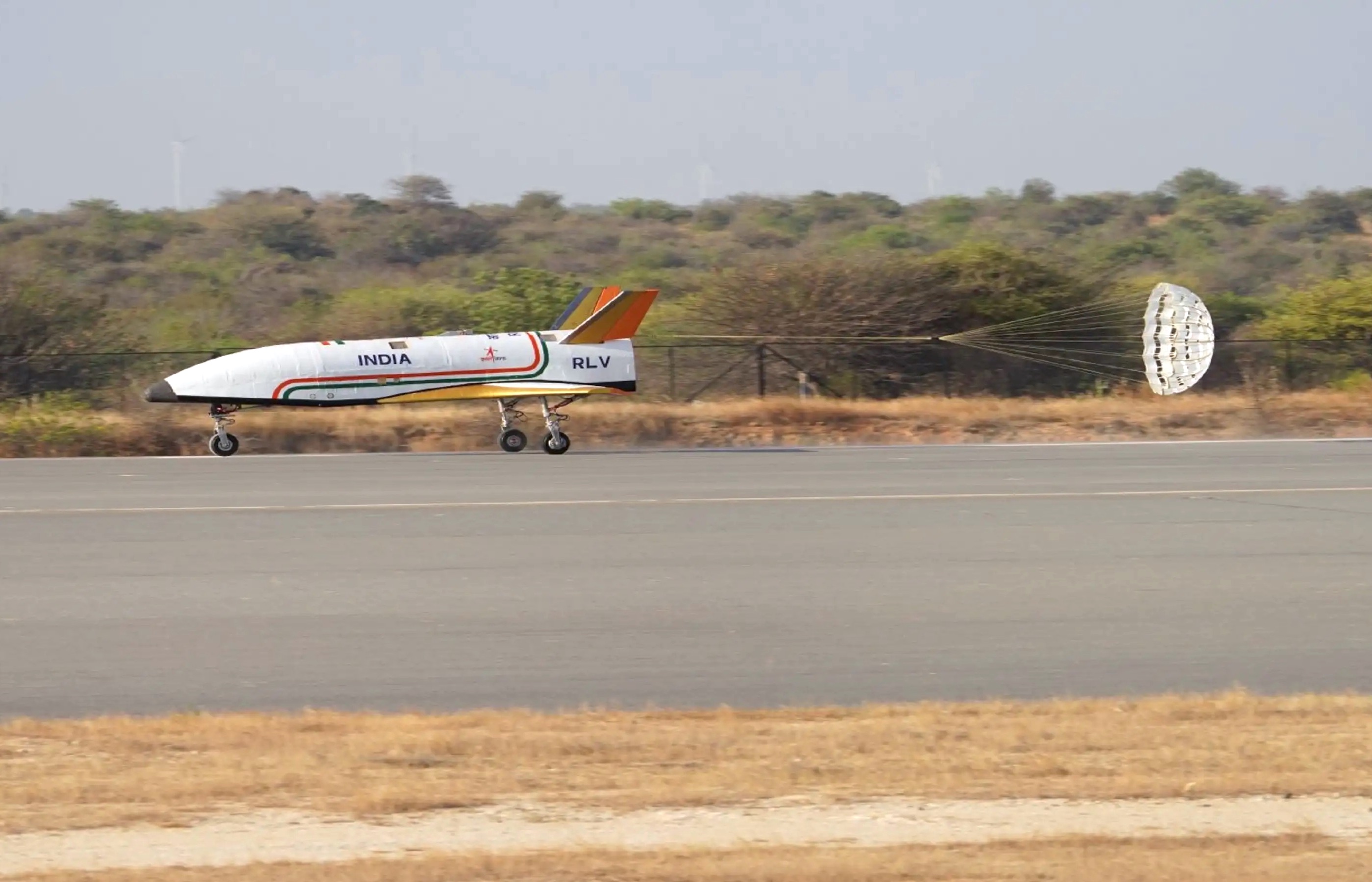
An uncrewed, autonomous spaceplane prototype developed by ISRO successfully landed on a runway at Chitradurga, India on April 2. The winged vehicle, officially called the Reusable Launch Vehicle Technology Demonstrator (RLV-TD), was heli-dropped from a height of 4.5 kilometers such that its descent simulates an approach from space. The RLV-TD plane then maneuverd itself to the runway, where it deployed a parachute to kill much of its velocity of 350 kilometers per hour.
ISRO uploaded a cool video which starts with the heli-lift and ends with the landing.
How we got here
ISRO built the RLV-TD as a flying testbed for evaluating various technologies needed to ultimately build an Indian reusable launch vehicle. This vehicle will sport a scaled-up RLV as its second stage or equivalent.
In 2016, ISRO launched a heat-shield-enabled RLV-TD to an altitude of 65 kilometers at hypersonic speeds, which then successfully steered itself 450 kilometers downrange to a sea splashdown in a targeted zone. This month’s precise landing test of an RLV-TD complements the 2016 flight.
Let’s go orbital
In a post-landing address, ISRO Chief S. Somanath said the agency will conduct more such landing experiments (LEX) with varied initial conditions so as to approach a robust RLV design. The ultimate such test will see a 60% larger RLV-TD autonomously land after being launched to orbit on a modified GSLV rocket.
The orbital RLV-TD could spend up to a month in space, autonomously operating onboard payloads and experiments, and then deorbit itself for atmospheric reentry leading to a runway landing. ISRO even intends to test air-breathing propulsion on a future RLV-TD flight to assess its viability as part of RLV’s ongoing design ideation.
What India’s spaceplane isn’t
Media outlets have frequently compared the RLV to NASA’s retired Space Shuttle. But ISRO is neither designing the RLV to carry humans to space nor is it intended to be a heavy-lift launch vehicle. As a highly autonomous platform, the RLV will be much more akin to the flying Boeing X-37B and Sierra Space’s upcoming Dream Chaser.
What’s the catch?
The RLV is an exciting project that could boost India’s rocket fleet but it’s also missing a publicly known target launch year. The RLV is being developed at a low priority while ISRO’s major growth focus remains its Gaganyaan program to indigenously send humans to space by mid-decade.
Originally published on Payload.
→ Browse the Blog | About | Donate ♡